Tuesday, September 12, 2023

Another bug hunt -- Aliens: Another Glorious Day in the Corps

Aliens, James Cameron's 1986 sequel to Ridley Scott's horror masterpiece Alien, is one of my all time favorite movies. The scenario of a group of strung-out marines trapped in an enclosed environment with a horde of bloodthirsty monsters is ideal fodder for gaming, so it's no surprise that the film has been mined for game material since it came out, both official (Aliens, Legendary Encounters: ALIEN) and unofficial (Argo, Nemesis, Space Hulk).

Leading Edge's Aliens (sometimes known as This Time It's War) game has long been one of my favorites. It has a simple, elegant tactical movement system and tense game play that effectively simulates the action from the film. The only thing wrong with it is its low production value, with bland graphic design, paper maps, and cardboard standees in lieu of miniatures (the publisher did offer upgrade packs of metal miniatures, but they were way outside of my price range in 1989).

So when Gale Force 9, publishers of the excellent Firefly board game, announced that they were doing an Aliens game, I got very excited. My hope was that they would do something similar to the Leading Edge Aliens, or even a reskin of their own Firefly Adventures, a cooperative tactical movement game that does some innovative things with non-player controlled enemies.
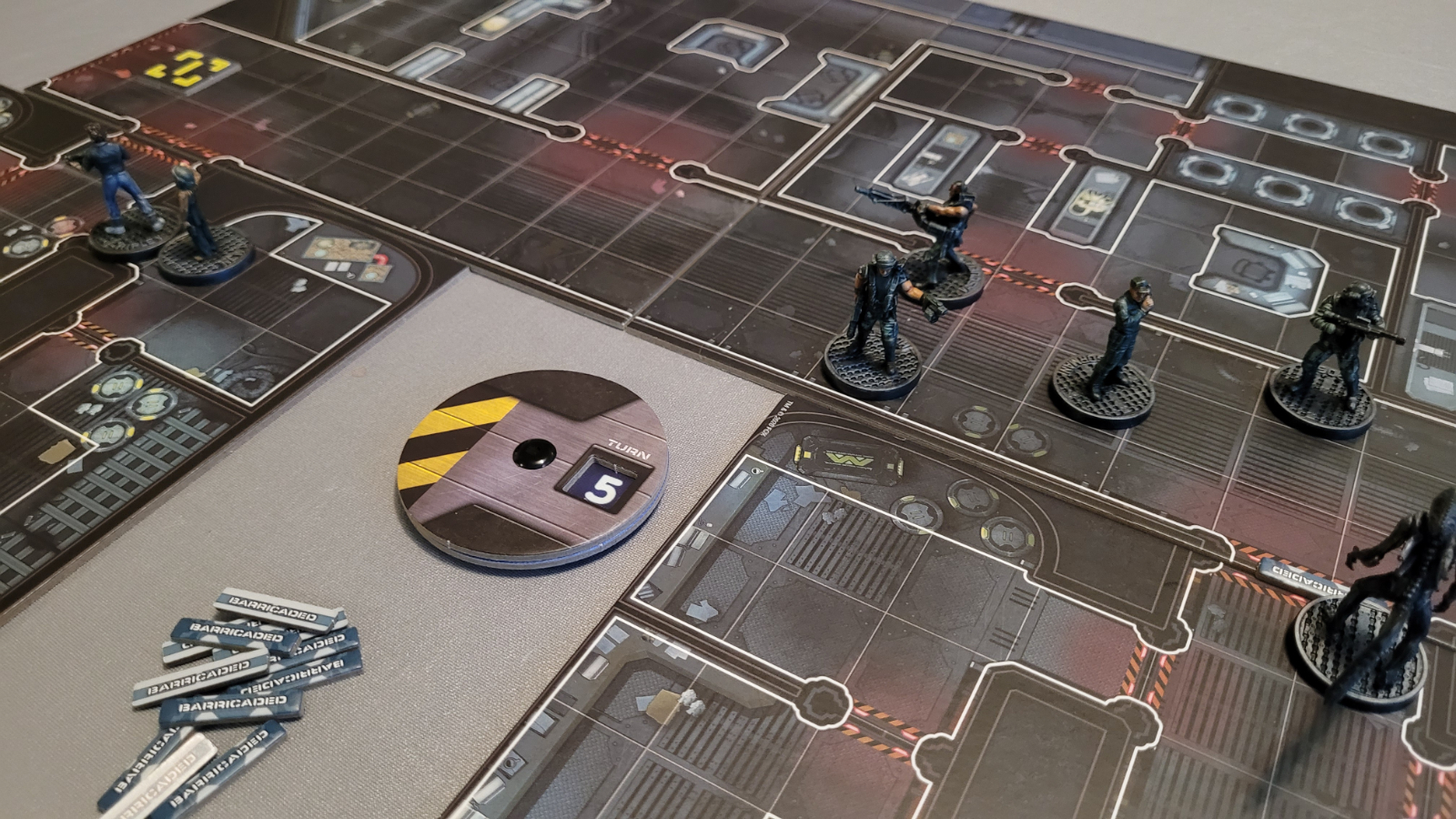
Somewhat surprisingly, Aliens: Another Glorious Day in the Corps isn't really either of those things. It's similar to Leading Edge's Aliens in that it is a cooperative game where the players control Ripley and the marines in an attempt to survive and escape rather than defeat all the Aliens (an impossible task). It's similar to Firefly Adventures mainly in that the rule book is confusing and poorly organized, managing once again to make a relatively simple game seem overly complicated. But that's pretty normal for rule books these days.

The components are definitely light years ahead of the Leading Edge game, with heavy cardstock boards and detailed plastic miniatures. There have been a fair number of complaints in various forums online about the fact that the miniatures require assembly, without any warning on the box, but they include detailed instructions and I didn't find it particularly difficult. The only poor design decision here is that the Aliens have long, spindly hook-shaped tails that were a little challenging to attach, get in the way during play, and make the miniatures difficult to store (remember Barrel of Monkeys?). They're nice looking miniatures though, and as far as I know, this is the first time the actual human characters from the film have been represented by official 28mm gaming scale figures.

The game uses miniatures, gridded tiles, cards and dice to recreate the key scenes from the film. Each player takes control of a single character, and any remaining characters remain in the game as "grunts" that the players can order around, but without complex game info to keep track of. This means you always have the same number of characters on the board, but your team has more interesting abilities if you have more players. Of course, that also means the game will be more challenging.

While the game is played out on a grid with miniatures, the core game element is the Endurance Deck, a stack of 60 cards representing weapons, equipment, events, and hazards. The deck is used as a timer (when the deck runs out the players lose the game), a currency to pay for game effects (by discarding cards from the deck), a way to generate random effects and give players extra tactical choices (by drawing or revealing cards). It also contains a few Hazards, negative effects that must be resolved when the card is drawn or revealed. It's very similar to the way the old Star Wars Customizable Card Game worked, but honestly the idea is so good that someone should be using it.

At the end of every turn, the players draw several "Blip" cards to determine where the Aliens appear. Aliens start out as blip tokens, unseen until they move into proximity to the human characters, at which point the tokens are replaced by one or more Alien miniatures. It's a neat effect that mimics the tension-building motion trackers from the film, and allows for some uncertainty as you don't know how many Aliens are approaching until they're in the room with you.

The details of the different scenarios allow for some variety, but ultimately the goal is always to escape the board with as many survivors as possible. This leads to some agonizing tactical decisions: do I take the time to weld that door shut, or just run for it? Do I keep my marines near the door to cover each other and all escape together, or is it better to risk some of them so that others can get out for certain?

If anything, my only complaint is that if too many Aliens are on the board all at once it can get to be a bit of a grind, both with the sheer number of Aliens you're moving around each turn, and also with the repetitive rolling to try to shoot Alien after Alien. But it's a good game that definitely simulates the action and tension of the film.

Rating: 3 (out of 5) I'm docking this game one star for the murky, hard to follow rule book, and another in acknowledgement that my overwhelming affection for the source material makes this game more fun for me than it might be for others.

Tuesday, September 5, 2023

Rocketeering -- The Rocketeer: Fate of the Future

The Rocketeer: Fate of the Future is a small board game that was published in 2022, and I'm not really sure why. It's based on the 1991 film, but it's a year late for the film's 30th anniversary, and in any case there wasn't much of an anniversary celebration that I'm aware of. But none of that really matters. I bought the game because The Rocketeer is one of my favorite films, based on one of my favorite comic books.

The game was designed by Prospero Hall, the design collective known primarily for what I call "Barnes & Noble games," light strategy games based on recognizable film and television properties that you would expect to see tastefully displayed at your local mall book store. This is not a criticism. These types of games frequently serve as gateways to get new players into the board gaming hobby, and to do that effectively, these games need to be easy to play, visually stunning, and remind players of the the intellectual property they're based on. The Rocketeer: Fate of the Future does all of that very well.

It's a two player game. One player controls the heroes: Cliff Secord, his girlfriend Jenny, and his irascible mechanic friend Peevey. The other player controls the villainous Neville Sinclair and his henchmen, gangster Eddie Valentine and hulking brute Lothar. All the memorable characters from the film are covered. The game consists of playing cards that move the various characters along the board, where they gain resources, fight to take possession of the plans to the fabulous rocket pack, and most importantly, draw Finale cards that provide victory points based on where everyone is at the end of the game.

Once you get past the theme, the actual game play is a bit too simple to be really interesting. If it weren't based on a beloved film, the game would be mediocre at best. But that's the point. It is based on a beloved film, and it evokes that film at every turn, from the 1930s style graphic design to the stunning artwork that reflects the characters without looking too much like the actors -- the decision not to use still photos from the actual film was a good one, as the artwork plays on hazy memories of the movie rather than the possible reality that it may be a little dated and not quite as good as we remember it being.

The real stroke of genius, though, is that the movie's plot is essentially about the characters running around to to different locations and fighting over the plans to the fabulous rocket pack. While it may not be a brilliant game in and of itself, it is an excellent simulation of the film. And that's all a game like this needs to be.

Rating: 3 (out of 5) Not an overly compelling game, but I'll play it any time I want to be reminded of the Rocketeer film without actually taking the time to watch it.


Monday, August 28, 2023

Buy low and sell high with Vikings on the Volga

Vikings on the Volga is a very simple game from the designer of Leaving Earth. This comes as a bit of a surprise, as Leaving Earth is by far one of the most complex games in our collection. The themes are broadly similar; both games are about planning a voyage in the most efficient way possible. But where Leaving Earth is a very complicated yet oddly compelling game about weight-to-thrust ratios, fuel consumption, and making certain you have enough food for the return voyage, Vikings on the Volga is a much simpler game about delivering the right commodities to the right city at the right time, and avoiding the dreaded Golden Horde.

The board is pieced together randomly out of very nice wooden tiles representing the Volga river and the cities that sit on it, as well as empty overland spaces that ships can travel over if they're willing to take extra time to do it. Each city has a corresponding pass that players can invest in; be the first to buy the pass for a particular city and all the other players have to pay you each time they want to enter or pass through it.

The game revolves around three different trade goods (amber, fish, and furs), each of which can be purchased in one city. There will be a number of public contract cards in play that determine which cities will buy which goods, and the price they sell for is determined by the number of cities that have been burned down by the Golden Horde (more on that in a moment). The bulk of the game is spent buying goods in one place and then selling them in another, hopefully along the shortest route possible.

While all this buying, moving, and selling is going on, there are two non-player pieces that move around the board: the aforementioned Golden Horde, and the Price of Kiev. Any player can give up their turn to move either the Horde or the Prince. If the Horde moves into a city, they burn it down, which will prevent buying or selling there. Also, when there are 5 burned cities in play, the game ends. If the Prince moves into a city, he puts the fire out, so moving the Horde and the Prince to help yourself and slow down your opponent is a key tactical move in the game.

It's a pretty basic pick up and deliver game, but the variable tile setup and the way the Horde and the Prince affect the game makes it a little more interesting. The graphic design is unusual but excellent, with understated colors, bold text that's easy to read, and lovely wooden tiles and player pieces that are much nicer than the punched cardboard you would normally expect from a game like this.

Rating: 3 out of 5. Gameplay alone is fairly mediocre, but the surprising production value is enough to make this game a little more noteworthy.

*Note: this game is made by a very small publisher who appear to print to order and do all the manufacturing in-house, so orders can take several months to be filled. I can't recommend ordering direct from the publisher unless you are extremely patient.

Wednesday, June 14, 2023

Going to war with Undaunted: Normandy

There's no denying that we're in the middle of a major renaissance for table top games. There have never been more titles available, the standard of quality has never been so high, and the hobby is more mainstream than it has ever been. With the vast proliferation of games currently hitting the market, game designers are forced to think more creatively in order to have their game stand out. One way to do that is by combining different game mechanisms.

Undaunted: Normandy features one of the more unlikely combos, mixing deck building (a relatively modern and extremely popular game type) with old-school counters-and-maps wargaming.

Wargaming has a long and storied history that I won't even attempt to go into here. These types of games have always emphasized accuracy and detail over aesthetics and accessibility, and only a few (such as Twilight Struggle) have managed to get much attention in the wider world of gaming, outside of their dedicated player base. Undaunted: Normandy attempts to rectify that by updating the classic wargame with elegant, streamlined rules, simple but well-designed components, and much nicer artwork.

The game is scenario based, running through a series of historical World War 2 battles each with its own board setup and asymmetrical victory conditions. The board is composed of tiles representing different terrain types such as forests, rivers, and open fields. These tiles are easily rearranged to depict a wide variety of different European battlefields. Each player starts the game with different types of units such as infantry or commanders, each with different abilities. Attacking opposing units is done by rolling dice, with the tiles providing a target number based on distance and cover. It's a very elegant system that is easy to remember during play, requiring very little (if any) looking up of complicated rules.

The real brilliance of the game, however, is the way it incorporates the deck-building mechanism. In most deck building games, players begin with a rudimentary deck of basic cards, and then add better cards to their deck as the game progresses. The same is true here, with the cards representing the different units on the board. Cards are played to move and attack with those units, and also used to keep track of how much damage a unit has taken. When one of your units on the board is hit by an attack, you take one of that unit's cards out of the deck and placing it out of play. You can mitigate damage by adding more of that unit's cards (purchasing them from a supply row, a common feature of most deck building games), but eventually you will run out of a specific unit's cards, and when you do, that unit is destroyed.

Additionally, the game uses "Fog of War" cards to track the unpredictability of warfare. These are essentially blank cards that players are forced to add to their decks at various points during the game, with each one decreasing your chances of drawing the unit card you need during your turn.

The deck building element is elegantly incorporated and solves a lot of problems with battlefield simulation games such as keeping track of damage, limiting how often a particular unit can act, and determining when reinforcements are available. Combined with the location tiles that keep track of often difficult game elements like cover, range, and line of sight, we have a wargame that is intuitive and easy to play.

Rating: 4 (out of 5) It may not offer a pinpoint-accurate combat simuation, but Undaunted: Normandy gives us a modern, accessible WWII battle game, ingeniously combining deck building with an updated move-and-attack wargame.

Tuesday, April 4, 2023

First impression: Doctor Who Nemesis

In Doctor Who: Nemesis, players take on the roles of iconic villains from Doctor Who and attempt to win by succeeding at their nefarious schemes before the other players do. Each villain has their own unique victory condition, and while the game is primarily a race to complete a particular combination of plays first, players can also interfere with the other players by playing hero cards designed to slow them down.

It is primarily a card game, with a small board worker placement element. Each player has their own board with four spaces representing different combinations of actions, mainly drawing and/or playing different types of cards, and a worker pawn that must move to a different space each turn. A lot of the game's decision points rest with which space to move to that will allow the player to play the type of cards they need to play that turn.

From the above description, Doctor Who: Nemesis sounds exactly like the Villainous series of games, which comes in Marvel, Star Wars, and classic Disney flavors. So exactly that it seems lucky for the designers of Doctor Who: Nemesis that the common wisdom is that it isn't possible to copyright game mechanisms. At the very least, comparisons between the games are inevitable.

I will concede that the games are extremely similar (with the caveat that I have only played Star Wars Villainous). The overall game structure is identical, but the card play in Doctor Who: Nemesis is quite different -- it reminds me a lot more of classic collectible card games from the 1990s, specifically Decipher's Star Wars and Star Trek CCGs. Cards in the game represent characters, permanent conditions, and temporary advantages. Character cards play to specific locations, and can be used to block your opponents' ability to use the actions on their board effectively, resulting in battles where the value of each player's characters at a location are totaled and compared, with the loser losing their forces but the winner having had to spend time fighting off the invaders instead of working on the scheme they need to play out in order to win. It adds a lot of player interaction that's missing from Villainous, and makes the game seem a lot less like double solitaire.

Where Doctor Who: Nemesis really improves on Villainous is in how the forces of good are included in the game. In Villainous, each character has a separate deck of hero cards that can be drawn and played by opponents in order to slow down that player. It works, but it's a little disjointed, and doesn't allow for any real strategy as you're drawing two cards, immediately playing one, and discarding the other. In Doctor Who: Nemesis, each player is given two randomly chosen Doctors at the start of the game; each of those Doctors comes with 4 cards that are shuffled in to that player's deck. The Doctor cards can be used to slow down the opponent by blocking their action spaces, and some of them offer alternate victory conditions that either player can work towards. It's a much more elegant solution and works well with the game's theme: it's easy to imagine Daleks and Cybermen competing for universal dominance, only to have the Doctor come along and foil everyone's plans.

The game was fairly easy to learn, with a surprisingly well-organized rule book and consistent graphics and reminders on the cards and boards. The only thing we found a little awkward was the turn structure. On your turn, you choose your action space, then play & move your characters and resolve battles, then do the actions on the space you've chosen. We found it to be a little counterintuitive to choose an action, then do something unrelated before resolving that action.

Rating: 4 (out of 5) All in all we enjoyed the game quite a bit. Yes, it borrows a lot from Villainous, but we thought it was a more interesting game.

Tuesday, March 21, 2023

Star Wars the Deckbuilding Game: good enough for now

I love deck building games. These card games that usually involve each player starting with a basic deck of cards that they use to purchase newer, better cards towards an eventual goal of defeating a villain (or the other players) or just accumulating victory points. The format gives me a lot of what I like about trading card games, but without the massive investment of time, energy and money, and has become so ubiquitous as a game mechanism that it has become just one of many design elements in recent (and immensely popular) board games such as Dune: Imperium, and Lost Ruins of Arnak.

Like most people who were children in the 1970s, I love Star Wars. Although the franchise has seen its share of ups and downs over the years, I have enough nostalgic affection for it that I'm prepared to forgive its occasional excesses, and I think its current owners have started to figure out what works and what doesn't, and it's still pretty spectacular when they get it right.

So imagine my relief when Star Wars: the Deckbuilding Game turned out to be a pretty good, if not fantastic, game.

The game's theme has invited a lot of comparisons to Star Realms, but honestly both games borrow their core mechanisms from games like Legendary: cards generate one or more different currencies (in this case, resources, attack, or Force) which are then used to attack your opponent or purchase from a center row of available cards. The game adds two new elements to the deck building game formula: a tug-of-war Force track, and the ability to attack unpurchased cards in the center row.

The Force track is a simple board with several spaces and a marker. When players play cards that generate Force, the marker moves towards their side of the board, and their turn starts with it all the way at their end, they get an extra resource to spend. There are also a handful of cards that have additional abilities if the marker is on one side of the board or the other. It's a game element that's not all that developed, but given the absence of major force-wielding characters like Yoda or Obi-Wan Kenobi from the game, I suspect this will be further developed in an expansion.

Normally in deck building games, players purchase new cards from a common pool or row of available cards, but how do you address that in a world as unambiguously black-and-white as Star Wars? It doesn't really work to have Han Solo working with a squad of stormtroopers, or Princess Leia and Grand Moff Tarkin suddenly resolving their differences and teaming up. The game solves this problem by having all the cards marked as Empire, Rebellion, or neutral. Anyone can buy neutral cards, but rather than the Rebel player being able to buy Imperial cards, or having them just sit there in the row taking up space, each player can attack their opponent's cards, giving them a short term reward and freeing up space for (hopefully) one of their own cards to become available.

The ultimate goal of the game is to destroy your opponent's bases, anywhere between 3 and 5 depending on the desired length of game. Different bases have different in-game abilities, and players can defend their bases by putting capital ships into play -- these horizontally formatted cards stay in play from turn to turn (unusual for a game of this type) and soak up damage directed at their players' bases along with supplying other resources and abilities.

Thematically the game sticks to content from the original Star Wars trilogy and Rogue One, which is set at the same time. In addition to the aforementioned Force-users, the franchise's droid characters such as R2-D2, C-3PO and K2-SO are missing from the game, which makes me think they've been held back for a possible expansion that would introduce additional mechanisms, which would be a good idea -- while the game is perfectly entertaining and playable as-is, it is a little on the simple side and could eventually benefit from some added content to keep players interested.

Rating: 3 (out of 5) A game that is perfectly entertaining, especially if you're a Star Wars fan, but lacking the depth of more involved deck building games like Legendary.