Showing posts with label ccg. Show all posts

Tuesday, March 5, 2024

Here we go again: Star Wars Unlimited

I've played a lot of different collectible card games over the past 30 years. I didn't get into Magic: the Gathering when it first came out, but I did play Decipher's Star Trek and Star Wars CCGs pretty heavily throughout the 1990s and early 2000s (I still play Star Trek regularly today), and I've at least tried a fairly large number of others, including On the Edge, Doomtown, Highlander, Aliens vs. Predator, Judge Dredd, Legend of the Five Rings, Shadowfist, Dune, and more others than I can count or remember. Magic finally got my attention when they started adding properties I know like Dungeons & Dragons, Lord of the Rings, and Doctor Who to the game. I even played Decipher's other two Star Wars CCGs, Young Jedi and Jedi Knights, and the short-lived Star Wars game that Magic publisher Wizards of the Coast did in 2002.

I like the format a lot. I like building customized decks from a collection of cards and then playing them against a variety of opposing decks. While I was perfectly happy with "living card games" like Lord of the Rings or Marvel Champions that did away with randomized booster packs in favor of fixed sets of cards, I never really minded the collectible aspect of this type of games. There's something exciting about ripping open a pack and seeing what you got, especially if it's a new game with unfamiliar cards.

After pioneering the non-collectible living card game format, Fantasy Flight Games has decided to re-enter the collectible card game market with Star Wars Unlimited. Unlike their earlier Star Wars: the Card Game, Unlimited will come in random booster packs supported by a two-player starter set. In advance of the game's March 8 release, FFG has offered a pre-release pack consisting of six random boosters, two fixed foil cards, counters, and a quickstart rulebook. The product is meant for a single player to use in an organized tournament event, but we were able to just about squeeze two 30-card decks out of the contents so we could try the game out.

The game is wonderfully simple. Each player chooses a leader and a base, and build the rest of the deck around the colored icons those characters provide. You can include any card you want in your deck, but cards with icons that don't match your leader or base will cost you more to put into play. It's a great bit of game design for this type of game -- you have incentive to focus on cards that match your leader and base, but if you really want to throw in a favorite character or starship that wouldn't otherwise fit, you can, and you can even mix light side and dark side characters in a way that no previous Star Wars game has allowed. In theory, any stack of cards can be a functioning deck, which makes organized play using sealed boosters a lot easier and more fun.

Unlike Magic, which requires matching land cards in order to get other cards into play, Star Wars Unlimited allows players to use any face-down card as a resource. This eliminates one of the major frustrations that can happen when playing Magic or other resource-based games -- sometimes you just can't play anything. Star Wars Unlimited's approach means that you never have a useless card in your hand, as you can always play it face down as a resource.

The structure of the game is very straightforward. Once you get your units into play, you use them to attack and eventually destroy your opponent's base. Since they're trying to do the same to you, each turn starts with a decision about whether or not to keep whittling away at their base, or take out your opponent's units so they can't attack you. It's pretty similar to Magic, but without that game's 30 years of keywords, rules additions, and edge cases weighting it down.
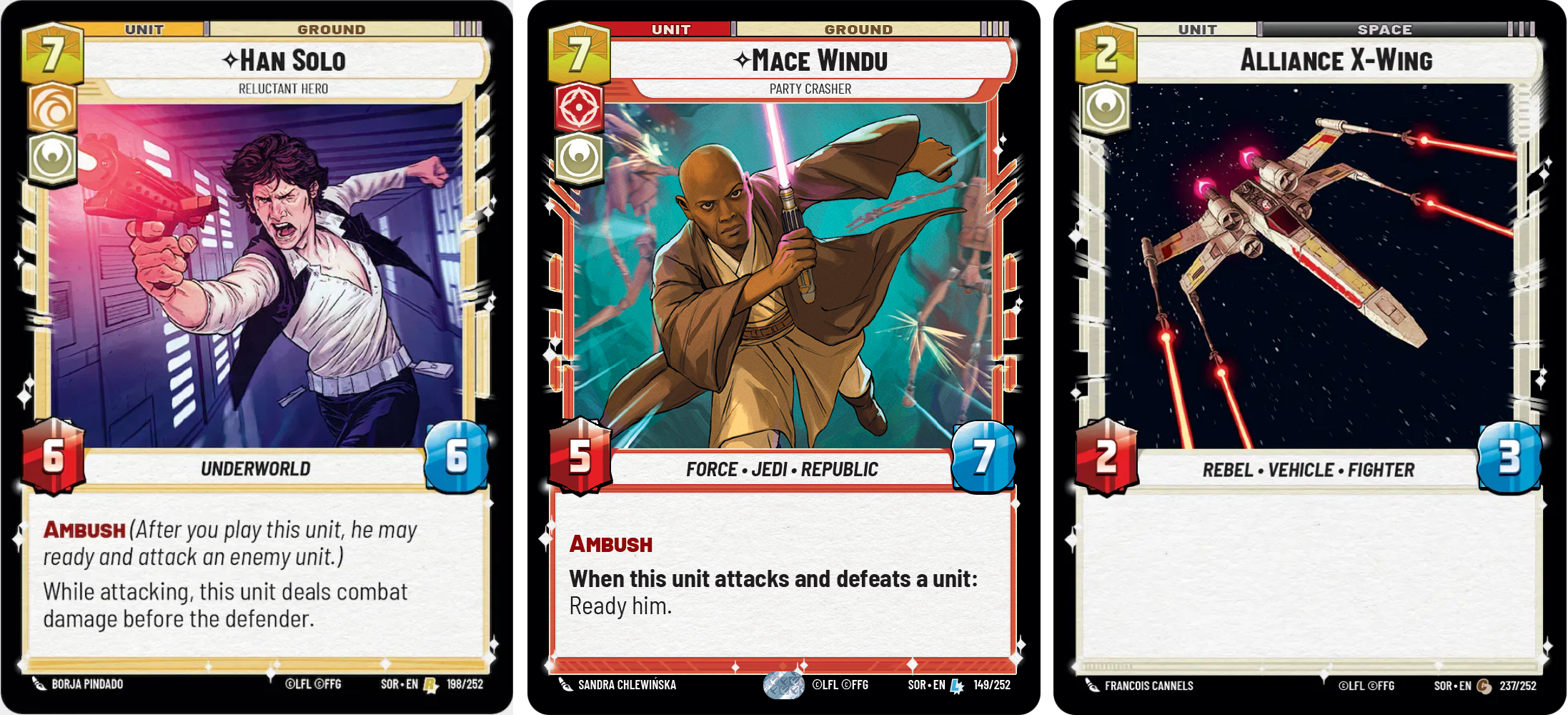
Another nice element to the game is the artwork. I'm never sure about using artwork for games based on films or television shows -- why not just use screen captures, especially for something like Star Wars that has a lot of high end visuals to work with? The use of artwork allows them to use elements from across the franchise's 47-year history of live action and animation and have it all look consistent, and it also makes it easy to accommodate characters and scenes that we never saw in any of the films.

If the pre-release pack is any indication, Star Wars Unlimited is off to a great start, but it remains to be seen whether it can flourish in a market that has seen several booms and busts over the years, and is currently dominated by a small number of games. Hopefully it will, as this first set of cards barely scratches the surface of the extensive, one might even say Unlimited, Star Wars universe.

Rating: 4 (out of 5) It lacks the depth of some of the earlier CCGs, but that isn't necessarily a disadvantage as the game's simplicity should make it a lot more accessible to new and casual players.


Wednesday, January 10, 2024

Now there's something I never thought I'd see: Doctor Who in Magic the Gathering

Let's pause for a moment and consider the fact that there is a Magic: the Gathering card for Peri Brown. This is definitely something I never thought I would see.

As a Doctor Who fan who started watching the show on non-profit public broadcasting in the early 1980s, I never could have imagined the success it currently enjoys. Back then we had to huddle in front of the cathode ray tube TVs of the previous century, crossing our fingers that the seasonal pledge drive for donations would be enough for the local PBS station to buy another year's worth of the Doctor's adventures, and it was rare that you ran into anyone who had even heard of it, let alone was a devoted fan.

But of course, the show's 2005 revival was incredibly successful, to the point that Doctor Who now goes out worldwide on Disney's streaming channel, and Wizards of the Coast considers it enough of a recognizable property that they're willing to devote an installment of their Magic: the Gathering: Universes Beyond product line to it. And they've done a great job.

The cards themselves are amazingly well thought out, with a lot of deep-dives into the show's 60-year history. There are cards for every single Doctor and companion, as well as most (if not all) of the major villains and many memorable guest stars ranging from Madame Vastra to Duggan, the punch-happy detective from 1979's City of Death. The artwork is uniformly spectacular, in many cases giving us what amounts to big-budget versions of scenes that may have been a bit...disappointing on classic Doctor Who's notoriously tiny budget.

Rather than a randomized set of cards that come in blind booster packs and require players to assemble their own decks for play, the Doctor Who Magic set consists of four preconstructed decks for the Commander format. Buying all four Commander decks will get you a complete set of all the cards in their basic, non-foil versions, but if you want to chase after the foils, extended art, and alternate art versions, you'll need to look for Collector Boosters.

Most of the set consists of new cards, but they did do a number of reprints of classic Magic cards with new Doctor Who artwork. Even the basic Land cards (the core building blocks of any Magic deck) got new artwork featuring the TARDIS in a variety of alien landscapes. Also included in each deck is a set of oversized Planechase cards, an optional add-on that introduces different locations to Magic games -- the idea of players moving between different worlds and environments is a natural fit for Doctor Who. 

In theory, having this card set come as preconstructed decks is a great idea, as it gives potential Doctor Who fans who might be new to Magic a way to get playing right away. The Commander format, which asks each player to come to the game with a deck consisting of exactly 100 unique cards, even makes sense as it allows for a wide range of new cards to be featured. However, Commander is also a bit more complicated and cumbersome than a normal game of Magic, so if you're new to the game and want to learn how to play, this might not be the best place to start.

For Doctor Who fans who are also Magic players, the set is fantastic, both in the breadth of Doctor Who characters and storylines that are covered, and also in the attention to detail and just the downright fun of it all. The development team was clearly made up of dedicated fans, or at the very least did some exhaustive research.

Rating: 4 (out of 5) a beautifully designed set of cards for Magic: the Gathering. Non-Magic players might find it all a little baffling, but Peri's card looks great!

Wednesday, April 29, 2020

Star Wars Destiny: may the dice be with you

When Fantasy Flight Games first released Star Wars: Destiny in 2016, I wasn't particularly interested. It appeared to be a collectible dice game similar to Marvel Dice Masters, which I had stopped playing and sold the year before. I thought Dice Masters was a fun game, but the customizable aspect (building a "deck" based on powerful or interesting dice combinations) was failing to hold my interest, while at the same time making the game difficult to play right out of the box.

However, after seeing The Rise of Skywalker in December and really enjoying it, I found myself wanting to play a game with content from the most recent Star Wars trilogy, which neither of our go-to Star Wars games (Rebellion and Outer Rim) has. Combine that with a bargain priced two-player into set and I was willing to give Star Wars: Destiny another look.

As it turns out, Destiny is a fun, simple game that isn't really anything like Dice Masters. It uses a combination of cards and dice for a straightforward dueling game that manages to remind me of everything I like about collectible card games, while doing away with some of the pitfalls of the format.

Where Dice Masters was a dice game that emulated the structure of a dueling CCG, Destiny is a card game that also uses dice. As such, deck construction is a lot more interesting, while at the same time being simpler than the complex CCGs of old thanks to a lower card count (30 cards per deck rather than the usual 50 or 60 cards) and the fact that your primary cards start the game in play, so the rest of the deck consists of support cards built around two or three main characters.

The goal of the game is to eliminate all of your opponent's characters by inflicting damage on them, while at the same time keeping your own characters safe. Roughly one third of your deck's cards will add dice to the pool started by your main characters; dice are rolled at the start of each turn and used mainly to make attacks and generate resources that are used to pay for additional card plays. The rest of the cards in your deck are played for various game effects, which balances the game between card plays and dice rolling.

A few weeks after we started playing, the publisher announced that the game would be ending, which we're not seeing as the bad news you might think it is. Really, it eliminates one of the primary down sides to collectible games: the expense of buying random expansion packs and keeping up with a steady flow of new product. Since the game is "over," we've been able to get product at very low prices, allowing us to build up a decent collection of cards and dice quickly, which keeps the collecting and deck-building aspect of the game enjoyable.

Rating: 3 (out of 5) This will be a good game to pull out when we're in the mood for Star Wars without wanting to dive in to a more complicated game like Rebellion or X-Wing.

Monday, April 13, 2015

Dune: a world fit for a CCG


Frank Herbert's Dune series of novels are about a universe populated by many different factions, each with its own distinct personality and flavor, using every resource at their disposal to fight for control of the most powerful planet in existence. It's a concept that sounds tailor-made for the type of epic strategy game that most collectible card games published in the 1990s tried to be.

The Dune CCG was originally published in 1997, and it has a lot in common with the majority of games published at around that time. The structure of the game is very complicated, with an elaborate system of battle comprising four different types of conflict and numerous, highly structured windows of opportunity to play cards that will affect the battle's outcome. The game's core mechanic revolves around the buying and selling of spice, for which there is a constantly fluctuating exchange rate. It also requires players to keep track of their numeric influence value, which changes throughout the game and can be used for various game effects.

Players use location cards to generate money, which is used to buy spice and pay for cards, but even getting those into play has an added layer of complexity. Locations (and other resource-generating cards) and main characters are played from a side deck, and when a player attempts to play one of these cards, the other players have an opportunity to bid the cost of the character or resource up higher in the hopes of making the card too costly to play, or at the very least causing a drain on their opponents' finances.

The mainstays of a player's deck are the persona cards, representing the unique characters working for the player's faction, and holdings, representing the player's income-generating property. All of these cards are unique, so a player's copy of a particular persona or resource card can't be played if another player already has it in play.

Over the course of the game, players put their personas and resources into play, bolster them with equipment and enhancements, and use them to attack the other players' cards via one of the four different methods of conflict: dueling, intrigue, battle, or arbitration. Each type of attack can only target certain cards, and each has its own rewards for success and penalties for failure.

One thing I definitely like about the game is that characters tend not to be as disposable and replaceable as they are in other CCGs. Here, when a character loses a battle they are turned face-down, and can be re-purchased by their player on a later turn; a nice touch that reflects the indefinite nature of death in the Dune books, where characters frequently return to life as ghola clones, or simply turn out to have narrowly escaped certain doom. It also helps the game feel like one of long term strategy rather than short term cost-benefit analysis.

All the action is in the service of helping the player get 10 influence points, and accumulate 10 spice. Neither is as easy as it sounds, as there is only a finite amount of spice available at the start of the game, so more has to be generated via game effects, and influence can be spent to help with card costs, or lost as a result of losing battles, so it can be difficult to hold on to.

It's a lot to take in, and a lot to remember while playing, but somehow this level of complexity seems in line with the tone of the Dune books, and doesn't seem out of place.

Rating: 4 (out of 5) Honestly I don't think we've played Dune enough to give it an accurate rating, but  we're intrigued enough to keep playing, in spite of the game's complexity and the difficulty in finding cards for an 18-year-old collectible card game.

Wednesday, January 28, 2015

Xeko: welcome to the jungle


Xeko was a great idea for a card game that was, sadly, very poorly formatted and marketed.

The game itself strikes a fairly good balance between being entertaining and educational. Players play cards representing different species of animals and plants into a grid on the table, representing the ecosystem. Cards must be played by matching colored symbols along the edges of the cards already in play, and when a card is first played, it comes into conflict with any adjacent opponent's cards. Interrupt cards can be played to affect the outcome of the conflict, but the eventual loser only loses cards from the top of their deck; the species card remains in play, symbolically representing the idea that every species finds its niche.

The game play is fun, and the educational element is there without being overbearing. The game introduces large concepts like ecological balance, as well as offering details about the particular species depicted on the cards, many of which are endangered. This would have been a great game to sell in gift shops at zoos and natural history museums (and maybe it was, I don't know).

The problem was that the game was released using the random booster pack model, in a fairly obvious attempt to grab the attention of kids playing Pokemon or Yu-Gi-Oh. This model works if there is a regular tournament community in place, giving players a place to visit and buy cards regularly, a steady stream of opponents, and a reason to keep up with new cards. But even the market of available customers for that type of game has shrunk to the point that it will only support a few games, rather than the dozens that were on offer throughout the 1990s.

Contents of the Xeko Mission: China starter set
Xeko didn't need to be a collectible card game, and I think it would have been a lot more successful at grabbing the attention of its intended audience if it hadn't been. They had some really nice starter products, with unusual and eye-catching box shapes: the one representing China's ecology was in the shape of a pagoda tower, and the one for Indonesia came in a really nice wooden box shaped like a crate.

If the game's publishers had focused on a self-contained game rather than trying for the largely tapped out collectible card game market, Xeko might still be around today.

Rating: 4 (out of 5) Xeko is a game that always takes us by surprise when we play, and manages to be very engaging despite its simplicity.

  • Xeko on BoardGameGeek.com

Date played: November 27, 2014

Tuesday, December 2, 2014

Bad timing: The Terminator Collectible Card Game


The commercial failure of The Terminator Collectible Card Game could be down to any number of things, but most likely it was timing. It was released in 2000, when nothing much was going on in the Terminator universe other than a handful of lackluster comic books from Dark Horse Comics. More importantly, by 2000 the collectible card game market was flooded with product competing for a dwindling customer base, and none of the 17 other CCGs released that year lasted either.

Poor marketing may have been a contributing factor as well. In 2000 I was hip deep in the CCG craze, actively playing several games and always looking for new ones, and I hadn't even heard of the Terminator CCG until I happened upon a few starter decks in a bargain bin in 2004 or so.

I picked up the game for several reasons: it was cheap, it was based on one of my favorite movies, and it was compatible with the Aliens Predator CCG, delivering on that game's thus far unfulfilled promise of being the first in a series of "Battleground System" games.

The two starter decks introduce a game based solidly on the first Terminator movie, with players taking control of either SkyNet's killer cyborgs or the brave heroes of the Resistance, and travelling back in time to either protect or destroy supporting characters with varying degrees of importance to the future.

The game adapts the system from Aliens Predator reasonably well, helped along by the fact that the Terminator storyline contains many of the same elements: military-style heroes, lots of weapons, innocent civilians that need to be rescued (or terminated), and a vicious opponent in the shape of the robotic Terminators. The problem is that the game takes a very literal approach to the strengths and weaknesses of the humans and the Terminators, to the point that the Resistance characters are hopelessly outclassed and almost never win.

It's a problem when playing with just the Terminator cards, but it even holds true when taking advantage of the game's compatibility with Aliens Predator. Even when pitted against the well-armed Predators or hordes of Aliens, the Terminators are pretty unstoppable, to the point that they aren't really much fun to play.

Viewed as its own game, The Terminator CCG is unfortunately one-sided in favor of the Terminators. Viewed as an expansion for Aliens Predator, it contributes some interesting weapon and action cards that the Aliens, Predators and Colonial Marines can take advantage of, but the Resistance faction plays too much like the Marines to be interesting on their own, and the Terminators still manage to unbalance the game to a pretty spectacular degree.

These issues probably could have been addressed in future expansions by adding cards that would balance things out for the other factions, or possibly even reigning in some of the game elements that make the Terminators so powerful. Unfortunately, the game never made it that far.

Rating: 2 (out of 5) It may have seemed like a good idea, but doesn't really hold together, either on its own or as a continuation of the Aliens Predator Battleground System.

Date played: October 26, 2014

Tuesday, November 25, 2014

Stargate Trading Card Game: too much like something else


With a feature film, 10 seasons on television, two spin-off series and two TV movies, you would be hard pressed to call the Stargate franchise anything other than successful. There was clearly an audience for the series and the stories it told, so it's not too difficult to see why someone thought a Stargate Trading Card Game would be a good idea.

In broad terms, the Stargate series tells the same kinds of stories that Star Trek does, with the Stargate itself taking the place of the Enterprise's transporter room as the device used to deliver the characters to the action. Like Star Trek, most Stargate episodes involve the characters arriving on a new planet and getting involved in some kind of plot there, with the occasional story taking place at Stargate Command, much like the ship-bound episodes of Star Trek. The point being that, like Star Trek, Stargate is about stories and intrigue more than it is about fighting and conflict, and the game's publishers seem to have understood that, to the extent that they hired several game designers who had worked on Decipher's Star Trek CCG to develop the Stargate card game.

The similarity between the two properties shows, but unfortunately so do Stargate's shortcomings. Faced with the relatively small number of underdeveloped alien cultures depicted on the show, the game designers opted for a setup similar to Decipher's Lord of the Rings Trading Card Game, with each player given control of their own crew of series regulars that exist independently of their opponent's crew.

The game play is understandably similar to the Star Trek CCG: a turn consists of a mission being played by the active player, which has a set of requirements, such as Culture, Combat, Ingenuity, or Science. The active player sends his characters to the mission, reinforcing them with gear and event cards, while the opponent plays obstacles and adversaries in order to make the mission more difficult. If the active player succeeds, he has the option to either keep going if he thinks he has enough unused characters to solve another mission, or stop if he doesn't.

When the active player's turn ends, the players switch roles, with the opponent now playing a mission and sending his characters to try to win out against the first player's obstacles and adversaries. It's a solid solution to the "good guys vs. bad guys" problem that faces game designers working on a licensed property, but in this case it combines with several other game features that are also taken from the Decipher Lord of the Rings TCG, such as a token based card cost system to balance the number and power level of the cards each player can play. Even the method of playing missions is very similar to the site path featured in Lord of the Rings. It makes for a game that feels very derivative and doesn't offer anything new other than the Stargate setting.

Rating: 2 (out of 5) This game would probably be fine for a fan of the Stargate franchise and trading card games, but we found it to be too mechanically similar to Lord of the Rings, and too thematically similar to Star Trek, with none of the depth or texture of either.


Date played: October 26, 2014

Monday, September 22, 2014

The perfect Star Trek game: Decipher's classic Star Trek Customizable Card Game


The designers of the Star Trek Customizable Card Game made a few missteps when it was originally released on the heels of Magic: the Gathering in 1994. They went a little too crazy with the random sorting of the starter decks; it's a game that relies heavily on having the right combination of cards, and frequently a starter deck wouldn't have all the cards one player needed to play. Additionally, they made all the television show's main characters rare cards that were difficult to come by, so you almost never saw Captain Picard or Commander Data unless you were willing to buy a lot of booster packs or pay high prices for single cards (my first games featured Doctor Crusher and Ensign Ro in starring roles).

Even though it was poorly distributed, the game was very well designed, and in spite of their mistakes the designers got two very important things absolutely right. First of all, in a massive wave of imitations, the Star Trek CCG was not really anything like Magic, other than that it was played with trading cards and sold in random booster packs. Second, and most importantly, the game's structure reflected the tone of the source material extremely well. Although there is an element of direct combat, it's not a fighting game. It's a game about assembling crews, flying starships to planets, and undertaking missions beset by plot complications.

Each player (the game is designed for two but can accommodate more with a little tweaking) constructs a deck composed of personnel, ships, equipment, and missions, as well as event and interrupt cards. At the start of the game, a spaceline is created composed of six mission cards from each player, laid out by each player one by one in a line. Missions require personnel to be present with specific combinations of skills (such as Engineering or Leadership), attributes (such as Cunning or Strength), and sometimes other requirements such as particular characters or equipment. Each mission is worth a certain number of points (generally from 20-50), and the first player to reach 100 points wins the game.


Of course, there is a lot more to it than that. Before the game begins, each player gets to place Dilemma cards underneath his opponent's missions in order to make the mission more difficult. Some dilemmas require certain skills to get past, and others will kill or incapacitate members of the crew. They represent unforeseen complications that players must try to be ready for when they send their personnel to attempt a mission.

Initially, the game was based on Star Trek: the Next Generation and offered players the chance to play as the Federation, the Klingons or the Romulans, with a sprinkling of "non-aligned" characters and ships representing the various other races encountered on the show. Later, the license grew to include the original series, Deep Space Nine, and Voyager, with expansions adding the Cardassians, Dominion, and even the Borg as playable factions.


The game was very successful and there were a lot of expansions, each one adding more and more complexity. The First Contact expansion added the concept of time travel, which was later expanded upon with a set of cards that allowed players to travel back to 1984 San Francisco and "save the whales" ala Star Trek IV. Just about anything that happened on Star Trek in any of its versions could be re-created in the game. But the real fun was in casting your own Star Trek adventures: suppose Dr. Bashir and Garak were given command of the USS Defiant, or Chakotay's Maquis ship and crew survived to explore the Delta Quadrant on their own? What if the Borg succeeded in assimilating Earth? How about Captains Kirk, Picard and Sisko leading an espionage mission to Romulus? The Star Trek universe is so rich, and so well-represented by the game, that anything seems possible.

As compelling as all this was, unfortunately all these added elements eventually caused the game to became virtually impossible to get new players interested in, despite several repackaged starter products that attempted to make it more accessible. After eight years the publisher chose to "re-set" the game with a Second Edition, offering re-designed cards and streamlined game play, but it never really caught on the way the original game did.

It is a testament to how compelling the Star Trek CCG is that a group of fans have continued to create new "virtual" cards long after the end of the game's official life. However, I think it's an even better testament to how well the game reflects its source material that every time I watch the show I want to play the game, and every time I play the game I want to watch the show.

Rating: 5 (out of 5) Despite being on the verge of collapsing under the weight of its own complexity, this is the gold standard for Star Trek games.


Date played: August 17, 2014

Thursday, September 18, 2014

Gaming in the final frontier

Star Trek in most of its forms is an optimistic story about the intrigue and adventure that go along with exploring space. More often than not it is a a character drama, with the vast majority of stories from the various television series concerning the interpersonal problems the characters encounter when they visit new planets. Even the shipbound episodes tend to be concerned with the characters solving problems and interacting with one another, with notable examples from the original series being The Doomsday Machine and Balance of Terror.

Nevertheless, Star Trek presents its characters as part of a decidedly military organization. That military flavor is a fundamental part of the series, so it's really no surprise that the majority of Star Trek games tend to be about combat between starships, taking their cues from naval war games. The most successful and long-lived of these is Star Fleet Battles, a game that is legendary for being hopelessly complicated, yet has a devoted following.

It also has an unusual (and likely relatively inexpensive) licensing deal that allows the publishers to use the starship designs, organizations, and setting from the original Star Trek series, but none of the specific characters. So the game includes Klingons, Romulans and even Tholians, but can make no mention of Captain Kirk or Mr. Spock.


I've always been somewhat interested in Star Fleet Battles, but its reputation for being overly complicated has kept me from ever playing it. This most likely makes me part of the market targeted by Star Fleet Battle Force, a card game based on the same concepts and set in the same universe. It's a game that tries really hard to be simple and accessible, but it occasionally stumbles over what I suspect are various attempts to make it mirror Star Fleet Battles.

Players are dealt a number of ship cards which begin the game in play, either on the front line or in reserve. They are also dealt a hand of action cards from which they mainly play attacks and defenses. The attack cards must be matched up with an attacking ship's weapons, so you can only play a phaser attack if your ship has phaser cannons, a plasma attack if your ship has plasma weapons, and so on.

This core game mechanic is straightforward enough, but for me it causes the game's main thematic flaw. Since all players are drawing from a common deck, you will often have a hand of attack cards that require a wide variety of weapons in order to use. But if your ships are all from the same faction (Federation, Klingon, etc.) they tend to have the same types of weapons, so a lot of the cards you draw aren't going to be usable.

The game compensates for this by having each player's starting ships dealt out randomly, so that all players will most likely have a mix of different ships with different weapons. This is great for game play, but bad for the theme as each player will have a mixed fleet of ships from different factions, which seriously disrupts the theme of galaxy-spanning empires going to war with one another.

Star Fleet Battle Force used to be our laundromat game, since it takes up relatively little table space and doesn't take too long to play, but it suffers when compared to less random and more thematically solid games like Star Trek Fleet Captains or the Star Trek Customizable Card Game.

Rating 2 (out of 5) The core game mechanic isn't bad, but everything about the game is too random to be immersive or strategically interesting.
Date played: August 3, 2014

Star Trek: the Adventure Game is another game from before The Next Generation, Deep Space Nine and Voyager expanded the Star Trek universe into the vast place it is today. But what it lacks in scope it makes up for in theme, as it is a game about traveling to different planets and having adventures, where each decision is crucial to the welfare of the quadrant (or at least, the score of the player).

While it's great that this game is about exploration and story rather than just being another ship combat game, what it amounts to is a two-player Choose Your Own Adventure. As a player reaches a new planet, their opponent reads from a book that describes the situation for the encounter on that particular planet, and offers several decision points that are influenced by the abilities of the crew tokens present, eventually arriving at an outcome that will move the score tracker in one direction or another.

One thing we noticed with this game was that once a player had a few bad encounters it was really difficult for them to recover, so that by halfway through the game it was pretty clear who the winner was going to be, to the point that it barely seemed worth playing to the finish.

Rating: 2 (out of 5) We enjoyed the novelty of this game when we first tried it a few years ago, but it seems dry and superficial when compared to similar games like Sherlock Holmes Consulting Detective or Star Trek Expeditions. The relatively poor quality of the components doesn't help mattters any.

Date played: August 16, 2014

Star Trek: the Card Game is something of an anomaly for a licensed collectible card game. It was published during an unusual "break" in the licensing agreement for Decipher, Inc.'s Star Trek Customizable Card Game. While Decipher was renegotiating their Star Trek license, which at the time only covered The Next Generation, another publisher managed to grab the rights to make a CCG based on the original series.

Whether by design or by accident, Star Trek: the Card Game is as different from Decipher's game as possible, opting for a much more abstract approach to game play. Players compete to construct stories from Mission, Plot and Discovery cards. Crew cards are used to overcome Challenges played by your opponent, and in an unusual twist for a collectible game, the three main characters are common cards played to the center of the table and usable by both players.

It has some interesting ideas, and I like the idea of playing cards to construct episodes of the television show. Unfortunately, the game is seriously bogged down by a nearly incomprehensible scoring and payment system involving placing and removing counters. It also suffers from some poor design choices that make many of the cards difficult to read.

Decipher eventually renegotiated their license for their Star Trek Customizable Card Game, and even expanded it to include material from the original series, so this game was largely forgotten.

Rating: 1 (out of 5) Even without comparing it to many much better Star Trek games, and even with a few unusual ideas, this game is mostly an unplayable mess.

Date played: August 16, 2014

I reviewed the Doctor Who version earlier in the list, and I really don't have much more to say about Star Trek SceneIt. It's an enjoyable trivia game, with some fun visual puzzles in addition to the usual tests of knowledge. The Star Trek edition definitely has a lot more source material to work with (Doctor Who SceneIt only covers the first three seasons of the new series), but that can be a down side too, as it has a fair amount of material from Enterprise, which we haven't seen a lot of (we'll debate the relative merits of the different Star Trek series at another time and place).

Rating: 3 (out of 5) Probably the best Star Trek video trivia game out there, limited only by the fact that in the end, it is just a video trivia game.

Date played: September 1, 2014

Thursday, August 28, 2014

Shadowfist: the best there is


Shadowfist was designed to be the best multiplayer collectible card game ever, and I think it delivers on that promise. It's a relatively simple game with a smooth combat system and a wonderful genre mash-up of factions including everything from street gangs to pulp adventurers to kung fu masters to battle-crazed cybernetic apes.

Maybe because of this focus on accommodating a table full of players rather than the more competitive two-player dueling format of CCGs, Shadowfist only really works if you have a community of dedicated and enthusiastic players.

Where games like Magic: the Gathering have always emphasized a formal tournament structure for most of their in-store gaming, the publishers of Shadowfist always seemed to be more interested in fostering their game's group dynamic. They encouraged regular league play rather than tournaments, with a host of interesting and unusual formats designed to keep players thinking creatively about the game. One great format was called "Rituals of the Unnameable," which required each player to chose three letters of the alphabet and construct a deck using only cards whose titles began with one of those three letters.

One of my favorite game formats (which I don't remember the name of) required each player to build a deck using the normal deck construction rules. At the start of the event, all the players' decks would be collected and randomly re-distributed, so you had to play with someone else's deck. Each player scored points when they won a game with the deck they'd been given, but also when the deck they brought to the event won a game for whoever it had been given to. That way, you had an incentive to build a deck that could win and was fairly easy to play, even though you wouldn't be playing it and might even end up playing against it.

For gaming conventions, the most pure source of community any gamer is ever likely to find, they had a format called "Who Wants Some?" At the start of the convention, each player was issued a badge indicating that they are participating. At any time during the convention, if a player spotted one or more people with a "who wants some" badge, they could challenge them to a game. The winner would be given a promo card or other token of victory, and at the end of the convention an overall winner would be determined based on who won the most games. It was a wonderfully free-form idea, with games spread out throughout the weekend rather than in one grueling block, and the format rewarded players who played the most games.

Unfortunately, we don't currently have a community of Shadowfist players in our area, so we hadn't played in eight years or so when we got our cards out to play a game for this review. Unlike the Lord of the Rings Trading Card Game, which kind of fell flat for us without the group we used to play with, we had a great time playing Shadowfist. Yes, it works best when you have a community of players, but the underlying game is solid and wildly entertaining.

Rating 5 (out of 5) Shadowfist is simply the best game of its kind.


Date played: July 5, 2014

Wednesday, July 30, 2014

On the Edge Trading Card Game: all that is sinister and bizarre


On the Edge was one of the first of a flood of collectible card games to hit the market in the wake of the phenomenal success of Magic: the Gathering. To their credit, the designers of On the Edge really made an effort to make their game as different as possible from Magic, in terms of both game play and content.

The game takes place in the same setting as the Over the Edge role playing game: the fictional Mediterranean island of Al Amarja, "home to all that is sinister and bizarre." With room for magic as well as technology, populated by strange characters of all descriptions and a slew of shadowy organizations all vying for control, it's a clever setting designed to allow for all manner of genre mash-ups, and a perfect home for a collectible card game.

On the Edge uses the basic structure of Magic as a starting point. Players assume the roles of behind-the-scenes puppet masters in control of a wealth of characters, locations and other assets. Resource cards, usually representing locations, are used to generate Pull points, which in turn are used to put characters, gear and permanent environments into play. Characters are "cranked" (turned sideways) in order to attack opposing characters, generate various game effects, or generate Influence points which are added to a running total; the first player to reach a pre-determined amount of Influence (based on the number of players) wins.

The game's main departure from Magic is in the way characters are deployed to the table in rows and columns. A character isn't vulnerable to attack if there is a friendly uncranked character in front of it, but it also can't make any attacks against enemy characters. So the basic strategy is to play your strong attackers in the front, with a middle row of strong defenders that you will try to leave uncranked and able to defend, and finally a back row of characters that can generate useful card effects or the all-important Influence.

Influence is another way On the Edge differentiates itself from Magic: generally, influence generated by your characters is added to your total, which is how you win the game. But it can also generate additional Pull points that are used to bring more cards into play, which gives players strategic decisions to make every turn. Do you build up an army of characters, or generate more Influence but leave your important characters vulnerable to attack?

Unfortunately, On the Edge does suffer from one of the main problems with Magic and many other similar CCGs: the main method of getting characters into play is via resource cards, and it can be frustrating if you don't draw enough resources early in the game. At the same time, resources aren't really good for anything else, so if you put too many of them in your deck you won't have enough characters and other cards you need in order to win the game.

Another issue for me is the artwork on the cards, which is wildly inconsistent and sometimes quite abstract. Combined with the genre-bending nature of the game's setting, the haphazard artwork makes it difficult for me to see the world of Al Amarja as a real place or get invested in the story.

Rating: 2 (out of 5) While quite inventive, especially for having come out in 1994, On the Edge has been left behind by too many newer, better-designed collectible games.


Date played: June 8, 2014

Tuesday, June 10, 2014

You had to be there


The Lord of the Rings Trading Card Game came out in late 2002 in what I can only describe as a perfect storm of circumstances. Trading card games had been around long enough to be a proven format, but the post-Magic glut of games had faded to the point where only the strongest contenders were still in the marketplace. The economy was riding the tail end of the late '90s dot com boom, so the target audience had plenty of disposable income.

The game was based on Peter Jackson's film adaptations of the Lord of the Rings books, which were wildly popular but strangely lacking in an overabundance of merchandise, at least at the beginning. The publisher, Decipher Inc, was at the absolute top of their game at the time, having gone from success to success with their Star Trek and Star Wars games. They had built up a fiercely loyal following of in-store tournament players around the world, and it was these players that the game was mainly designed for.

It's an incredibly elegant game design. It gets past the problem of whether to play good or evil by having players do both: a player's customized deck consists of an equal number of Free Peoples and Shadow cards so that on each player's turn, that player plays his Free Peoples cards and his opponents play their Shadow cards in opposition. The competition lies in which player can move his party of characters through an unfolding line of locations more quickly, or alternatively, keep them alive long enough to destroy his opponent's ringbearer and seize the Ring.

The cards are divided into the various cultures of Middle-earth depicted in the films, both good and evil. Deciding whether to play Elves or Dwarves, goblins of Moria or minions of Saruman, or some combination of cultures was the basis of the game's deck-building strategy, and it gave players in the tournament community banners to rally behind.

The in-store community of players was where the game really thrived. It was competitive but very well balanced, to a point that there was never one deck type that dominated tournament play for more than a few months. The publishers kept a close eye on the tournament community and worked to eliminate what they referred to as "negative play experiences," situations that might come up in the game as a result of unforeseen strategies or card combinations. For an unfortunately brief time, they were able to foster a gaming environment that was challenging and competitive but still enjoyable.

When we dug our Lord of the Rings cards out of storage to play for the first time in several years, we found that the rules came back to us quickly, the cards looked just as good as we remembered, and all the game's brilliant mechanics were still there, but ... something was missing. With just the two of us playing, with decks we had built over 10 years ago, we were missing the environment that we used to play in, the community of players who kept the game fresh and challenging by bringing a variety of deck designs, strategies and personalities to the table.

The game was definitely poorer without them.

Rating: 3 (out of 5) It would be a 5 out of 5 for the game design, but we're rating it lower to reflect our lessened enjoyment of the game outside of the community we used to play it with.


Date played: April 27, 2014

Sunday, April 27, 2014

A wide world for a narrow audience


On first glance, Clive Barker's epic dark fantasy novel Imajica seems like a strange choice to be made into a collectible card game, but makes a little more sense if you look at the context. In 1997, when the game was published, comic book stores were a major outlet for CCG sales, and Marvel was publishing a line of comics co-created by Clive Barker, so he was a presence in the overall marketplace. More importantly, the Imajica CCG was one of two games published by Clive Barker's publisher Harper Collins, so negotiating the rights was probably pretty easy.

The novel details a modern-day artist's discovery that he has a part to play in the Reconciliation, a joining of Earth with four other worlds where magic is commonplace. The worlds described in the book are populated by all manner of strange creatures, providing the game with a ready made cast of characters. Locations from each of the five worlds are played to the center of the table, and each player's goal is to use their characters and action cards to take control of at least one location from each world.

The game play is interesting, with a fair amount of strategic options. You can focus on targeting your opponent's characters, limiting his ability to take over the location cards he needs, or you can play defensively and try to grab your locations as quickly as possible. Many of the locations offer strategic advantages to whoever controls them, and most of the more powerful characters can only be put into play if you control a location native to their home world.

There is a lot of great artwork on the cards, and the graphic design favors the art with full sized images and minimal game text. However, good as the artwork is, it also runs a very wide range of inconsistent styles, even using some public domain images by Manet, Sargent, and other classical portrait artists, which makes it difficult to really immerse yourself in the game's world.

Like many collectible games from the 1990s based on licensed properties, most notably Decipher's Star Trek and Star Wars games, in Imajica most of the source material's central characters are rare cards, so players often end up playing with minor, forgotten characters. This probably isn't a problem for players who haven't read the book, but I can't imagine the game attracting too many of those. Interesting as it may be to give those minor characters their day in the sun, fans of the book might be put off by the relative difficulty in acquiring cards representing the book's main characters.

In the end, the Imajica CCG is an okay game, but not overly compelling, especially if you're not familiar with the novel. The game play is a bit too complex for it to be an entry-level game for Clive Barker fans. Unfortunately, this limits the game to a too-small audience of Barker fans who are also experienced gamers.

Rating: 3 (out of 5) A decent game if you're a fan of the novel and collectible card games.


Date played: March 8, 2014

Tuesday, March 11, 2014

Don't lose your head

Most collectible card games (the well-designed ones, at least) offer a tremendous amount of complexity and strategic depth. Players take on the roles of unseen masterminds in control of armies of creatures, fleets of starships or groups of intrepid heroes, fighting in epic battles with the fates of universes at stake. This approach works great for expansive settings like the fantasy world of Magic: the Gathering or the teeming galaxies of Star Trek or Star Wars.

Highlander: the Card Game, on the other hand, is a different story. The storyline in the Highlander television series and original film (we'll forget the bewildering sequel films for now), a tale of wandering immortals who must behead each other in sword duels until only one remains, has an "every man for himself" feeling that is at odds with the approach most CCGs take.

However, in the late 1990s pretty much every recognizable genre film, television and literary property was given the CCG treatment, and Highlander was no exception. Thankfully, the game designers understood that at its core, Highlander is a story about sword fights, so they made it into a game about sword fights.

Each player represents an immortal, out to win duels with other immortals. A player's deck consists primarily of fight moves: attacks and blocks to various areas, dodges and sidesteps, and specialized attacks and defenses such as slashes, parries and guards. Events and other special cards such as Head Shots and Bystanders give momentary advantages and add spice to the game.

If a player is lucky enough to possess one of the rare Persona cards featuring characters from the films and television series, they can use that character's Signature moves such as The Kurgan's Scare (which gets rid of bystanders) or Connor MacLeod's Slash (which is very difficult to block), but the game is just as exciting without them.

Each player starts with an Ability of 15, which is also that player's hand size. As the player takes damage from successful attacks, their Ability goes down, which means the more damage they take, the fewer cards they have access to each turn. A player's deck of cards is referred to as his Endurance, and if he draws his last card he gets to reshuffle, but loses five Ability, reflecting the exhaustion of the ongoing battle.

Each turn, a player plays a defense card to block or dodge his opponent's attack, followed by an attack of his own. Attack and defense cards are marked with a 3x3 grid of squares representing areas of attack: upper left, upper center, upper right, middle left, and so on. Attacks tend to target one square, while defenses cover a more general area of 3 or four squares. Dodges will counter any attack, but they usually prevent you from attacking in the turn you use them.

Players have the option to make Power Blows when they attack: they can double the damage they inflict if they discard 5 cards from the top of their deck to represent the energy being used on the strike. With the aid of a Head Shot card, they can even go for the win in one sword stroke.

The game's design is incredibly smooth, with the cards in a player's deck representing sword maneuvers and plot twists but also keeping track of the two variable game elements (Ability and Endurance) in a way that influences game play.

I used to play this game quite a bit when it was first published in 1996, but I didn't keep up with later expansions and hadn't played for years until I broke it out a few years ago for a friend who is a Magic player and a big Highlander fan. It struck me then, as it did when Katherine and I played recently, what a great, forgotten gem this game is.

Rating: 4 (out of 5) Not quite a game that we would play all the time, but a solid, enjoyable game that perfectly reflects its source material.


Dates played: February 7 and March 9, 2014

I wanna be a cowboy


I love the western genre, and I love a good collectible card game. So far, Deadlands: Doomtown is the only game to successfully combine these things, and it has such a huge supernatural horror element to it that it is really more like a fantasy setting with western trappings than it is a true historical western.

So I was very interested when Wizkids (publishers of Heroclix) announced High Stakes Drifter in 2005, their first collectible card game, and since the CCG market was starting to dry up at the time, there wasn't much competing for our attention.

It was nearly 10 years ago, but I remember liking High Stakes Drifter. It had a purely western setting, with no fantasy elements at all. It used historical photographs for the card illustrations and included characters from history such as Doc Holliday and Wyatt Earp. In addition to the cards, the game used custom poker chips printed with text that affects the game.

We hadn't played the game since 2005, and after our re-examination of it, it was pretty clear why. Thinking back, I recall that a lot of the marketing for this game attempted to cash in on the Texas Hold'em poker craze that was sweeping the nation at the time. True to that marketing, the game uses several poker elements, including playing character and enhancement cards face down and players betting on whether they will win the round or not.

In fact, the game uses so many elements from poker (and so little else) that I found myself wondering why I wasn't just playing poker, a game which would give me much the same experience without having to purchase more than a $3 deck of playing cards.

As my good friend Robb put it, "playing poker is more fun than whatever it is HSD was trying to do."

Rating: 1 (out of 5) If you know how to play poker you should have no use for this game, and if you don't, poker is easier to learn.


Date played: February 6, 2014

Wednesday, March 5, 2014

Too many ideas for one game


A common criticism leveled at first-time novelists is that they tend to put too many ideas into their first novel, as if they are afraid they won't get a chance to write another so they have to get it all out at once. This can certainly be said about Heresy: Kingdom Come, a collectible card game originally released by Last Unicorn Games in 1995, during the first wave of games to come out in the wake of Magic's phenomenal success.

It's a little sad that, given the CCG format's inherent flexibility, most of the games in that first wave tended to copy Magic's game structure: use resource cards to put characters and support cards into play, attack your opponent with your characters, play interrupt cards to disrupt combat. Heresy was no exception, but it tried to make up for it by presenting a complex game world. Actually, several complex game worlds...

The setting for Heresy is a post-apocalyptic wasteland populated by different factions struggling to survive. Added to that is a cyberspace element, with players able to move their characters into the digital landscape and attack their opponent's data nodes. And, as if fighting on both the physical and the digital planes wasn't enough, there are swarms of displaced angels who for some reason need cyberspace in order to get back into heaven. I'm not kidding.

The angels can fight with the humans in the physical world, and some of them can enter cyberspace and interact with what is going on there; in that way, they aren't that different from the game's human characters. However, the angels also have a complicated system of dueling each other one on one, and they have a voting system where all players (the game supports more than two and seems designed for multiplayer) can use their angels' influence to lend support to one player over another.

Playing Heresy feels like playing two separate games that sometimes intersect. One game is about the different factions of a post-apocalyptic world fighting for control of cyberspace. The addition of a second battlefield adds some interest to what is otherwise a bland Magic clone. The addition of the angels, with their one-on-one challenges and complex voting system to resolve conflicts, is a poor fit for the rest of the game, adding too much complication without improving the game play. It is as if the game designers had two mediocre games, and they hoped that by mashing them together they would get one good one.

The game's faults aside, mention must made of its stunning artwork by such gaming and comics industry luminaries as Rick Berry, Tim Bradstreet, William O'Connor, Brom, and Michael Kaluta, all presented on cards about an inch taller than standard gaming cards. The extra room lets the artwork really dominate the cards, which is great for the artwork, but the readability of the game text often suffers.

Rating: 2 (out of 5) the genre mash-up and oversized artwork feel like compensation for what is an overly complicated and mediocre game.


Date played: February 1, 2014

Monday, January 27, 2014

Why wouldn't there be a Judge Dredd card game?

The late 1990s and early 2000s really were an interesting time for gaming. Magic: the Gathering had taken the games industry by storm, and as a result, the market was flooded with dozens of collectible card games. You would have been hard pressed to find an active science fiction or fantasy intellectual property that hadn't been made into a CCG, so with its distinctive setting and cast of characters developed over 20 years (and in spite of the terrible 1995 film), Judge Dredd must have seemed like a natural to get the CCG treatment.

Detailed in the pages of Britain's 2000 AD Weekly, the world of Judge Dredd is one where humanity lives in giant mega-cities and the law is in the hands of the Judges, who dispense swift justice by acting as on-the-spot judge, jury and executioner. In Dredd: the Card Game, each player controls a team of five Judges; crime cards are "reported" to the center of the table from each player's hand, and then assigned to each player's team. Players then take turns adding locations and criminals from the Dredd universe to each crime. When a crime has both a location and a "perp," it can be investigated by the assigned player.

In true Judge Dredd fashion, players first attempt to intimidate the perp into coming along quietly, and if that doesn't work they enter into combat. Occasionally a game effect will remove the location from the crime, thus leading to a "chase" while the player waits for a new location to be played on the crime.

The criminal characters have signature crimes which make them more difficult to defeat when they are attached to certain types of crimes, so much of the game's strategy lies in sticking your opponent with the right combination of crime, location and perp so as to make it difficult for him to solve and score points, while at the same time clearing your own case load as quickly as possible.

The game is true to its source material in that it is definitely a game about catching and punishing criminals, and the artwork and lore on the cards definitely bring the Dredd comics to mind. Players can choose to focus their decks on street judges or psychics, but other than that there is little variety in deck-building or game strategy, so it tends to feel like the same game over and over again.

Rating: 3 (out of 5) Not a bad game, especially if you're a fan of Judge Dredd, but not one with a great deal of variety to it.


Date played: January 11, 2014

Thursday, January 16, 2014

It just doesn't feel like Doctor Who

Doctor Who fans often talk about the show's "undefinable magic." The vague something that makes it such a great television series, that inspires incredible devotion among its fans, has consistently defied all efforts to, well, define. Personally, I think it has something to do with the way Doctor Who manages to pile unique idea on top of unique idea. Its malleable format allows for an incredible range of stories to be told, free from the constraints of series with more conventional settings and characters.

That "undefinable magic" may be what makes the show so compelling, but it could also be the very reason why no one has managed to create a Doctor Who game that really feels like Doctor Who.

Cubicle 7's amazing Doctor Who: Adventures in Space and Time role playing game may be the one exception. Perhaps a free-form game format like a role playing game, as opposed to the more constrained nature of most board and card games, is the only way to get the feel of the Doctor's adventures onto the table top. Nevertheless, when Cubicle 7 announced that they were releasing a Doctor Who card game, I had high hopes.

Doctor Who: the Card Game is certainly an interesting game. Players put location cards into play, which they must then defend from their opponents. Monster cards are used for attacks, and the Doctor and his companions are used for defense, thus allowing each player to play the heroes and the villains. Successful defense allows a player to place a "defended" token on his location, and a successful attack means the opponent's monster stays at the location. A player wins if they ever has five "defended" tokens or five monsters in play at the beginning of their turn.

The game manages to avoid the trap that a lot of card games fall into, where a player's victory rides on getting the right combination of cards, by virtue of a "pass the trash" game mechanic that requires each player to end their turn with three cards in hand, which they then pass to their right before drawing two new ones. It's fast paced and features some great artwork of the Matt Smith Doctor, companions and monsters, but I can't help feeling that the theme is secondary to the game's mechanics.

Rating: 3 (out of 5) While the Doctor Who theme feels a bit painted on, the game itself is pretty engaging.


Date played: December 30, 2013


The Doctor Who Collectible Card Game, published in 1996, features characters and photo images from across the original series' 26 year history. However the game itself is an unremarkable attack and defense numbers game similar to Magic: the Gathering which, while not uninteresting to play, doesn't really feel like Doctor Who. I suspect that this game was developed with no particular theme in mind, just waiting for whatever licensed property happened to come along.

Rating: 3 (out of 5) Not a bad game by any means, but fairly uninspired, and the only thing about it that really calls Doctor Who to mind is the card images.


Date played: January 1, 2014


Apparently, Doctor Who: the Game of Time and Space from 1979 started out as a fantasy treasure hunting game. Games Workshop bought the game design and decided that it would work for the Doctor Who license they had purchased but weren't using. Featuring many monsters such as Astro-Rats that are nowhere to be found in Doctor Who, and a few bizarre illustrations that look nothing like the characters they are supposed to be (in some cases their names are even spelled wrong), this game clearly used Doctor Who for brand recognition rather than inspiration.

Rating 1 (out of 5) Dull to the point of being unplayable, yet it remains in the collection for nostalgia's sake.


Date played: January 1, 2014


It is a testament to its "fill in the blanks" nature that there is a Monopoly set for every conceivable licensed property, and despite its utter lack of any connection to real estate investing, Doctor Who is no exception. The Doctor Who 50th Anniversary edition of Monopoly is a mixed bag. The board is actually quite lovely, and the traditional Monopoly properties have been replaced by episodes of the series with recurring monsters, which is an inspired idea. The text on the "chance" and "community chest" (here renamed "Gallifrey" and "UNIT") cards displays a fair knowledge of the show. But the playing pieces, which are supposed to be Doctor Who artifacts like the fourth Doctor's scarf and the sonic screwdriver, just look like bland lumps of metal.


In general I don't really like Monopoly, but playing this one I found myself having a good time, for a while at least. Unfortunately, we soon found ourselves just passing money back and forth across the board, and the game's fatal flaw as an elimination game that takes way too long to play reared its ugly head.

Rating: 2 (out of 5) As good as Monopoly can possibly be, but at the end of the day it's still Monopoly.

Date played: December 25, 2013


Doctor Who SceneIt was probably the most entertaining of the Doctor Who games on our list. I like trivia games, but I often find that the questions are a bit too easy if the subject is one I'm obsessively familar with, as I am with Doctor Who. However, in addition to the standard questions on cards, SceneIt adds unique video challenges where puzzle solving and reaction time play as much a part as trivia knowledge.

Rating: 3 (out of 5) More fun than your average trivia game.

Date played: January 2, 2014


At the end of our list of Doctor Who games are two versions of Top Trumps; one from 1978 and one from 2006.

The first one pits Doctor Who (a crudely illustrated Tom Baker) and the Legendary Legion, a bizarre group of fictional and historical figures, including Lord Nelson, Sherlock Holmes and Annie Oakley, against the Alien Attackers, a motley collection of monsters pulled from the first 15 years of Doctor Who. It's a simple game, but the descriptive text is surprisingly accurate, both for the monsters and the Legendary Legion.

As you might imagine, the 2006 edition is much slicker, with crisp images from the new series and somewhat overdesigned borders. The game is basically the same, with the cards divided equally among the players, who then compare statistics such as intelligence, darkness and courage, with the winner keeping the losers cards and play continuing until one player has all the cards. Great for a playground game, but a little juvenile for us.

Rating: 2 (out of 5) An overly simple game, although to be fair, we aren't really the target market.

Date played: January 3, 2014