Showing posts with label space opera. Show all posts

Tuesday, March 5, 2024

Here we go again: Star Wars Unlimited

I've played a lot of different collectible card games over the past 30 years. I didn't get into Magic: the Gathering when it first came out, but I did play Decipher's Star Trek and Star Wars CCGs pretty heavily throughout the 1990s and early 2000s (I still play Star Trek regularly today), and I've at least tried a fairly large number of others, including On the Edge, Doomtown, Highlander, Aliens vs. Predator, Judge Dredd, Legend of the Five Rings, Shadowfist, Dune, and more others than I can count or remember. Magic finally got my attention when they started adding properties I know like Dungeons & Dragons, Lord of the Rings, and Doctor Who to the game. I even played Decipher's other two Star Wars CCGs, Young Jedi and Jedi Knights, and the short-lived Star Wars game that Magic publisher Wizards of the Coast did in 2002.

I like the format a lot. I like building customized decks from a collection of cards and then playing them against a variety of opposing decks. While I was perfectly happy with "living card games" like Lord of the Rings or Marvel Champions that did away with randomized booster packs in favor of fixed sets of cards, I never really minded the collectible aspect of this type of games. There's something exciting about ripping open a pack and seeing what you got, especially if it's a new game with unfamiliar cards.

After pioneering the non-collectible living card game format, Fantasy Flight Games has decided to re-enter the collectible card game market with Star Wars Unlimited. Unlike their earlier Star Wars: the Card Game, Unlimited will come in random booster packs supported by a two-player starter set. In advance of the game's March 8 release, FFG has offered a pre-release pack consisting of six random boosters, two fixed foil cards, counters, and a quickstart rulebook. The product is meant for a single player to use in an organized tournament event, but we were able to just about squeeze two 30-card decks out of the contents so we could try the game out.

The game is wonderfully simple. Each player chooses a leader and a base, and build the rest of the deck around the colored icons those characters provide. You can include any card you want in your deck, but cards with icons that don't match your leader or base will cost you more to put into play. It's a great bit of game design for this type of game -- you have incentive to focus on cards that match your leader and base, but if you really want to throw in a favorite character or starship that wouldn't otherwise fit, you can, and you can even mix light side and dark side characters in a way that no previous Star Wars game has allowed. In theory, any stack of cards can be a functioning deck, which makes organized play using sealed boosters a lot easier and more fun.

Unlike Magic, which requires matching land cards in order to get other cards into play, Star Wars Unlimited allows players to use any face-down card as a resource. This eliminates one of the major frustrations that can happen when playing Magic or other resource-based games -- sometimes you just can't play anything. Star Wars Unlimited's approach means that you never have a useless card in your hand, as you can always play it face down as a resource.

The structure of the game is very straightforward. Once you get your units into play, you use them to attack and eventually destroy your opponent's base. Since they're trying to do the same to you, each turn starts with a decision about whether or not to keep whittling away at their base, or take out your opponent's units so they can't attack you. It's pretty similar to Magic, but without that game's 30 years of keywords, rules additions, and edge cases weighting it down.
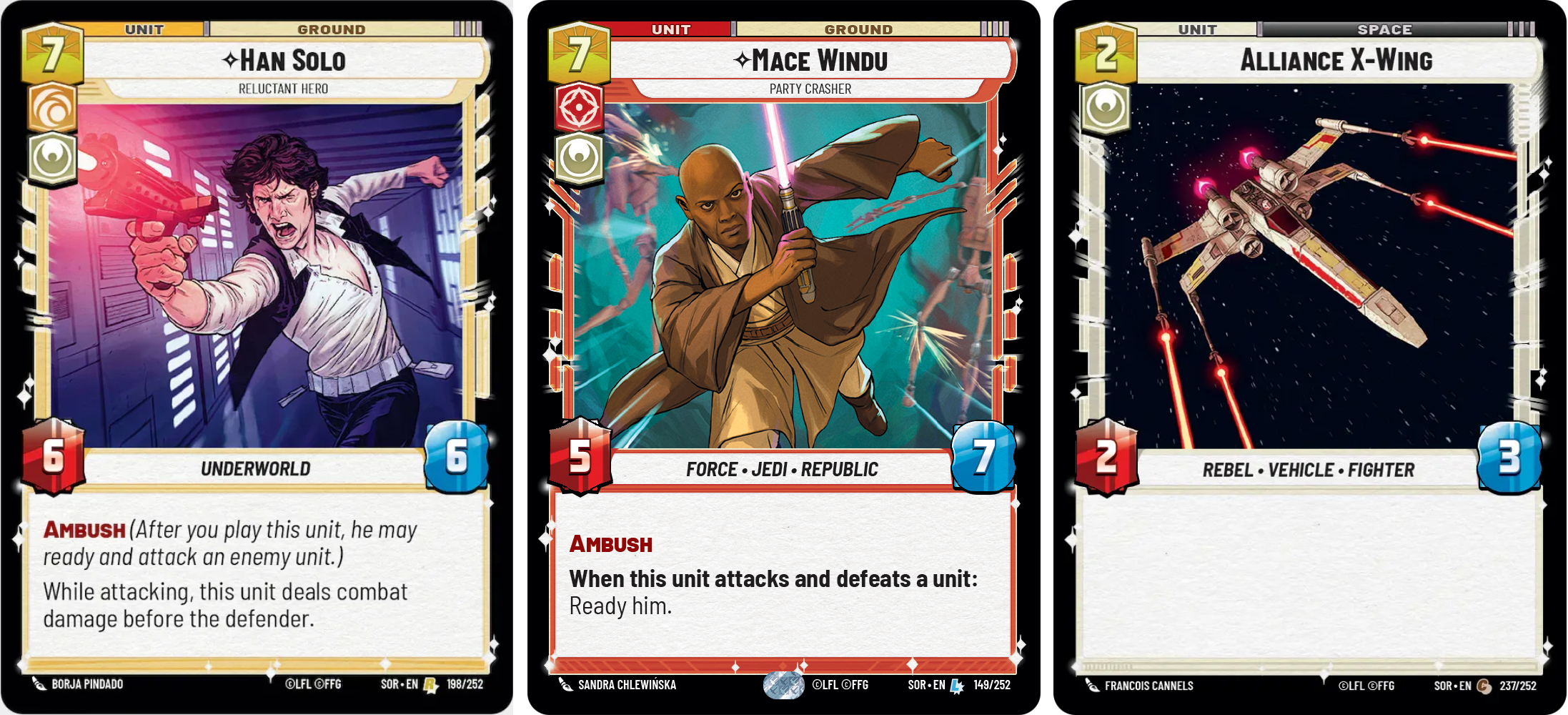
Another nice element to the game is the artwork. I'm never sure about using artwork for games based on films or television shows -- why not just use screen captures, especially for something like Star Wars that has a lot of high end visuals to work with? The use of artwork allows them to use elements from across the franchise's 47-year history of live action and animation and have it all look consistent, and it also makes it easy to accommodate characters and scenes that we never saw in any of the films.

If the pre-release pack is any indication, Star Wars Unlimited is off to a great start, but it remains to be seen whether it can flourish in a market that has seen several booms and busts over the years, and is currently dominated by a small number of games. Hopefully it will, as this first set of cards barely scratches the surface of the extensive, one might even say Unlimited, Star Wars universe.

Rating: 4 (out of 5) It lacks the depth of some of the earlier CCGs, but that isn't necessarily a disadvantage as the game's simplicity should make it a lot more accessible to new and casual players.


Wednesday, April 22, 2020

Come back to Arrakis: the classic Dune board game gets a new lease on life

The long-awaited reprint of the Avalon Hill Dune board game finally hit store shelves back in November, and honestly it's everything I had hoped it would be: the same game, but with updated graphic design and streamlined, easier-to-understand rules that don't read like a calculus textbook. It's a huge improvement on what was already a great game.

The changes to the actual game play are minimal enough that my review of the original game should still serve as a good description. What remains to be seen is whether or not a 40 year old game design can hold its own in the current (and much more mainstream) board game market. To be fair, new publisher Gale Force 9 have given it every chance, with nice, crisp graphics, a plethora of "how to play" videos on YouTube, a relatively low price point, and wide availability at mainstream retailers such as Barnes & Noble.

The improved production value and availability should help, but the game's biggest problem remains: it was designed for six players, and while it can play with fewer, the shifting alliances are what makes it interesting, and this aspect doesn't come off nearly as well with fewer players. And even with board gaming's popularity at an all time high, it can still be challenging to get six players together who want to spend 3-4 hours playing a game based on a 50 year old book, even if it was a science fiction masterpiece.

Rating: 4 (out of 5) A great game made even better, but the main barrier to playing it regularly remains.
  • Dune official website
  • Dune on BoardGameGeek

Tuesday, April 7, 2020

You, too, can make the Kessel Run in less than 12 parsecs in Star Wars: Outer Rim

Star Wars: Outer Rim turned out to be our most played game of 2019, which took us completely by surprise because it didn't even come out until October of last year, and we hadn't really been planning on getting it at all. A friend bought it and brought it over for us to try, and we were instantly hooked, buying our own copy a few days later.

Not only did we play it 11 times in less than three months, but we've found that it's a big hit among most of our gaming friends. The Star Wars theme is a pretty easy sell, but on top of that it's a really engaging and accessible game, without the direct confrontation in most Star Wars games like X-Wing or Rebellion.

Each player chooses a ship captain to play as, with choices ranging from well-known stalwarts like Han Solo or Boba Fett to more obscure characters like Dr. Aphra from the comic books or Ketsu Onyo from the Star Wars Rebels animated television show. The time frame that the game takes place in is intentionally vague, but is roughly between the prequel trilogy and the originals, a little after the time of Solo: A Star Wars Story.

Characters start with a choice of generic ship and a starting mission or bounty, and the goal from there is to achieve fame points by travelling between planets, delivering cargo, catching bounties, and eventually upgrading to a better ship. Each character also has a unique personal goal they can try to complete to gain extra points and unlock additional special abilities.

What's great about the game is how open-ended it is. Players have numerous options when visiting a planet and can do anything from hiring contacts to having random encounters after they've delivered their cargo, turned in their bounty, or completed whatever errand they've been hired to run. Success or failure is determined by a simple dice roll system, with rolls modified by the various skills and abilities of the player's captain and crew.

It's a "pick up and deliver" game similar to Firefly or Wasteland Express Delivery Service, but where Firefly strains under the weight of its expansions, Outer Rim gives a similarly epic play experience in half the time and taking up a fraction of the table space.

Rating: 5 (out of 5) A terrific adventure game that avoids the epic good vs. evil battles of Star Wars in favor of exploring its rich, textured setting.

Wednesday, March 25, 2020

Tiny Epic Mechs is a tiny epic disappointment


I've enjoyed most of the games I've played in the Tiny Epic series, with Tiny Epic Western being my favorite (go figure) and Tiny Epic Galaxies coming in a close second. Not all of the Tiny Epics have appealed to me, however: their core line of fantasy games has a cartoony style that doesn't appeal to me, and Tiny Epic Zombies, while a decent game, fell victim to the general burnout that makes me hyper-critical of any and all zombie games.

Having grown up with Battletech as my first combat/skirmish game, I had high hopes for Tiny Epic Mechs, so I backed the Kickstarter campaign for it without really looking at it in too much detail. I was seduced by the publisher's ITEMeeple system that features little plastic weapons and armor that attach to an otherwise standard-looking meeple, a set-up that they've used in some of their other games to varying effect.

Alas, backing a Kickstarter game without knowing anything about the game play is usually a recipe for disappointment. It turns out that Tiny Epic Mechs is definitely not the arena combat game I was hoping for, but rather a programmed movement game similar to Robo Rally or Colt Express, although its small scale makes it much less chaotic than either of those games. Unfortunately, in this case "less chaotic" also means "less interesting."

The game is played in a series of six rounds. Each round, players secretly program 4 moves from their hand of eight cards, and right away this is problematic and awkward. Each move card has an arrow that needs to be pointing in the direction you want your playing piece to move, which means the orientation at which the cards are placed is critical. You ca't just play your secret moves face down, as turning them over might change the orientation of the card. Cards need to be played with another card covering them, which makes planning your four moves awkward an difficult unless you're playing solo (which the game does support).

Resources and points are gained by controlling areas, which means the mech combat in this supposed mech combat is secondary. You will often find yourself needing to run around taking control of tiles in order to catch up on points and gain the resources you need to upgrade your weapons and armor, and a few well-placed moves by your opponents can lock you out of being able to do anything effective.

Your playing piece starts out unarmored, with a single weapon. Over the course of the game you need to "power up" into armor and upgrade to better weapons, and this is where the ITEMeeple plastic bits come in. Each weapon you equip slots into your meeple, which in turn fits into a clever little suit of power armor, showing exactly what your warrior is armed with, which should be really clever. However, the game also uses cards to represent your weapons and armor, even down to the placement of the cards showing where the weapons are equipped, which renders the plastic bits superfluous and unnecessary as anything other than decoration. The whole thing seems really gimmicky.


Lastly we come to the actual combat system, for those rare occasions when two mechs actually fight each other. The game uses a variation of rock-paper-scissors, where if you follow an opponent's attack with one that "counters" it, your attack will be more effective. It sounds neat in theory, but the rules use some counter intuitive verbiage that makes it difficult to teach, and it's a little to fiddly for a game this simple.

At the end of the day, Tiny Epic Mechs is a programmed movement game that wants to be an arena combat game, and it ends up being mediocre at both.

Rating: 2 (out of 5) A disappointing entry in the Tiny Epic series that manages to feel over-engineered and too simple at the same time.

Thursday, December 26, 2019

Toy soldiers, part 3: Core Space

When I was a kid Star Wars toys were all the rage. One thing that the developers of the original Star Wars action figures back in the 1970s got absolutely right was that the space ships, vehicles and especially the environments were at least as important as the characters, so they scaled their toy line in such a way that they could include play sets representing locations from the films for kids (and adults) to place the characters in.

Environment is at the heart of Core Space, a game developed by the makers of the Battle Systems line of cardboard miniatures terrain. Their sci-fi series, representing space station corridors, futuristic cities, and planetary outposts, was their most recent (and most successful) product to date, so naturally when they decided to create a game to go with their terrain, it was going to have a space opera theme.

While they could have gone with a standard skirmish game, they opted instead for something with a lot more narrative and adventure to it. Players control crews of scoundrels and pirates in what is essentially a sci-fi dungeon crawl, creeping around in labyrinthine space stations searching for cash and equipment (and yes, the loot is even stored in futuristic treasure chests). While players can opt to attack each others' crews, that would take precious time away from searching for goods and interacting with non-player civilians who might provide useful information or even be persuaded to join the crew.
If it sounds too easy, there's the inevitable catch: the galaxy the game takes place in is under attack from an enigmatic race of killer robots, and a few turns into the game those robots start appearing on the board, their actions controlled by a simple but very effective AI that governs where they move and who they attack. As the game progresses, more advanced (and deadly) models start appearing, and the tension ramps up. The game turns into a "press your luck" situation where you know you should be moving all your crew back to the airlock, but wait, there's a cargo crate we didn't look in yet...

The rules are simple and cinematic, using proprietary dice and an easy measuring system for combat, and there are lots of options for non-combat actions like interacting with civilians, opening and closing doors, using computers and even breaking and jumping through windows. And the fact that the game is designed specifically for the Battle Systems terrain means it gets the most out of it.

The game really shines when played in a series of linked missions over several games, using an experience system that allows crew members to improve their abilities and equipment over the course of the campaign. It even allows for improvements to the crew's space ship, allowing it to do things like scan the station for information or even defend the airlock from off-screen.

Rating: 5 (out of 5) a well designed game with rich, familiar-yet-different characters and a setting that can't help but be fully immersive thanks to the ingenious terrain.

Friday, December 13, 2019

Imperius: sometimes great artwork is enough

Imperius caught my attention entirely due to its striking artwork, which crisply illustrates a far-future interstellar empire (clearly based on Frank Herbert's Dune) where great houses vie for power through a combination of two-faced intrigue and raw military might.

Each player is given an assortments of cards in their color, representing characters such as nobles, bodyguards, and assassins. All the players' cards are shuffled together (along with a handful of event cards) and then redistributed by means of a card draft: each player is dealt a hand of 5 cards, keeping one and passing the rest to the next player until all the cards have been drafted. The strategy here is to balance taking cards you know you want with keeping powerful cards out of the hands of your opponents.

The thing that makes drafting a little different in this game is that you're not just drafting cards from your own faction. You're also looking at which of your opponents' cards you would prefer to have some control over; for example, if you want to make good use of your Noble, you may want to also draft your opponent's Assassin in order to keep it from interfering with your plans (more on how the cards interact in a moment).

Once players have drafted their cards for the round, they take turns playing them to various different location cards at the center of the board. Two cards can go to each location face down, but once that limit is reached, remaining cards are played face up, so you have to choose carefully which cards you want to keep a secret and which ones you don't mind your opponents knowing about. After everyone has deployed their cards, the cards that have been played to each location are revealed and resolved in a pre-determined order (not necessarily the order they were played in).


As cards are resolved, Assassins kill Nobles, Royal Guards protect Nobles from getting killed, Ambassadors and Nobles (if they survived the Assassin) score victory points, and Commanders place control points on locations, which in turn score points at the end of the game. Each character has a rating in strength and favor, which are used to determine who wins if, for example, two different players have their Noble at the same location.

What makes this really interesting is that you aren't always playing your own characters, so you might play an opponent's Ambassador to a planet that isn't worth many points, in order to keep him out of your way, or you may even be able to play one opponent's Assassin against another opponent's Noble, paving the way for you to sneak the location's victory points out from under them.

The game play describes a lot of dramatic intrigue. It might be a little bit more interesting if the game took place in a world that we knew more about, such as the aforementioned Dune or even Star Wars, but the evocative artwork paints a detailed picture of an interstellar setting that seems a lot deeper than it is.

Rating: 4 (out of 5): Imperius has some unusual concepts that can be a struggle to explain to new players, but once everyone understands the basic strategy it's a compelling mid-weight game with simple mechanics but a lot of depth.

Thursday, December 5, 2019

Into the tiny with Tiny Epic Galaxies

Tiny Epic Galaxies delivers on its promise: it has the feel of an epic exploration game, but it comes in a small box and doesn't take all day to play. Now, don't get me wrong, it isn't Xia or Star Wars Rebellion, but it still creates a sense of mighty space empires growing stronger as they explore and conquer new territory.

It's a dice placement game, a growing sub-genre of worker placement where players roll dice to determine what actions they can do in a given round. The actions here are moving a space ship between planets, acquiring one of the game's two resources (energy or culture), using either diplomacy or economy to advance colonization efforts on a planet, or utilizing an established colony's special ability for a game effect.

Players start with 4 dice and two space ships, and compete to exploit the resources of a row of planet cards at the center of the table. Landing on a planet conveys a one-time use of that planet's special ability. Orbiting the planet and taking the time to colonize it takes longer but adds the planet to your pool of colonies, meaning only you may use its special ability. Additionally, each planet provides either energy or culture, so spreading out your ships to take the best advantage of the acquire resource action is critical to having the resources you need to upgrade your empire, which gets you more ships and dice to use on later turns.

As with all the games in the Tiny Epic series, this one doesn't really offer anything truly original, but that's not the point. The accomplishment is that it offers something similar to what you normally only get from much larger and more time-consuming games. The amount of game that designer Scott Almes is able to get out of a minimum of components is astonishing.

Rating: 4 (out of 5) There's a lot more going on in this game than can be expected from a 5" x 7" box, that's for sure.

Thursday, May 16, 2019

Clank! In! Space! -- In space, everyone can hear you


I like a good deck building game, but they do tend to get a bit repetitive after a while, with different themes grafted on to what is essentially the same game. Most games of this type use the familiar "buy cards, use those cards to buy better cards" formula, and attempts to innovate usually involve adding additional currencies, such as with the Legendary series or Star Realms, where players need to balance the ability to buy better cards with the ability to combat villains (or other players).

Clank! In! Space! goes in a different direction entirely. The deck building mechanics are the same as with any deck building game, but this game adds a board and an additional currency in the form of  movement, with players moving their pawns around the board in a press-your-luck style treasure hunt similar to games like DungeonQuest, where players can go for safer, lower-value treasure or risk it all for the big score.

On top of that, there's one more thing to keep track of: noise. The premise of the game is that players are essentially burglars sneaking around a giant space ship, and certain card plays will produce noise in the form of clank tokens. At various points during the game the clank tokens are drawn randomly from a bag, and if yours are drawn they are added to a damage track. Ten or more damage knocks you out of the game, so in addition to everything else you need to take opportunities to heal damage so you can stay in the game.

A few simple additions to the standard deck building game formula makes for a more interesting game overall, but also provides a wider variety of game effects for the cards. Buying cards isn't just a matter of "does it generate money to buy more cards, or combat to defeat monsters," they can also generate movement effects and add or remove clank tokens.

The artwork and graphic design are top notch. The theme is a light science fiction parody, with cards referencing pop culture mainstays such as Star Wars and Star Trek, which is fun but also stops it from being really compelling. It doesn't generate a unique world of its own, but not every game needs to.

Rating: 4 (out of 5) An entertaining game that brings some much-needed innovation to a game genre that may be getting a little tired.

Tuesday, September 11, 2018

Sol: Last Days of a Star -- just brilliant


Sol: Last Days of a Star is a rather ingenious resource management game set in outer space. Players take control of a fleet of ships attempting to siphon off enough energy from a dying sun to allow their colony ship to escape a doomed solar system.

The game has some really interesting mechanics involving movement, positioning, and generating and spending resources. Your main ship is moving slowly around the outer edge of the board. You have to launch smaller ships and position them in particular ways in order to build the other structures that you will need to generate energy, which then allows you to build more of those smaller ships, and also accumulate momentum, the points that will determine the game's winner.

All the while, the game is counting down by way of a deck of cards that are drawn. What you build and where you build it determines how many cards you draw at the end of your turn, so each player's actions will make the game end come faster or more slowly. Additionally, cards drawn can give you different powers and abilities to use.

It's a simple, elegant game with a lot of significant decisions to make, and very little random chance. The countdown mechanic creates some tension and urgency, while also making sure the game doesn't take too long to play and providing lot of variation between games thanks to the different special abilities the cards give you. It is a terrific game.

But that's not why I bought it.

I bought this game because it is absolutely gorgeous to look at. The graphic design isn't just top-notch, it is stunning, and incredibly well balanced. The design accommodates the game play perfectly, and at no point does it look like one had to compromise for the other. Everything about the look of this game is exceptional. Seriously, graphic design students should study it as a piece of exceptional design.

Imagine my relief when it turned out to be an excellent game too.

Rating: 5 (out of 5) An incredible game design, both visually and mechanically.

Wednesday, December 20, 2017

Star Wars: Rebellion -- getting the war into Star Wars


At their core, the Star Wars movies are about the journey from adolescence to adulthood, with characters such as Luke Skywalker and Rey learning about their abilities and place in the world, Anakin Skywalker finding his ultimate destiny as Darth Vader, or even Jyn Erso finally finding a cause worth dying for. It's the human drama that really makes the Star Wars saga as compelling as it is.

But it's also about a whopping big war in space, and that's the part that Star Wars: Rebellion successfully translates into a board game. The box says it's a game for 2-4 players, buttthe four player option just splits each player's duties, and isn't really worth considering. This is definitely a two-player game, as befits the Star Wars saga's rather black-and-white struggle of Empire vs. Rebellion.

What's interesting about the game is that it isn't just an armies-on-a-map Risk-style game with both sides starting out equal. Each player has different goals: the Empire, which starts with a lot more resources, must use a combination of deduction and brute force to find and wipe out the hidden Rebel base, while the Rebel player has to accomplish hit-and-run objectives to drive down the Empire's popular support and undermine its credibility.

Game play involves using the personalities of the Star Wars universe such as Han Solo, Princess Leia, Darth Vader, and even Boba Fett and Jabba the Hutt, to attempt missions and lead attacks into enemy territory. Missions can be a simple as using diplomacy to convince a planetary system to join the Rebellion (or the Empire), or as complex as leading an attack on the Death Star, the destruction of which will seriously undermine the Empire's credibility.

The characters available to each player are revealed gradually over the first half of the game; no game is ever exactly the same, as you never know whether you will end up with Han Solo, Luke Skywalker, or lesser known characters like Wedge Antilles to work with. Additionally, the mission and objective cards vary from game to game, which keeps the game fresh over multiple plays.

Rebellion is a very complex two-player game that takes about four hours to play, so it definitely isn't going to be for everyone. But if you like rich, deep strategy games and you like Star Wars, it can't be beat.

Rating: 4 (out of 5) The limited number of players and long play time prevent it from getting to the table on a regular basis, but this is usually the first game I think of if I want to play a Star Wars game.

Tuesday, September 26, 2017

7TV: wargaming in the world of cult TV

Before playing 7TV, most of my experience of tactical combat games was with collectible miniatures games like Heroclix and Star Wars Miniatures, which really play more like 3D trading card games, where killer combos and extensive knowledge of what each piece does usually win the day. I've also played quite a lot of X-Wing, which is a bit of a hybrid in that, while the pieces aren't actually collectible in the blind-box sense, the game does hinge largely on upgrade card combos and knowing what to expect from your opponent's ships.

7TV is a more traditional miniatures skirmish game of the type favored in Britain and Europe, where painting the figures and constructing the terrain to play on are at least as important as actually playing the game. There are skirmish games based on every imaginable genre, from straight up historical warfare to Tolkien-style fantasy to far-future combat; this one is based on 1960s and '70s cult television, and draws its inspiration (and many of its figure designs) from British "spy-fi" TV shows such as The Avengers, Doctor Who, Danger Man, and The Prisoner, to name a few.

Some of 7TV's Future Freedom Fighters
We decided to jump into 7TV because we are big Blake's 7 fans, and the game's Future Freedom Fighters bear more than a passing resemblance to Blake, Avon and the crew of the Liberator. We ordered a bunch of figures and, after lovingly painting them, sat down to play. Since we didn't have any of the fancy terrain that most miniatures wargamers use, we decided to play on a poster map from the Star Wars Miniatures Game, as many would argue that Blake's 7 was the BBC's answer to Star Wars anyway.

We enjoyed the game quite a bit, but we did agree that we needed some proper terrain to play on, so we put the game on the shelf until we could get some (in our case, the excellent modular sci-fi terrain from Battle Systems). Our second play-through was a lot more enjoyable, which got me wondering: I never minded playing Star Wars minis or Heroclix on flat maps, so why did having 3D terrain seem to make this game so much better?

2D vs 3D - a huge difference
Our conclusion, reinforced by a recent game of Heroclix, was largely that the structure of the games is so different. The rules for Heroclix are significantly more complicated, which I think is intentional. Played at the in-store tournament level, Heroclix is a very competitive game where a player's knowledge of the rules and ability to manipulate them is the key to victory, so they need to keep changing the rules in order to keep those high level players interested (and buying figures).

On the other hand, I think the point of games like 7TV is really the tactile pleasure of moving hand-painted miniatures around in an evocative environment, so the job of the rules is to provide a framework for that, and then get out of the way.

That said, the rules for 7TV do have some very interesting elements in the form of two decks of cards that are used while playing: the Gadget deck and the Countdown deck.

Gadgets are one-time use cards that a player can use to spice up the game a bit, providing relatively simple effects such as free moves, re-rolls and extra victory points. They can only be used by a player's main character minis, which gives some incentive to avoid swarming the board with tons of low-level troops. And of course, mad scientists get extra Gadget cards.

The Countdown deck is probably the aspect of the game that provides the most flavor. It adds quite a bit of randomness to the game, which may be a turn-off for more serious-minded gamers, but we thought it was a great way to keep us from taking the game too seriously. The deck is populated with a number of random event cards based on the size of the playing surface, broken up into an equal number of relatively mild "act one" cards, slightly more significant "act two" cards, and game-changing "finale" cards.

Each player draws a Countdown card at the start of their turn, and the game ends when the cards run out, so in addition to random effects, the deck provides the game with a built-in time limit. Effects range from temporarily neutralizing figures on the board to bringing back dead characters, and players have the option to draw 2 in one turn if they wish, which gives them more of the currency the game uses to move figures, but also accelerates the end of the game.

All in all we had a great time playing 7TV, which in a way is unfortunate because it has set us on a path to one of the more expensive and time-consuming aspects of the gaming hobby. But it might also be one of the more rewarding.

Rating: 5 (out of 5) It would have to be, given the amount of cost and effort involved in playing any game like this.
  • 7TV official website
  • 7TV on BoardGameGeek (not much activity here)
  • 7TV Productions Facebook page (very active)
Check out my OnTableTop.com project blog about playing through all six chapters of the 7TV Dracula Feature Pack.

Monday, August 7, 2017

Helionox: rushing toward the last sunset

I picked up Helionox: the Last Sunset some time ago on a whim. The artwork on the cover reminded me of one of my favorite current comic book series (the excellent East of West by Jonathan Hickman and Nick Dragotta), the science fiction theme is one I enjoy, and it came from the publisher of Spurs, a game I enjoy quite a bit. Additionally, the price was under $25, which is a good way to get me to try a new game without too much "should I buy it or not" agonizing.

We played it a couple of times and enjoyed it, but then it went in the "small games" cabinet and we pretty much forgot about it. Clearly the game play wasn't quite compelling enough to make us want to keep playing, but at the same time, the box is small enough that it escaped the last few recent game purges.

Just recently I had occasion to take another look at Helionox - it was next on the list of games to review that I'm woefully behind on, and the creator had launched a Kickstarter for a deluxe edition and expansion of the game.

At its core, Helionox is a game about averting disasters. The playing field consists of five locations representing planets of the solar system, and players get extra abilities in the game depending on where their spaceship token is currently located. Each turn an event card is drawn that details a crisis befalling one of those systems, and if the crisis isn't dealt with in two turns or less, the location's extra ability is neutralized. Players earn points by overcoming event cards, and the game ends when the deck of event cards runs out.

The game uses standard deck building game mechanics, with players starting with a deck of relatively weak cards and using their resources to buy better cards for their deck. I like the relatively non-competitive theme of averting disasters rather than just attacking the other player, and I like the idea of moving between different locations for different game effects, but the problem I have with this game is that the event cards run out (ending the game) before I feel like I've had a chance to build up a deck of interesting cards to play with.

We had a similar problem with Eldritch Horror, which is one of the reasons we eventually removed that game from our collection. The game presents an interesting world, but the time limit and often abrupt game end means that you never really get a chance to explore that world.

Rating: 2 (out of 5) Really not a bad game, but the short built-in time limit makes it less fun than other deck building games such as Legendary or Star Realms.

Tuesday, May 12, 2015

Another look at Star Trek: Fleet Captains


I really wish Star Trek: Fleet Captains was a better game than it actually is. It has an incredible amount of potential to be a truly epic game, but is hampered by some clunky, overly complicated game play. A lot of this could be solved by a tiny bit of rules streamlining, but really the game just needs a reference card that clearly summarizes the rules and mechanics, so that players won't be forced to constantly refer to the overwritten and poorly organized rule book.

One of the core mechanics of the game is each player's assembly of a Command Deck of cards. For each faction (Federation, Klingons, Romulans and Dominion) there are 10 mini-decks of 10 cards each, grouped around themes such as "Way of the Warrior" or "Sensor Upgrades," or around particular characters like Captain Kirk or Worf. Each player chooses four of these to shuffle together, giving them a deck of 40 cards that they can use during the game. It's a neat idea in theory, and it adds a bit of CCG-style strategy to the game, but in practice I too often find myself with uninteresting cards that I can't use clogging up my hand. This could be solved by allowing players to further customize their decks by removing cards they don't think they'll use during the game.

An unfortunately under-utilized element of the game is the Encounter Deck, consisting of cards that represent things a starship might encounter while exploring space, such as Abandoned Outposts or Independent traders. Again, this is a wonderful idea that fails a bit in practice, since each unexplored location a ship moves into will only sometimes give up an encounter, and even then, only once per location. We've tried a few different house rules to make encounters happen more often, such as always having an encounter in a newly discovered location, and then checking for additional encounters each time the location is moved into again.

There are also a few superficial issues with the components, such as the unpainted ship miniatures, the poor font choice on the clix dials making them very hard to read, or the flimsiness of the cards and especially the location tiles, but these are easily fixed or ignored. The point is that there are just a few things stopping Fleet Captains from being a magnificent game, and I don't think any of them are insurmountable.

Most of the time I shy away from creating "house rules" or other improvements to commercial board games, my argument being that there are so many games out there that work fine without me needing to change them, so why should I spend my time picking up the game designers' slack? But in this case, the game is so tantalizingly close to being great, and there really isn't another Star Trek game like it...

Read the original review.
Original rating: 3 (out of 5)
New rating (pass or fail): PASS

Another look at Star Trek: Expeditions

With its generic game board and easily replaceable plot cards, Star Trek: Expeditions was clearly designed to be expandable with new missions and challenges for the Enterprise crew. But so far, the only expansion for the game has been a little box containing three new crew member miniatures and their corresponding character cards -- no new mission cards, which is what the game really needs. My suspicion is that the game failed to sell particularly well, and the double-whammy of the license for the Star Trek reboot film and game designer Reiner Knizia's no doubt higher-than-average royalties have made the game's continuation too expensive for the publisher to consider.

We dug the game out recently for a replay, and we enjoyed our game quite a bit, perhaps even more than we were expecting to given the noncommittal rating we originally gave it. We enjoyed everything you are supposed to enjoy about a cooperative game: working together to make decisions, dividing up the game's resources and challenges based on whose characters were best suited, and the feeling that we were struggling against difficult (but not impossible) story-driven game mechanics.

I can still see that my original assessment of this game holds true, in that the thing that will get old after repeated plays is the repetitiveness of the plot cards. While there are incidental side-plots that are randomized for each game, the core plot cards that move the game forward (and determine the players' score at the end) are always the same. Other co-op games like Arkham Horror or A Touch of Evil give players a variety of different enemies to fight, in order to add variety and increase replay value.

However, I honestly don't think the repetitive game play is too much of a problem for us since we only seem to play it every seven months or so, and we always have a good time when we do.

Read the original review.
Original rating: 3 (out of 5)
New rating (pass or fail): PASS

Thursday, April 30, 2015

Star Realms: saving the CCG


During the collectible card game boom of the 1990s, I tried quite a few of the different games that hit the market, from mainstream games like Decipher's Star Trek and Star Wars, to some of the more obscure titles like On the Edge and Clive Barker's Imajica. I love the concept of building a customized deck of cards with different abilities that would work in combination, and I also enjoyed the way these games (when designed well) would immerse you in their worlds.

Unfortunately, the CCG business model demands a fairly large financial commitment from its players, and the market, combined with a flailing economy, just couldn't keep up with the sheer number of games that were produced. Additionally, many CCGs would continue to add layers of complexity in order to keep players interested, which usually put up a barrier making it very difficult for new players to get into the game. The CCG boom eventually collapsed under its own weight, with only a handful of games such as Magic and Legend of the Five Rings still being produced today.

Fantasy Flight Games pioneered the Living Card Game format in order to keep their Call of Cthulhu and Game of Thrones CCGs alive, and that has since proved to be a viable format that preserves CCG-style gameplay without the random booster packs. The games are much easier to keep up with in terms of the amount of cards you need to buy, but keeping up with evolving rules and strategy for just one of these games can still be a full-time job.

Enter the deck building game, a sub-genre of card games that is also helping to preserve CCG-style game play, but with the strategic focus on building your deck during the game with what happens to be available, rather than chasing rare cards to build the ultimate card-gaming machine. It's a lighter and much more accessible type of game.

All of which brings us to Star Realms, a science fiction themed deck building game created by a group of professional Magic players. Unlike most deck building games, which tend to involve players racing to achieve a certain number of points or other goal, the object of Star Realms is to knock your opponent out of the game by directly attacking him.

Much like in Magic, each Star Realms player starts with an amount of Authority points, which are whittled away at by opponents' attacking ships. Cards in the game represent ships and bases, with ships making attacks and bases providing defense, as well as other resources. Cards also generate trade, which players use to buy more and better cards for their decks. The universe of the game consists of four spacefaring factions, each with its own strengths and weaknesses. Ships and bases from the same faction will often work better in combination, but the factions can be combined as needed.

It's a lot like Magic in a lot of ways, but what makes Star Realms such a great game is its simplicity and accessibility. The rules are incredibly simple, with a loose turn structure and easy to understand game text on the cards, and only a few different card types to keep track of. It's easy to play, easy to teach, but still has a surprising amount of strategic depth, with lots of decisions to be made by players during a game.

Best of all, a base set containing enough cards for two players is only $16 retail, well below the entry point for almost any other game on the market. $5 expansion packs add a few interesting extras like hero characters, event cards that affect all players, gambit cards that give players unique abilities at the start of the game, and even outside threats that make it into a cooperative game, with all the players working together against hordes of pirates or unfathomable space monsters.

Rating: 4 (out of 5) Star Realms is very quick to pick up and easy to play, and offers a lot of the strategy and entertainment value of a collectible card game for a fraction of the time and money.

Monday, April 13, 2015

Dune: a world fit for a CCG


Frank Herbert's Dune series of novels are about a universe populated by many different factions, each with its own distinct personality and flavor, using every resource at their disposal to fight for control of the most powerful planet in existence. It's a concept that sounds tailor-made for the type of epic strategy game that most collectible card games published in the 1990s tried to be.

The Dune CCG was originally published in 1997, and it has a lot in common with the majority of games published at around that time. The structure of the game is very complicated, with an elaborate system of battle comprising four different types of conflict and numerous, highly structured windows of opportunity to play cards that will affect the battle's outcome. The game's core mechanic revolves around the buying and selling of spice, for which there is a constantly fluctuating exchange rate. It also requires players to keep track of their numeric influence value, which changes throughout the game and can be used for various game effects.

Players use location cards to generate money, which is used to buy spice and pay for cards, but even getting those into play has an added layer of complexity. Locations (and other resource-generating cards) and main characters are played from a side deck, and when a player attempts to play one of these cards, the other players have an opportunity to bid the cost of the character or resource up higher in the hopes of making the card too costly to play, or at the very least causing a drain on their opponents' finances.

The mainstays of a player's deck are the persona cards, representing the unique characters working for the player's faction, and holdings, representing the player's income-generating property. All of these cards are unique, so a player's copy of a particular persona or resource card can't be played if another player already has it in play.

Over the course of the game, players put their personas and resources into play, bolster them with equipment and enhancements, and use them to attack the other players' cards via one of the four different methods of conflict: dueling, intrigue, battle, or arbitration. Each type of attack can only target certain cards, and each has its own rewards for success and penalties for failure.

One thing I definitely like about the game is that characters tend not to be as disposable and replaceable as they are in other CCGs. Here, when a character loses a battle they are turned face-down, and can be re-purchased by their player on a later turn; a nice touch that reflects the indefinite nature of death in the Dune books, where characters frequently return to life as ghola clones, or simply turn out to have narrowly escaped certain doom. It also helps the game feel like one of long term strategy rather than short term cost-benefit analysis.

All the action is in the service of helping the player get 10 influence points, and accumulate 10 spice. Neither is as easy as it sounds, as there is only a finite amount of spice available at the start of the game, so more has to be generated via game effects, and influence can be spent to help with card costs, or lost as a result of losing battles, so it can be difficult to hold on to.

It's a lot to take in, and a lot to remember while playing, but somehow this level of complexity seems in line with the tone of the Dune books, and doesn't seem out of place.

Rating: 4 (out of 5) Honestly I don't think we've played Dune enough to give it an accurate rating, but  we're intrigued enough to keep playing, in spite of the game's complexity and the difficulty in finding cards for an 18-year-old collectible card game.

Wednesday, October 29, 2014

Star Wars: X-Wing -- all pilots to your fighters!


One of the problems with using miniatures on a tabletop to simulate combat is the lack of continuous movement, especially if your game includes flying characters or vehicles. While some game systems may use clear stands to indicate movement through the air, most of the time fliers in tabletop games tend to "hop" from one position to another, without any real sense of fluid movement.

Star Wars: X-Wing solves that problem in a variety of ways. Ships move using templates that make movement a bit more fluid than using a tape measure or bouncing from square to square. More importantly, every player has to decide on the direction and distance of their move each turn at the same time, deciding in secret and revealing simultaneously. Once moves are revealed, ships move in order of the skill of their pilot, starting with the rookies and working their way up to the seasoned fliers like Han Solo and Darth Vader. After all the ships have moved, they get the opportunity to fire if they have any targets within range, this time starting with the best pilots and working their way down.

It's an excellent system that conveys a sense of constant movement while at the same time using the limitations of a tabletop miniatures game (the fact that the miniatures still need to be moved one at a time) to simulate an advantage that better pilots would have over lesser ones. Additionally, it can sometimes be difficult to envision exactly where your ship will end up after moving along your chosen template, which adds a great element of unpredictability to the game. It also means I tend to crash into asteroids a lot when I play...

Players choose their ships based on a pre-determined point system, with a choice of several different pilots for each ship as well as a host of optional upgrades such as extra missiles, co-pilots and astromech droids. Will you go with Darth Vader piloting his TIE Advanced, maybe with one or two wingmen, or will you opt for a swarm of TIE Fighters in an attempt to overwhelm the pesky Rebels? Would you rather have Han Solo or Lando Calrissian piloting the Falcon? This gives players a lot of strategic decisions to make before the game even starts, and ensures that the game is different every time.

The pre-painted figures are exceptional, with a lot of great detailing, and they are perfectly to scale with one another, giving larger ships like the Millennium Falcon their own advantages and disadvantages when compared to the smaller X-Wings and TIE Fighters.

Most importantly, the game really feels like Star Wars, so much so that you can almost hear the screaming engines and laser blasts.


Rating: 5 (out of 5) Great looking miniatures and a game system that suits the source material perfectly.
Date played: October 5, 2014

Tuesday, October 28, 2014

Star Wars, in miniature

Any time a product is wildly successful it is bound to spawn imitators, and WizKids Games' Heroclix was certainly no exception. Collectible miniatures didn't quite sweep the gaming industry the way collectible card games had in the wake of Magic: the Gathering, no doubt owing to the relatively high cost of producing pre-painted plastic miniatures. Most of the collectible miniatures games that did hit the market tried to approximate the Wizkids click dial (no mean feat since they were smart enough to file a patent for it), which makes me think that they may have missed the point.

Mage Knight and Heroclix creator Jordan Weisman had said that he got the idea for the game after seeing how difficult it was to get started playing tabletop combat games like Warhammer, and how complex the rules to those games were. He wanted a miniatures game that was easy to play but still offered strategic depth and the tactile experience of moving great-looking figures around an environment filled with obstacles. For him, the click dial was the way to help simplify tabletop miniatures, but it certainly wasn't the only way.

Enter Wizards of the Coast, the largest player in the hobby gaming market, owners of Magic: the Gathering and Dungeons and Dragons, and (in 2004, at least) holders of a license to produce Star Wars games.

Star Wars Miniatures was inevitable, but Wizards of the Coast were smart about how they went about it. They adopted Wizkids' distribution model of randomized blind "booster packs," But their packs contained more figures for the price. More importantly, they appeared to understand what the appeal of Heroclix really was: a tabletop combat game with relatively simple rules, using pre-painted figures and printed map boards rather than expensive 3-D terrain.

The designers of Star Wars Miniatures didn't try to come up with an alternative for the click dial, instead opting for a plain black base and a simple reference card that accompanied each figure, detailing its game statistics. This had the added bonus that the figures could easily be used with the Star Wars role playing game in addition to the combat game, and it made them a little nicer for Star Wars collectors who may not have been interested in playing either game, but have an insatiable appetite for figurines of their favorite Star Wars characters.

The game itself features a stripped down version of the combat rules from the d20 role playing game system, used by Dungeons and Dragons, Star Wars, and a host of other role playing games. The rules were modified somewhat to work as a tabletop game with no referee or game master, but players of the d20 role playing games would definitely find the core concepts familiar.

This basis in role playing is the main advantage Star Wars Miniatures has over Heroclix. Star Wars tends to be a much more story-driven game, with rules for things like firing around corners, hiding in trenches, or jumping through windows that Heroclix just doesn't address. Star Wars has more "wiggle room," allowing players to play out a story rather than just engaging in a mindless battle. Several products for the game even included a host of scenarios allowing players to play out scenes from the films as well as new stories.

The game's other main advantage, of course, is being set in the Star Wars universe. What Star Wars fan wouldn't want to demolish an army of Battle Droids with just a few Jedi Knights, or take command of the Rebel forces defending Hoth from the dreaded Imperial Walkers?

Rating: 5 (out of 5) The simple but versatile rules really put you right into the action, and the games feel more like stories than just mindless battles.


Date played: September 27, 2014

Sadly, Wizards of the Coast gave up their Star Wars license a few years ago, but there is plenty of Star Wars Miniatures product on the secondary market. Meanwhile, Fantasy Flight Games has Imperial Assault coming soon, which is planned to work both as a tactical game and a board game similar to Mansions of Madness.

Wednesday, October 15, 2014

To boldly clix, part 3 -- Star Trek Heroclix: Tactics


The release of Star Trek Heroclix: Tactics came as a bit of a surprise to me. Wizkids Games had already released Fleet Captains, so I wasn't expecting another Star Trek game from them, let alone one that appeared to use the same ship models. I was even more surprised when it turned out that Tactics used the regular Heroclix rules word-for-word, with no changes made to accommodate the fact that it's starships rather than superheroes. Powers and abilities were renamed on individual ship cards, but the rule book and reference card refer to ships having incongruous powers like Super Strength or Psychic Blast.

In all honesty I found the whole thing more than a little bit silly, and as the game did appear to use all the same ship models that had been included in Fleet Captains (although in Tactics they are fully painted, at least), I decided to give the whole thing a miss.

That is, until the first expansion came out. Tactics II introduced Romulan, Cardassian, and even Vulcan ships to the game, but the ship model that sold me on the game after all was the bright orange Ferengi ship, proving that human beings do indeed respond emotionally to bright colors.

We bought a bunch of ships and played a few games. I suppose it was nice that we didn't need to learn a new rules set, but it still seemed a little silly when the odd superhero term would come up during a game.

In spite of that, the Heroclix rules do lend themselves fairly well to the way space combat is depicted on Star Trek. Game pieces in Heroclix don't move fluidly so much as hop around the board from square to square, and they have to stop moving before making an attack, which is more or less what happens on Star Trek, with its ponderous starships slowly moving into position and then firing until the other ship is destroyed or surrenders.

While Heroclix is a tried and true game system, at the end of the day it reduces Star Trek to a simple fight, with none of the drama or intrigue offered by the various television shows, or even by the other two Star Trek clix games.

I still thought it was odd that Wizkids had two competing Star Trek starship games on the market, so imagine my surprise when the announced Star Trek: Attack Wing, yet another ship combat game that would use the same models from Tactics and Fleet Captains, but with the rules system licensed from from Fantasy Flight's Star Wars: X-Wing. I'm definitely not touching that one...

Rating: 2 (out of 5) While Heroclix with space ships works surprisingly well, Star Trek Tactics suffers in comparison to the more interesting Fleet Captains.
Date played: September 14, 2014

Tuesday, October 7, 2014

To boldly clix, part 2 -- Star Trek: Fleet Captains


The second Star Trek game from Wizkids Games, Star Trek: Fleet Captains has all the makings of an epic. Rather than go the route of a straight-up combat game, Wizkids delivered a surprisingly deep game about exploration and mission solving, with combat playing only a small part. Players draft fleets of ships and explore a cosmos made up of randomly sorted tiles. The ships you choose determine what types of missions you are given, anything from colonizing planets to scanning stars to conducting hit-and-run attacks into your opponent's territory.

As a player, you can tailor your tactics with the use of a semi-customized deck of Command cards, composed of characters, actions, and combat maneuvers. There are 10 mini-decks of 10 cards organized around themes such as engineering, warfare, or subterfuge; at the start of the game, each player chooses four of these to shuffle together, forming a 40 card deck.

Play centers around solving missions to score points, with bonus points available from random encounters as well as by doing things like building starbases. Play proceeds until one player reaches a number of points (10 in a normal game) determined by the size of the players' starting fleets.

The Star Trek universe is certainly well-represented. Each faction plays differently, with the Federation focused on science and exploration, the Klingons on battle, the Romulans on subterfuge, and the Dominion on brute force conquest. Ships and characters from the original series, The Next Generaition, Deep Space Nine and Voyager are all present, and there's even a Klingon ship from an episode of the animated series.

While it is very successful in terms of theme, the game itself is often bogged down by complicated game play. The game tries to be open-ended, but unfortunately that has resulted in a lot of rules that aren't always intuitive and are often difficult to remember. We have found that we have to refer to the rules very frequently, even after playing several times.

The Command deck is an interesting idea, especially with the ability to customize the deck a bit without spending time hand-picking all the cards. However, each of the mini-decks has too many cards that are only useful in very specific situations. You often find yourself with a hand of cards you can't use, which means you get in the habit of just ignoring them all together.

As with Star Trek Expeditions, the patented clix dial seems a bit out of place and tacked-on. Ostensibly it is used to track power adjustments to each ship, so more power to the shields means less power to the sensors, but the numbers on the dials are in a poorly chosen font that is very hard to read, and in any case all the numbers are also printed on each ship's card, making the dials pretty unnecessary.

Rating: 3 (out of 5) The incredible use of theme goes some way towards making up for some clunky game play, but not enough to make Fleet Captains a great game.


Date played: September 1, 2014

UPDATE May 12, 2015: Another look at Star Trek: Fleet Captains