Showing posts with label worker placement. Show all posts

Wednesday, July 10, 2024

General Orders: World War II gets wargaming down to the bare essentials

General Orders: World War II, by Undaunted creators David Thompson and Trevor Benjamin, is an interesting game that abstracts two of the most iconic types of battles from that war to the point that it doesn't really matter which side is which. Players merely choose to play as either yellow or blue and start on opposite sides of the board, which the game even declines to name as a particular theatre of war, instead calling them either "alpine" or "island," depending on which game mode you choose to play.

The game is a mix of worker placement and area control, with a bit of card play thrown in for good measure. The boards are divided up into hexes, with the path to victory being to deploy and move armies in an advance towards the center of the board. The game ends after four rounds, with players scoring points based on which map hexes their armies occupy, but it can also end early if a player manages to occupy their opponent's headquarters space on the opposite side of the board.

Each hex has one or two worker placement spaces. Most of them are used to move armies into the hex, with a few offering different options like landing paratroopers or firing artillery into nearby spaces. The hexes in the middle of the board offer in-game bonuses for occupying them such as gaining extra troops, extending the range of artillery, or drawing cards. If a player moves into a hex occupied by the opponent's troops, the conflict is played out with a simple dice roll followed by an attrition mechanic that removes an even number of each player's troops until only one player's troops remain.

The game uses cards to add a little extra uncertainty to the combat, with cards providing advantages such as extra dice, rerolls, troop reinforcements, and even extra turns.

The alpine board is the basic game, with each side using paratroopers and artillery to fight over a village surrounded by mountains. The island board represents a beach assault adding planes that can drop bombs on locations and help control the areas they're flying over. Even with that added bit of complexity, the game manages to be wonderfully simple, distilling a war game down to being about as simple as it can be while still being engaging for the players. And, like all of Osprey's board game offerings, the graphic design, illustration, and component quality are all top-notch.

Rating: 4 (out of 5) a neat little game that strips out unnecessary historical detail in favor of getting down to the mechanics of combat in two of the most prevalent types of World War II battles.

Wednesday, April 3, 2024

Pan Am: an unlikely theme for a board game, but it works

Funko Games' design team, who work under the collective name Prospero Hall, are very good at creating games based on media properties that tend to be a little on the simple side, but are always well thought out and true to their source material. A quick look at their website shows a catalog that runs the gamut from Star Wars and Jurassic Park games to some that seem less obvious like The Rocketeer, Hitchcock's Rear Window, or 1970s dystopian classic The Warriors. But Pan Am the Game? Really? A board game based on an admittedly glamorous but long defunct airline seems a little obscure, even for Prospero Hall. There was a short lived TV series in 2011 starring Christina Ricci and Margot Robbie, but the game isn't based on that, it's just about the airline.

The first thing that is striking about the game is the board itself. It presents what appears to be an odd, distorted world map until you realize that the map is centered on the North Pole -- many intercontinental flights take a northern route as, due to the curvature of the Earth, it's often the shortest distance. And there's that attention to theme that Prospero Hall is so known for.

Something else Prospero Hall is known for is excellent graphic design, and that is certainly evident here as well. The board, along with all the components, are done in a classy early 1950s style that looks great without sacrificing readability.

Pan Am is a worker placement game with a little bit of bidding thrown in for good measure. Like most worker placement games, it follows a standard structure of placing workers to get different resources and eventually trading them in in different combinations to score points. In Pan Am, players represent small fly-by-night airlines who want to establish exclusive air routes between cities with an eye towards eventually selling their routes to Pan Am (a non-player entity controlled by the game), and then using the money to buy Pan Am stock. 

On their turn, a player's options are to build airports, collect destination cards representing the cities on the board, buy newer, larger airplanes, establish routes between cities, or draw directive cards that offer various bonuses and other advantages. Each of these actions is represented by a space on the board, but unlike most worker placement games, if a player has one of their workers on the space you want, you have the option to outbid them. You can opt to pay more to use the space, which gives the other player their worker back to either place in another space, or bid higher (up to a maximum amount). Once each player has placed all their workers, all the actions are resolved one by one.

Routes are established using a combination of airports and/or destination cards. In order to claim a route, the player must secure landing rights in each city by either having an airport there, holding a card that matches the city, or discarding either one card from the city's region or two matching cards from another region. Then they need to have a plane large enough to fly the distance between the cities. Maintaining airports and flight routes will give the player a little bit of income each round, but the real gravy is in selling your routes to Pan Am.

At the end of each round, a die is rolled that determines which routes Pan Am wants to buy. Routes are marked on the map starting in Miami (where Pan Am was founded) and spread out in three different directions -- the die roll tells you which direction they're buying in each round. There is also a "wild" die result that will allow players to sell any of their routes to Pan Am, which is the only way to sell the longest and most lucrative routes.

After Pan Am does their buying each round, players must decide how much Pan Am stock to buy vs how much cash to keep on hand for the following round. The stock price will fluctuate up or down throughout the game, so buying as much as you can when it seems to be low can be important. After seven rounds, whoever has the most Pan Am stock is the winner.

In most games like this, the point is to build up an engine that will allow you to process the games resources and turn them into victory points in as efficient a manner as possible. The thing that makes Pan Am interesting is that this game is all about taking advantage of opportunities by trying to anticipate what routes Pan Am is going to want to buy, and claiming those before your opponents do. It forces a very different mindset and makes you pay a little more attention to what your opponents are doing than you normally would in a game that isn't about direct conflict.

Unlike the other Prospero Hall games I've played, I can't really judge this one on how closely it adheres to the property it's based on -- it's not a film or TV show so I don't know what the story is or who the characters are. But it does have a well-developed, pleasing aesthetic and game play that definitely calls to mind the "golden age of air travel." The theme could have been more generic rather than calling out a real world airline, but Pan Am does lend it a shorthand for vintage, glamorous air travel, and the blue logo on the box is one that most people over a certain age will recognize.

Unfortunately, it appears that Funko has recently sold Prospero Hall to family games giant Goliath, who laid off the majority of the studio's designers. However, some of the displaced creatives are bouncing back by founding a new design collective, Tempest Workshop. It will be interesting to see what they do next...

Rating: 4 (out of 5) Early 20th century air travel is as good a theme as any, and the gorgeous retro design and streamlined game play make for a fun, accessible game.

Tuesday, March 12, 2024

Shipwrights of the North Sea Redux: you build your ships, I'll build mine

I am a big fan of Shem Phillips' series of medieval worker placement games. Raiders of the North Sea was the first one I played, and is still my favorite, but I like all of them well enough...except for what I thought was the one weak link in the series: Shipwrights of the North Sea. Compared to the other North Sea games, it had a lot of mean spirited "take-that" style game play which I didn't enjoy -- it was an engine-building game where too much of the strategy involved tearing down your opponent's engine rather than building your own.

It came as a bit of a surprise that the designer felt the same way:

"The original had a lot of take-that, and hate-drafting. It had no rounds (which meant it could really drag on with 4-5 players). The drafting was also flawed in a lot of ways. You could often end up with a handful of cards you couldn't use. It was a very tight, and unforgiving game."

-- Shem Phillips, on the Shipwrights of the North Sea Redux Kickstarter campaign page

I was delighted to hear that a redesign was on the way, although the designer contends that this isn't a redesign or "second edition," but an entirely new game that shares some thematic elements with the original. For the most part I agree, but since it was designed to address and eliminate the shortcomings of the original game, it will be impossible to review it without comparing the two.

The core of the game is the same as in the original: players start each round by drafting cards which represent ships, buildings and craftspeople. For those who might be unfamiliar, card drafting is a game mechanism designed to add tactical depth to what otherwise would be a random selection of cards. Each player starts with a hand of cards, chooses one to keep, and then passes the rest to the player on their left or right. They then choose a card from the new ones they've been given and pass the rest on. This continues until all the cards have been distributed. Players should now have a more tactically chosen hand of cards, and especially sharp-minded players will also have a sense of what cards their opponents are holding.

Once drafting is complete, players can play their cards for a variety of temporary or permanent effects. One of the most negative play experiences you can have in any game is feeling like you can't do anything on your turn. Shipwrights Redux alleviates this problem by giving each card multiple uses, so it's easier to mitigate your circumstances if you don't have what you need in your hand.

Building cards are played to the table and make up the game's worker placement element. Each player begins the game with 3 worker meeples and can gain more through card plays. Some cards require the player to discard a worker in order to gain specific resources, but the other main use for them is in conjunction with the building cards, which provide a repeatable way to gain resources over multiple rounds. However, unlike most worker placement games, workers are discarded at the end of each round so you'll need to watch for cards that allow you to gain more workers.

The main thing you are trying to do is to build ships, which happens by first playing the ship card to your player board, and then accumulating and spending the resources needed, which include particular types of craftspeople as well as the usual wood, cloth, iron, gold and money. Another major new element that Redux adds to the game is a progress track. In addition to scoring victory points, building ships allows you to move forward on one or more of three tracks that represent military strength, trade, and renown. Passing certain milestones on these tracks will give you advantages such as more resources from raiding or extra income at the end of each round. It's a clever way to reward players during the game rather than just at the end.

Once players have finished their actions for the turn there is an income phase where players gain resources depending on what permanent cards they've played. In addition, the player who is farthest along on each progress track gains a hero card that gives them an advantage in the following turn. A new round then begins, with players drafting five new cards. The game ends after five rounds.

It is a more engaging and entertaining game that the original Shipwrights, and it feels more in line with the other two North Sea games, and with the rest of Phillips' medieval series (which also includes the West Kingdom and South Tigris series). However, in attempting to mitigate the original game's issues with being too confrontational, it is possible that Redux has gone too far in the opposite direction. Other than the card drafting phase, there is no direct interaction with the other players and very little you can do to affect what they are doing. The game is primarily a race to see who can get the most ships built within the five-round time frame. The main action phase is even meant to be played simultaneously, meaning that players just make all their plays rather than taking turns, which exacerbates the feeling of it being multiple solitaire -- there isn't any reason to pay attention to what your opponents are doing.

Rating: 3 (out of 5) Overall, Shipwrights Redux is a big improvement on the original, but it seems to have gone from having too much confrontation to not having enough. It's still the weakest of the North Sea game series.


Tuesday, February 13, 2024

An underrated gem: Iki, a game of Edo artisans

Iki is a beautiful, lavishly designed game about wandering through a marketplace in historical Edo-era Japan, with an interesting spin on the tried-and-true worker placement mechanism. Normally in worker placement games, players start with a handful of workers and they compete to place them on the board in the spaces that will benefit them the most, usually by giving them a resource they need in order to buy assets that will in turn generate victory points. Iki more or less does that too, but in this case, players are only placing one worker on a turn.

Each player has two primary game pieces: an Oyakata and an Ikizama. Rather than being picked up and placed somehere new each turn (as with most worker placement games), the Oyakata remains on the board moving in a linear loop from turn to turn. Each space offers actions such as buying or selling rice and wood, buying fish, or building up firefighting ability (apparently fires were a huge problem in the crowded marketplaces of old), which among other things determines who goes first each round. Additionally, players will place cards on the representing artisans who add additional options to the space where they are placed. So the position of a player's Oyakata is important, and controlling how far it moves each turn is critical.

The Ikizama behaves more like a traditional worker placement piece. At the start of each round, players place their Ikizama piece on one of five possible spaces. These spaces determine how far that player's Oyakata will move on this round, either 1, 2, 3, or 4 spaces, with a fifth choice that allows the Oyakata to move anywhere from 1 to 4 spaces. These numbers indicate exactly how far that player will move their Oyakata, and only one player may place their Ikizama on each space -- this is where we see the normal worker placement competition. The fifth space allows a player to move their Oyakata anywhere from one to four spaces, but at the cost of forfeiting part of their turn -- they won't be able to place a new artisan card. Players can collect Sandal tokens from various sources that can be spent to add to their Oyakata's movement, which allows for a little wiggle room.

It's an interesting combination of elements because it gives the player different things to think about when planning their turn: how far do I need to move to accomplish the task I want to for this turn, and how can I make the most of my turn if I can't get to the market space I wanted? These are common conundrums in worker placement games, but Iki offers some different mechanisms for getting there, and as a result the game feels a little fresher than more traditional fare like Lords of Waterdeep or DinoGenics.

Players score victory points by collecting sets of retired artisans, which points to another interesting element of the game. Each round, players have the option to hire artisans, strategically placing them to make board spaces more useful to land on. These artisan cards also provide resources to their owners during an income phase that happens once every three turns. Each time an opponent uses one of your artisans, they gain experience which changes the income they give but also gets them closer to retirement -- after a certain amount of experience, the artisan card leaves the board for its owner's player area, where it continues to generate income and also contributes towards victory points based on the number of different types of artisan cards a player collects.

In addition to collecting retirees, players can score bonus points by purchasing fish, pipes and tobacco (an oddly specific collection of cultural items) and also by spending resources to add building cards to the board. Buildings take up artisan spaces, but instead of offering an action they generally give end-of-game bonus points, so they're a trade-off but give players something to work towards. As if that weren't enough to keep track of, buildings and artisans are vulnerable to the dreaded fire, which is the game's way of occasionally clearing the board to keep things from getting stale.

At three points throughout the game, a fire starts in a random corner of the board, removing building and artisan cards unless the card's owner has sufficiently built up their firefighting ability, which they do mainly by playing artisan cards to the board and by visiting certain board spaces. A player's firefighting number also determines where they go in the turn order each round, so they have extra incentive to keep this number moving forward over the course of the game.

Akebono, an expansion that appears to have been unfortunately underprinted and is a little difficult to find, adds a riverfront where players can build boats that act similarly to the artisan cards, providing resources to any player that cares to use them and letting their owners rack up a "trade score" that provides bonuses at various points in the game. It also adds a board to better keep track of which artisans and buildings are available.

Rating: 4 (out of 5) Like the best games of this type, Iki combines a few different game mechanisms, gives them a new spin, and straddles that fine like between complex and complicated.

Thursday, January 26, 2023

Lost Ruins of Arnak: the days of hybrid adventure

Like Dune: Imperium, Lost Ruins of Arnak is a hybrid of two game types: worker placement, where each player is given a set number of pawns, which are placed on the board in order to gain benefits, and deck building, where players start with a deck of relatively simple cards, and then add better and more effective cards to their deck over the course of the game. 

The two games are similar enough that they get compared on a near-constant basis, and debate over which one is better is both extensive and inconclusive. We started playing both at around the same time, and quickly concluded that yes, they are similar, but they are also different enough to justify keeping both in our collection.

The game consists of three elements: a worker placement board representing explored and unexplored locations; a card row populated by two different types of cards for players to add to their starting decks; and a research track, where players spend resources in various combinations to advance along the track, gaining bonus points and other benefits. What makes the game especially fun is the way these three elements interact with one another.

There are several different types of resources: coins and compasses, which are used for buying cards, and tablets, arrowheads, and jewels, which are used in different combinations to advance along the research track. Placing workers at locations is the main way to gain resources, but the more lucrative locations are unknown quantities until someone places a worker there for the first time. A temple tile is revealed, which tells you what treasure (resources) you find there, but there is also a guardian tile, a monster that must be defeated by discarding a particular combination of resources. If you don't defeat the guardian by the end of the turn you gain a Fear card, which goes in your deck and is worth negative points at the end of the game. Defeating guardians will gain you various one-time benefits as well as additional points.

In order to place a worker, you have to play cards from your hand with matching travel symbols -- the more remote the location, the more travel symbols it costs to get there. Most of your starting cards also provide either coins or compasses, which are used to buy better cards, but you have to choose whether to use a card for travel or for its resource, you can't do both.

The thing that makes the card-buying row more interesting than in a lot of deck building games is that there are two types of cards: tools and artifacts. Tools tend to have simple, practical game effects, while artifacts are more powerful and worth more points, but also cost more resources to use. At the start of the game, the card row consists of 1 artifact and 4 tools, but each round the number of artifacts increases and the number of tools decreases, substantially changing the nature of the available cards over the course of the game.

It's a great example of a game whose different elements interact with each other in such a way that you have to pay attention to everything that's going on, but the game play is smooth enough to keep this from being overwhelming. There are only five rounds in the game, which doesn't seem like enough in the early rounds when you're only able to do a few actions, but the point of the game is to build up your deck so your cards give you longer and more efficient turns. It's very satisfying, and sufficiently different from Dune: Imperium that I don't see a problem with owning and enjoying both games.

Rating: 5 (out of 5) Lost Ruins of Arnak has been a huge hit for us: it hits the table regularly (which is a struggle when you own 200+ board games) and we always have a great time with it.

Tuesday, January 24, 2023

Dune Imperium: worker placing and deck building to keep the spice flowing


The vast majority of deck building games use a simple economy at their core: the cards you play generate resources, which you then use to buy better resource-generating cards from a common pool, repeating until you've generated enough resources to accomplish the game's end goal. Competition tends to be indirect, with players vying for the same cards but not directly attacking each other (although there are a few exceptions to this, such as Star Realms).

The structure of most worker placement games is nearly identical: players compete to place their workers on the most advantageous spaces on the board, which then generate resources that are used in various combinations, ultimately earning the points that will win the game when it comes to an arbitrary conclusion, usually a pre-determined round limit or the accomplishment of a game-ending goal.

It was only a matter of time before someone had the bright idea to combine these two popular game mechanisms. I don't think Dune: Imperium was the first to do it, but it does it very well, creating a game that gives players enough strategic decisions to make them feel like they're at the head of an interstellar political family.


Like most deck building games, players start with a deck of fairly mediocre cards, with the goal of using them to buy better cards that will give them the resources they need to have more efficient turns. And like most worker placement games, players start with a few workers that they take turns placing on the board in order to generate resources. What makes the game especially interesting is how these two separate mechanisms work together during play.

In order to place a worker on the board, you also need to play a card with a symbol that matches the space you want to play to, and which will often have an additional effect when you play it. The spaces on the board generate the world of Dune's much- needed resources such as spice, water, money, and political influence, and also troops which are used in a conflict phase later in the turn. Any cards left in your hand after you've played out all your workers can be used to buy new cards, but some will instead give you other of the aforementioned resources, or increase your strength during the conflict phase.

At the end of each round, players compare the number of troops they managed to generate over the course of the turn, combined with any bonuses from leftover cards, with the winner gaining a prize, usually more resources, control over the board's locations, or the victory points needed to win the game.


The game gives you a lot to think about, but the different resources and economies all flow together in a very elegant game design, with rules that rely on smoothness and consistency over the dozens of sub-rules and exceptions that can plague games of this complexity. Add to that some well-produced components and beautifully illustrated cards that still manage to be easy to read, and you have an epic, satisfying game.

Since the game's release there have been two expansions that do exactly what expansions should: they make the game better without making it more complicated. In this case, some of the underdeveloped and less interesting sections of the worker placement board are replaced with new game mechanisms, and of course more cards are added to the deck building selection.

Rating: 5 (out of 5) A great variation on both the worker placement and deck building genres that fits the theme like a glove.

Tuesday, January 17, 2023

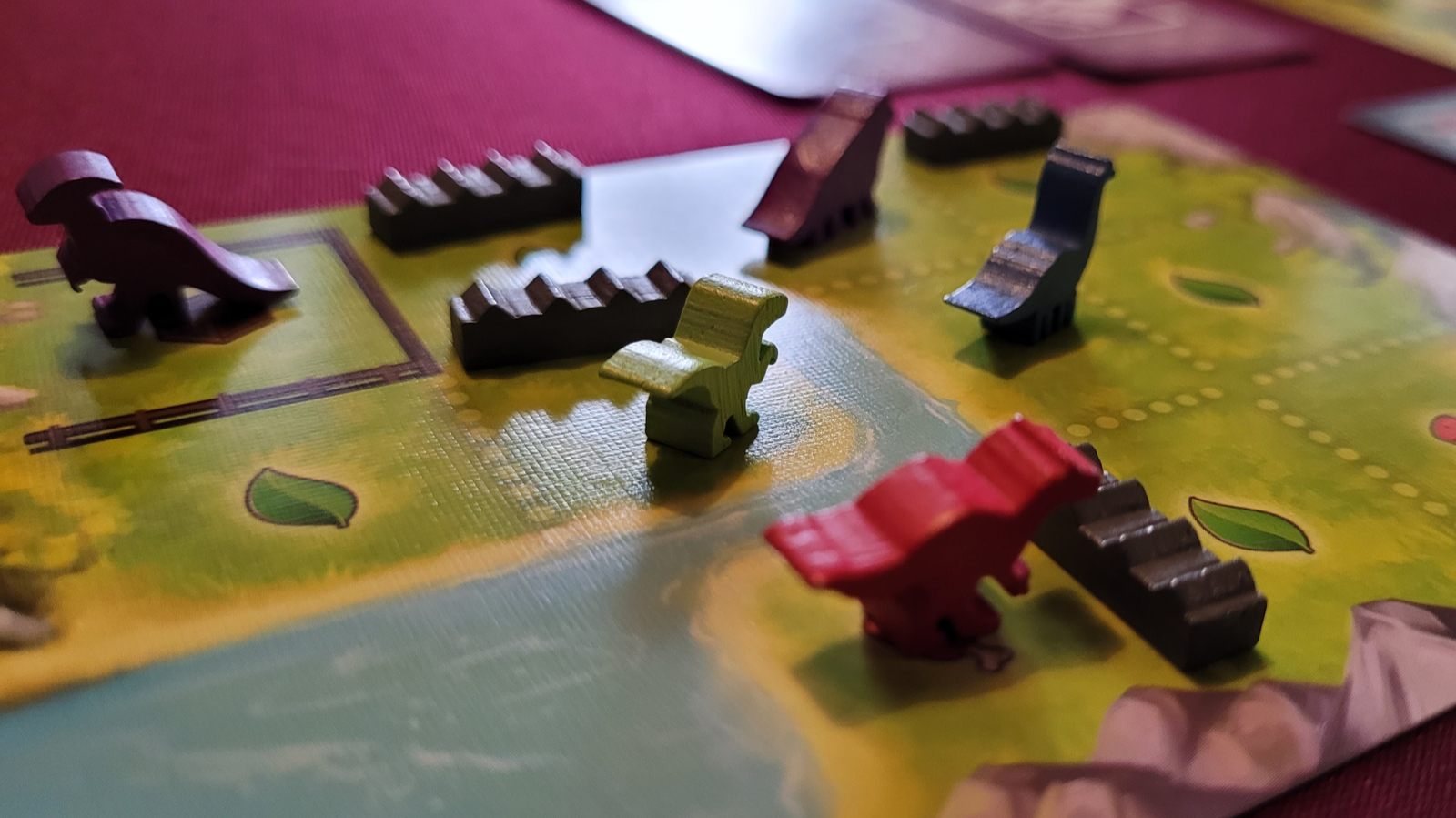
Tiny Epic Dinosaurs: because you can never have too many dinosaur cloning games...

It took a little convincing for me to pick up Tiny Epic Dinosaurs. I already have two dinosaur-themed worker placement games that I like quite a bit (Dinosaur Island and Dinogenics), and I didn't enjoy the last Tiny Epic game I bought, Tiny Epic Mechs -- I thought it was overly gimmicky and possibly a signal that the series had jumped the shark. But, my affection for dinosaur-shaped meeples won out, and I ended up buying Tiny Epic Dinosaurs after all.

It's definitely a triumphant return to form for the normally very clever Tiny Epic series. Unlike most of the other games in this oddly crowded sub-genre, this one isn't about building a dinosaur zoo. Thematically it's about catching and breeding the animals and then selling them off, so it could just as easily be based on the 1962 John Wayne classic Hatari!, although that game might have a harder time finding an audience.

The worker placement mechanisms are straightforward and easy to understand, but still offer meaningful decisions as you agonize over what type of dinosaur to try to breed first, or struggle to to have enough food and space on your ranch for your expanding population. An interesting wrinkle that I haven't seen in other games of this type is that your resource collection is based on how many empty spaces you have on your ranch board, so the more dinosaurs you have standing around, the fewer units of food you're going to collect each turn. This makes the game a balancing act between saving up larger groups of dinosaurs for a better payday, or going for a quicker trade-in that might be worth fewer points but clears much needed space.

One of the main selling points of the Tiny Epic games is their compactness, and that is definitely true here -- this is a lot of game for how little space it takes up on the table. We recently played Tiny Epic Dinosaurs and Dinogenics back-to-back, and it was a little difficult to justify the fact that Dinogenics takes up easily ten times as much space for what amounts to a very similar game experience. However, I did find myself wishing that the Tiny Epic Dinosaurs components were maybe 25% larger than they are, especially the tiny print on the tiny cards that my aging eyes are starting to struggle with.

Rating: 5 (out of 5) This is easily my second favorite in the Tiny Epic series (after Tiny Epic Western), and the relatively low price point and shelf footprint make it easy to add to any game collection.

Tuesday, January 10, 2023

Tapestry: three games in one

Tapestry, designed by the prolific Jamey Stegmeier (whose game reviews and cat pictures always seem to be at the top of the feed whenever I open Instagram) caught my attention due to its beautiful cover art and nifty fully painted plastic buildings. I took a chance on it without really reading any reviews, so imagine my relief when it turned out to be a solid, engaging game. Actually, three solid, engaging games that feed into each other in interesting ways.

First, you have a variation on worker placement, where you spend resources to progress along four tracks representing aspects of civilization such as science, technology and warfare. The farther you move on each track, the more expensive each movement becomes, so a key decision point is whether you want to focus on moving as far as possible along one or two tracks, or move along all of them evenly, which gets you more but smaller rewards.

Several spots along these tracks reward you with either small income buildings or larger monuments (the aforementioned nifty prepainted miniatures), which you then place on a 9x9 grid representing your capital city. It has certain squares pre-filled, and the goal is to fill up your city as efficiently as possible, with rewards of additional resources when you fill up a 3x3 portion of the grid, or an entire row or column. These resources are then used to move you along the civilization tracks described above.

Additionally, the center of the board is occupied by a hex map representing the unexplored land around your city, which is used for exploration and conquest. As you move along the exploration track, you draw tiles and add them to the center map, with each new tile giving you a one-time resource gain. As if that weren't enough, when you progress on the warfare track you can conquer previously explored tiles, with each conquest giving you resources or points, and also the chance to slow down your opponents' progress.

It can sometimes seem like you're playing three separate minigames, except that they feed into each other to such an extent that you can't really afford to focus too much one one or the other (with the possible exception of conquest, which does provide a good way to gain points and resources but doesn't really directly affect the other two aspects of the game.

To add even more variety, each player starts with a specific civilization style such as alchemists, entertainers, or craftsmen (to name just a few), which gives a unique ability or benefit. On top of that, at various points in the game you play a new tapestry card, which gives you additional benefits and can help steer you towards a particular strategy. This is particularly helpful as the game gives you a lot of options for what to do with your turn, and can sometimes trigger the dreaded analysis paralysis.

The game may seem complicated but it runs very smoothly, with only four pages of rules, and graphics on the board and cards that serve as great reminders once you get the iconography down. We have found that after a couple of plays we rarely need to look anything up in the rulebook or online -- the game does a great job of explaining itself.

Of course the full color buildings especially stand out, but all the components are bright, colorful, and extremely well made, with some really nice artwork on the cards and tiles.

Rating: 5 (out of 5)Tapestry is one of those rare gems, a game that is both simple and complex, easy to play but with a lot of variation and replayability.

Thursday, April 9, 2020

Paladins of the West Kingdom: complexity escalation

New Zealand designer/publisher Shem Phillips has made a career out of creating a series of worker placement games that manage to be both familiar and different. With each game he comes up with a new take on the genre, whether it's Raiders of the North Sea's focus on using a combination of empty and occupied spaces, or Architects of the West Kingdom's lack of a traditional round structure. However, clever as he is, his games are beginning to fall victim to what's known in collectible games as power creep.

In collectible games such as Magic: the Gathering or Heroclix, the business model relies on enticing players to keep buying more product, rather than them buying just a single game. In an effort to keep players interested (and buying), the designers of such games have in the past felt compelled to make new cards more powerful and complicated. This may have proved effective in the short term (at least, it did in the heady CCG days of the 1990s and early 2000s), but in the long term the added levels of complexity usually end up creating a barrier to new players that's far more detrimental than having older players get bored and move on.

Board games that have followed a similar model of using frequent expansions to sustain interest from an existing player base have fallen victim to a similar problem, where the crushing weight of increasingly complicated expansions makes the games unplayable (I'm looking at you, Arkham Horror). This isn't the exact problem with Shem Phillips' games, but it is similar, as he appears to be increasingly relying on his existing fan base (via Kickstarter) as the main audience for his new games, and so he feels the need to ramp up the scale on each new game.
All of which brings us to Paladins of the West Kingdom, the second in the West Kingdom series and the fifth in Phillips' overall series of medieval-themed games. Like his others, this one starts with a basic worker placement mechanic, and then builds on it with an unusual series of innovations. Rather than giving each player a finite set of workers, Paladins instead has different types of workers (warriors, priests, laborers, and so on), and players draft different combinations of them at the beginning of every turn. Game play then involves choosing from a dizzying array of options, so many that a key component of the game's strategy is to decide what you're going to do and stick to it -- the worst thing a player can do in this game is try to do a little of everything, because the scoring system is focused on doing a lot of the same thing.

It's an interesting game with a lot of options, and it's different from any of Phillips' other games while still being familiar thanks to the consistent illustration and graphic design across the whole series. And that's really kind of the problem. In his rush to avoid repeating himself, he's created a game with just a little too much going on. There is a lot to keep track of in this game, from building garrisons to sending out missionaries to hiring townsfolk (with two different options for each) to choosing whether to fight outsiders for a one-time benefit, or convert them for an extra end-game victory point condition. It's just a little too much, especially when compared to the other games from this designer.
We play (and enjoy) Raiders of the North Sea and Architects of the West Kingdom quite a bit, and we find that both games (even Raiders with two expansions) offer just as much depth and entertainment value, with a much lower level of complexity. In short, they're just as fun but a lot easier to play.

Rating: 3 (out of 5) an interesting game design, but a little too complicated when compared to this designer's other games.

Friday, December 6, 2019

DinoGenics: there's a dinosaur cloning game for everyone

Crowdfunding, pre-orders and limited print runs are rapidly becoming the standard for game publishing, and it is because of this that I had to decide whether I wanted DinoGenics before I was able to play Dinosaur Island. Based only on information from their respective crowdfunding campaigns the two games look very similar, and honestly, how many dinosaur cloning games does one person need?

If I'd been looking at both games at the same time I most likely would have only chosen one, and that one would have been DinoGenics, based on its more conventional illustrations and graphic design -- the obnoxious look of Dinosaur Island remains one of the few things I don't like about the game. Unfortunately (or perhaps fortunately) I had to make a decision on DinoGenics after I had committed to buying Dinosaur Island, so I ended up with copies of both games. In the end I'm glad I did.

The two games are similar in that they are both worker placement games about building a zoo filled with cloned dinosaurs, but that's where the similarity ends. DinoGenics is a much more traditional worker placement game, with players competing for spaces on the board so they can get the resources they need to clone dinosaurs, build appropriate enclosures for them, and add enough support buildings to accommodate an increasing number of guests. And don't forget to feed those carnivores, or they'll break out of their enclosures and you'll likely spend a lot of your next turn making repairs...

The game design is solid if not overly innovative, but where DinoGenics really shines in in the quality of its components. The graphic design is excellent and does a much better job of evoking Jurassic Park than the much more stylized Dinosaur Island. The meeples are wood rather than plastic (in my opinion plastic meeples are a disturbing trend in game publishing and a scourge upon mankind), done in very nice greens, browns and greys that make it easy to tell the different types of dinosaurs apart. The cards and tiles are sturdy with high quality printing -- the only thing I don't like is that some of the text on the building tiles is very small and difficult to read.

If I had to choose between DinoGenics and Dinosaur Island, I would probably choose DinoGenics, although I do think the game play in Dinosaur Island is a bit more innovative. In the end the games are different enough that I'm happy to have both in my collection.

Rating: 5 (out of 5) This game features more traditional worker placement style game play than its competitor, but the much more lavish graphic design more than makes up for it.

Thursday, December 5, 2019

Into the tiny with Tiny Epic Galaxies

Tiny Epic Galaxies delivers on its promise: it has the feel of an epic exploration game, but it comes in a small box and doesn't take all day to play. Now, don't get me wrong, it isn't Xia or Star Wars Rebellion, but it still creates a sense of mighty space empires growing stronger as they explore and conquer new territory.

It's a dice placement game, a growing sub-genre of worker placement where players roll dice to determine what actions they can do in a given round. The actions here are moving a space ship between planets, acquiring one of the game's two resources (energy or culture), using either diplomacy or economy to advance colonization efforts on a planet, or utilizing an established colony's special ability for a game effect.

Players start with 4 dice and two space ships, and compete to exploit the resources of a row of planet cards at the center of the table. Landing on a planet conveys a one-time use of that planet's special ability. Orbiting the planet and taking the time to colonize it takes longer but adds the planet to your pool of colonies, meaning only you may use its special ability. Additionally, each planet provides either energy or culture, so spreading out your ships to take the best advantage of the acquire resource action is critical to having the resources you need to upgrade your empire, which gets you more ships and dice to use on later turns.

As with all the games in the Tiny Epic series, this one doesn't really offer anything truly original, but that's not the point. The accomplishment is that it offers something similar to what you normally only get from much larger and more time-consuming games. The amount of game that designer Scott Almes is able to get out of a minimum of components is astonishing.

Rating: 4 (out of 5) There's a lot more going on in this game than can be expected from a 5" x 7" box, that's for sure.

Monday, December 2, 2019

Architects of the West Kingdom: idle meeples are the devil's tool

There are a ridiculous number of worker placement games out there, so it's unusual when one comes along that has something innovative about it.

Most worker placement games follow the same basic pattern: players are given a number of workers (usually four or five) and take turns placing them on spots on the board that give the player game advantages or resources. Once every player has placed all their workers, the board is cleared, the workers are reclaimed, and a new round of placement begins.

Architects of the West Kingdom, designed by Shem Phillips (of Raiders of the North Sea fame) does things a little differently. While unmistakably a worker placement game, with a lot of the same game elements (placing workers to achieve game effects), Architects does away with the round structure, instead making reclaiming workers one of the available actions in the game.

It may seem like a small thing, but its a huge shift in the way worker placement games are played. In addition to the normal concerns of gathering resources and spending them to put building cards into play, players must now look at their available pool of workers, and when it's the best time to either reclaim their workers from the board, or from the prison space where they can sometimes end up.

The prison space helps the players cultivate a sense of urgency. Various game effects will send your workers to prison, and at certain points during the game, whoever has the most imprisoned workers has to take a debt card, which causes point loss if it isn't paid off by the end of the game.

This brings us to the other interesting thing about Architects: the idea of virtue. The game board includes a virtue track that players will move up and down on, depending on their actions during the game. Being low on the virtue track has certain advantages (such as not having to pay taxes, which makes a lot of the in-game purchases cheaper), but also causes a loss of points at the end of the game. So manipulating your position on the track to your best advantages adds another strategic layer of the game.

It's a terrific game with a lot going on in spite of the relatively simple rules, with several different paths to victory and quite a bit more interaction between players than you normally see in games of this type.

Rating: 5 (out of 5) Shem Phillips knocks it out of the park again. Anyone who likes worker placement games should love this one.

Friday, February 22, 2019

Covert: it's a spy world after all


There are good reasons why the Cold War (the period between the end of WWII and the fall of the Soviet Union in 1991) is such a compelling genre for stories and games. The massive distrust between America and Russia combined with a fear of all-out war, plus the rapidly advancing but still largely analog stealth and surveillance technology made it a unique time in world history, both thrilling and terrifying.

Covert, designed by Kane Klenko and published by Renegade Game Studios, does a good job of evoking the cold war with what on first glance seems to be a disparate group of game mechanics. The goal of the game is to collect sets of cards representing spy gear like listening devices, travel documents and hidden escape kits, and then turn those cards in for points, but as usual there's a bit more to it than that. The sets players are going for are determined by mission cards that will sometimes also include the need to have a pawn in a particular spot on the board.

Movement around the board is also one of the principal ways of gaining more cards, either by having a pawn in a certain part of the board when it's time to draw cards, or by following other players around and collecting clue tokens that they leave behind as the move from city to city on a board representing Europe during the Cold War.

But that's not even the most interesting part of the game. Player actions are determined by a dice placement system where at the start of each round, each player rolls 5 dice and uses them to determine what of 6 possible actions they'll be able to do that turn. The first player to choose a particular action can do so freely by placing a die showing any number on that part of the board, but the next player who wants to be able to do the same action has to place a die that comes either before or after the dice that are always there. For example, if your opponent plays a 2 on the "draw a card" action, you have to play either a 1 or a 3 in order to also do that action.

If the numbers just aren't cooperating and there's nowhere on the board you can play, you can spend a die to draw a random token that gives you a one-time special ability, such as being able to switch the number on a die or play two in a row. You can also just end your turn early, which guarantees that you'll get to go first on the next turn.

On top of all that, there's a code-breaking phase consisting of two rows of random numbers, and a deck of equipment cards with 3-digit codes on them. If you can manipulate the numbers so that any 3 of them match the code on your card, you can either use that card as part of a set of equipment (the main way of scoring points), or cash it in for bonus points at the end of the game.

Covert is be complex without being complicated, and it manages to make all of its different abstract game mechanics work together well, and also feel like they're intrinsic to the theme. When I play this game I really feel like I'm getting a sense of what it must have been like for those Cold War spymasters, managing tons of moving parts, manipulating events to work out in their favor, and taking advantage of situations they might not have control over.

Rating: 4 (out of 5) A very entertaining game that combines theme and mechanics well.

Thursday, December 6, 2018

Building a better dinosaur with Dinosaur Island


Dinosaur Island is almost exactly the game I wanted it to be. I really like engine-building games, where the goal is to use the game's options to build up a point-generating mechanism. This game lets you do just that, offering meaningful and thematic choices in the process: do I focus on tons of different dinosaurs, or do I balance them with other attractions like carnival rides and snack shops? Do I play it slow and safe with plenty of security, or do I allow the occasional dinosaur to escape its pen and eat a visitor or two, hoping to mitigate the damage later?

The game structure is complex but not complicated; I find that we rarely need to consult the rules while playing, which to me is a sign of a well-designed game. Each turn is broken up into four phases: in the first, dice are rolled to determine which DNA strands are available for the turn, then players go through a few rounds of worker placement, deciding whether to research new DNA, increase DNA storage so more can be stockpiled, or grab dinosaur "recipes" in order to create animals for their parks.

Next comes a buying phase, where players spend their cash on equipment upgrades, staff specialists, and secondary park attractions such as restaurants and gift shops. After that is the game's main worker placement phase, where players clone new dinosaurs, build larger habitats for them, increase security, and gather investment capital.


Finally comes the park phase, which is a delicate balancing act of attracting visitors and making sure they all have something to do in the park. Each dinosaur has an excitement value, which determines how many visitors line up outside your park. You gain income from all these visitors, but you only get points for the ones that find something to do in the park, whether it is actually looking at a live dinosaur, or thrilling to carnival rides with amusing names like "Jurassic Whirled."

Some dinosaurs (generally the large, carnivorous ones) are more exciting than others, so if you have a lot of these you will find yourself with more visitors than you have space (which is why you need thrill-rides and gift shops). Additionally, the visitors are drawn randomly out of a bag, which contains a number of "hooligans" who don't pay admission and take up valuable space in your park. And if you don't have enough security, dinosaurs will escape and eat your paying customers, which loses you points.

Event cards provide different global game effects, and the conditions that end the game are drawn randomly as well, so no two games are much alike. Even frequent players are forced to try out different strategies depending on what the global effects and end conditions are, and what resources are available from turn to turn,

You may notice that at the beginning of this review I stated "almost exactly the game I wanted it to be." My only quibble with Dinosaur Island (and it is a minor quibble at that) is the obnoxious graphic design. It's intended to evoke the early 1990s when Jurassic Park was first released, but I find all the pink and yellow just a little bit off-putting. Not enough to stop me from enjoying the game though.

Rating: 5 (out of 5) A terrific game with a lot of meaningful decisions to make, and a ton of replay value. And I guess the graphics aren't that bad...

Monday, January 29, 2018

Viking roundup, part 2: Champions of Midgard

Continuing our look at the weirdly large number of viking games we've acquired recently.


Champions of Midgard is a viking themed worker placement game, which means we can't help but compare it to Raiders of the North Sea, especially since we picked up both games within a few months of each other. Apart from the obvious similarities, however, the two games couldn't be more different.

For the most part, Champions is a more traditional worker placement game. Each player gets a set number of workers, which they use to compete over common spaces on the board. Spaces are a mixture of resource gathering and opportunities to fight monsters such as trolls, giants, draughr, and dragons, which is the primary way to score victory points. Players use their workers to recruit warriors (represented by dice) and supplies which are needed to travel to far off monster-infested lands.

An interesting wrinkle on the "use resources to fulfill quests" theme is blame, a currency in the game that subtracts from a player's score. One of the spaces on the board is the Troll, and the player who successfully fights the Troll each round gets to give a blame token to another player, and get rid of one of his own if he has one. If no one fights the Troll, every player gets a blame token. Blame tokens are worth negative points at the end of the game in a somewhat exponential manner: one blame is -1 point, 2 is -3 points, 3 is -6, 4 is -10, and so on, so managing blame becomes a critical part of the game's strategy.

Warriors are represented by dice which are rolled to combat monsters. The different types of warriors are not necessarily better or worse than each other; sword- and spearmen provide some defense, allowing you to play it safe, while axemen tend to do more damage but provide no defense, meaning that more of your warriors will be killed in combat.

There's a fair amount of variety as far as what you can choose to focus on in the game, and this is guided to some extend by Destiny cards, which grant extra points at the end of the game for accomplishing goals such as having killed the most of a particular type of monster, or having the most gold or food left over at the end of the game.

It's a little more involved than Raiders of the North Sea, and a lot more fantastical, to the point that I think it has more in common with Lords of Waterdeep than any of the more historical viking games like the North Sea series. It is definitely sufficiently different that we play both games fairly often, sometimes even in the same weekend.

Rating: 5 (out of 5) A good mix of worker placement and dice rolling, with a fun theme and some neat twists you won't find in other games of this type.

Wednesday, December 20, 2017

Viking roundup, part 1: Raiders of the North Sea

I'm not really sure why Vikings are so popular lately. Likely it has something to do with the success of the Lord of the Rings films and the Game of Thrones television series: swords and armor are at the front of the public consciousness, and the historical Viking era provides a ready-made setting without any accompanying copyright issues. Let's take a look at the inordinately large number of Viking games that have made their way into our game library over the past year.


Raiders of the North Sea is an entertaining and great-looking worker-placement game. It's part of New Zealand designer Shem Phillips' North Sea series, which also includes Shipwrights of the North Sea and Explorers of the North Sea. I'm not sure what order the series was originally published in, but Raiders looked like the most interesting of the three so that's the one we picked up first.

Most worker-placement games give players a set number of workers, which are then placed on various spaces on the board in order to gather the resources needed to accomplish the game's goals. Raiders does something a little different: each player starts with one worker, and a normal turn consists of placing that worker on an available space (activating it to gain whatever resource it provides), and then picking up a worker from an occupied space, activating that space as well. So rather than just competing with the other players for available spaces, your second move is limited to spaces that other players have played on. It's a unique twist on the worker-placement game mechanic that I don't think I've seen in any other game.

The second part of the game involves raiding settlements. Part of the board is divided up into areas of varying difficulty, each containing a random assortment of plunder such as gold, iron and livestock. Raiding the more distant settlements requires more resources and larger crews, but they also give more victory points. Raiding also continues the "place one worker, then pick one up" game mechanic -- you still have to place a worker in order to raid, but part of your reward is a more advanced worker (in a different color) that gives you access to different resources and allows you to raid the more distant and lucrative settlements.

It's a relatively simple but quite ingenious game. It gives players a fair amount to think about, but the rules are quite simple. Additionally, the game play is fairly non-confrontational and so should appeal to less competitive players.

The engaging game play is helped along by some truly spectacular artwork by Mihajlo Dimitrievski, as well as top-notch graphic design by the game's designer, Shem Phillips.


Rating: 5 (out of 5) a game that's easy to play but still challenging, with stunning graphics and high-quality components.

Monday, October 23, 2017

Send lawyers, guns and money: Tiny Epic Western


At its core, Tiny Epic Western is a game about controlling commercial real estate in the wild west.

The game consists of six mats placed in a circle, with locations on each that offer different resources or game abilities. Players use worker placement to secure those locations to secure the resources they need, either money, law, or force (or lawyers, guns and money for you Warren Zevon fans). These resources are used in different combinations to buy building cards from an available pool, which then give victory points as well as additional locations that can be used on future turns. Play goes for six turns, at which time the winner is the player with the most victory points.

That may not sound particularly wild or western, but if you think about it, the struggle in the American West was entirely about controlling land - land for farming and settlement, land for mining gold and silver, land for building towns to exploit the new found wealth of the people mining the gold and silver, land to build railroad tracks, and so on. The famous gunfight in Tombstone was the result of a power struggle between two factions trying to control the town, and the range war that Billy the Kid found himself involved in was started by two competing mercantile companies. So really, nothing could be more wild western than fighting over who controls the general store or the post office.

In order to convey the sense of struggle and lawlessness, Tiny Epic Western adds some very clever game play to the standard worker placement game model. In most worker placement games, you place your worker to either get a particular game effect (usually a resource of some kind), or to prevent your opponent from getting it. Tiny Epic Western does that too, but many of the spaces on the board only give a reward if the player wins a hand of three-card poker, either against the other players who have placed their workers on the same mat, or against a non-player rival.


The way the poker works is particularly interesting. As already mentioned, the main play area is made up of six mats placed in a circle. In between each mat there is a poker card drawn from an abbreviated deck made up of cards numbered one through five in four suits. At the start of each round, players are dealt a "hole card" from the deck, and after all workers are placed, they must play a round of poker against the other players who have workers on the same mat, using their own card and the cards on either side of the mat to make the best poker hand they can. The winner earns an overall reward, and additionally many of the spaces on the mat only pay out to the poker winner.

To prevent a player from winning simply by virtue of being the only player on a particular mat, there is a non-player "rival," a card which is dealt face down at the start of each round and revealed to provide an opponent when no other players are fighting for control of that particular mat.

It's very thematic, and it adds an air of strategy and uncertainty to worker placement, when in most games the advantage always goes to the player who places first.

As if that weren't enough, it's also possible to duel other players for placement in a particular space. If another player's worker is in the space you want, you can challenge him to a duel, which involves rolling dice, spending resources for re-rolls, and possibly using your hole card to give you an extra advantage. The winner of the duel gets control of the space, and also gets the "wanted" card, which provides extra resources, and is also worth victory points to whoever is holding it at the end of the game.

The game is tense, exciting, involves a lot of strategic decision making, and the only real random element is the dice-rolling during gunfights. It's very engaging, and the western theme is fully integrated rather than just painted on. Not bad for a game about real estate...

Rating: 5 (out of 5) It's everything it says on the box: an epic power struggle of a game with a strong western feel, and it comes in a very small box.