Showing posts with label animals. Show all posts

Tuesday, July 29, 2025

Get all the animals living together happily in Harmonies

Harmonies is one of those rare games that lives up to the phrase "deceptively simple." Placing tiles on your board to match the patterns shown on your cards sounds simple enough, but this game uses its theme, the idea that an ecosystem is a balance of interlocking pieces, to give players a bit more to think about when they're selecting and placing their tiles.

A game of Harmonies starts with five sets of three random tiles in the center of the table. Each player has their own small board, a grid made up of hexagonal spaces in either a 5x5 or a 4x7 pattern. There is a spread of four cards with absolutely stunning artwork by Maëva da Silva, depicting a range of animals from penguins to meerkats. Each card shows a specific pattern of tiles needed in order to place a cube representing that animal. The patterns will usually involve placing two or more tiles of different colors (representing terrain such as mountains, grasslands or water), but the cube only occupies one of those tile spaces -- there can only be one cube placed on a tile, but patterns that use the same colors can intersect, neatly demonstrating how different animals share the ecosystem they live in.

Players take turns, first choosing a set of three tiles to place, and then choosing a card from the spread. Each player can only hold a maximum of 4 cards at a time, so you have to be careful to pick cards with patterns that complement what you already have in play. Each card comes with between two and five cubes, to be placed each time the player manages to form that card’s pattern on their board. The more times a player is able to create the card’s tile pattern, the more points the card is worth, and when all the card’s cubes are placed, the card is moved to a separate victory pile, making room for a new card.

There is a lot to think about over the course of the game. You want to choose complimentary animal cards, but that doesn’t necessarily mean cards that use the same types of tiles – you also have to look at which tile in the card’s pattern the animal cube needs to occupy, so you can try to place the most cubes using the fewest tiles.

When choosing tiles, there are five sets of three random tiles to choose from. The catch is that a player must place all three tiles on their board right away, so there is a lot of anticipating where to place the tiles that you don’t need right now so that they’ll be useful on a future turn.

At the end of the game, players score based not only on their animal cards, but also on the type, quantity and patterns of the tiles they’ve played. Mountains score more if they’re connected in a range, and also if the tiles have been stacked to form higher mountains. Trees score based on their height, and rivers based on their length. Players have a lot of options for how they want to play: go for long rivers or high mountains, and seek out animals that will fit in those environments, or look for combinations of animals that can be placed as densely as possible.

Harmonies is very similar to Habitats in theme, look, and game play (although the artwork in Harmonies is definitely nicer), but I think they’re different enough that I won’t mind hanging on to both games. Habitats makes more of a game out of how the tiles are selected, where Harmonies is more about planning for how you play the tiles in order to maximize their position on the board. On balance I find Habitats to be a little more mechanically interesting, but Harmonies is just more delightful in terms of the artwork and overall attractiveness of the components.

Rating: 5 (out of 5) Whenever I finish a game of Harmonies I almost always want to play it again. Everything about the game is just pleasing, from the gorgeous artwork to the simple but high-quality wooden tiles.

Thursday, October 10, 2024

Chomp! A game about herding dinosaurs

Why do dinosaurs seem to have such an enduring appeal? I think it’s the idea that, once upon a time, there was a world teeming with thousands of varieties of fantastical, dragon-like creatures, untouched by human mediocrity. And that world wasn’t dreamed up by a novelist or game designer. It was real, at least as far as the reasonably dependable science of paleontology can tell us.

I’m not sure if Chomp, a small box tile laying game published last year by AllPlay, quite captures the majesty of prehistory, but it is a pretty fun little game.

The game consists of 36 double-sided tiles, plus a handful of tokens and a lovely dry-erase board (pen included!) for keeping score. The tiles depict herds of carnivorous or herbivorous dinosaurs in different sizes, lush vegetation, nests, watering holes, and tar pits in various combinations of two, three or four shapes. Sometimes the different elements on a tile are separated by mountains, sometimes not. The idea is to draw and place tiles in order to form larger herds of same sized dinosaurs, making sure they are adjacent to food sources – vegetation for the herbivores and watering holes populated by unwitting prey for the carnivores. But you have to keep an eye out for tar pits, as they are certain doom for your dinosaur herds.

It’s the tile placement that’s particularly interesting in this game. Tiles can be placed overlapping other tiles, as long as the grid is maintained and individual elements are completely covered. This means you can pivot your strategy more easily than in most traditional tile-laying games, perhaps placing a tile that’s good but not ideal in the hopes of covering up some or all of it later in the game. 

On the reverse side of each tile is a bonus scoring condition, granting extra end-of-game points for things like having the most of a particular size of dinosaur, or even having the most uncovered tar pits among your tiles. At the start of each player’s turn there will be three face up and three face down tiles to choose from. Players can choose either on their turn, balancing the need for more layout tiles with the ability to score extra bonus points.

The game goes for eight rounds, after which each player has to check each of their herds to see if they are made extinct by an adjacent tar pit. Remaining herds must then be fed from an adjacent food source, with carnivores eating herbivore herds if no other prey is available. All adjacent dinosaurs of the same size and type, no matter how many, count as one herd. Each herd only requires one adjacent food source, so the challenge is to maximize the tile placement for large herds to take advantage of a single source of food. The bonus tiles provide some guidance for which types of dinosaur herds to go for and how best to try to lay out your tiles.

Any herds who can’t eat are made extinct, after which all the surviving dinosaurs are counted up for points. Larger dinosaurs count for more points than smaller ones, but also take up more space on their tiles and so are theoretically more difficult to place efficiently.

Rating: 4 (out of 5) Like most tile-laying games, Chomp has a fun puzzle-like quality to it, and I really like the idea that you can cover up some or all of your previously placed tiles if your strategy is moving in a new direction.

Monday, July 22, 2024

Habitats, a game about good animals making good neighbors

I'm not overly interested in computer or video games, but every once in a while one comes along that catches my interest. In the early 2000s I was quite fond of Zoo Tycoon, a zoo-building game that covered everything from building well-balanced enclosures to managing crowds and balancing income and expenses. My favorite part of the game was building enclosures for the animals; you had to balance different kinds of terrain, topography, and just the right type and amount of trees and bushes to keep the animals happy.

Zoo Tycoon board game came out last year, but I found it to be a little too fiddly and complicated to be enjoyable. I started looking around for another game that would scratch the same itch. Ark Nova is a great zoo game and includes some of the building element that I enjoyed in the Zoo Tycoon computer game, as do Dinosaur Island and DinoGenics, although they are more focused on cloning dinosaurs and stopping them from eating your park visitors.

I recently stumbled across Habitats, a game from a small publisher based in the Netherlands that has since been reprinted in the United States. And I must say, it is exactly the game I wanted.

In Habitats, you're managing a nature preserve rather than a zoo, so the thematic goal is entirely to create an environment that your animals will be . It's a tile-laying game with one really interesting innovation: the way each player picks up new tiles to play. The game starts with a grid of tiles in the center. Each player has a jeep meeple ("jeeple" just seems too precious) that moves around the grid, one tile at a time. On your turn, you can choose a tile that is ahead or to the left or right of your jeep. After choosing a tile you move your jeep into the tile's space, and then place a new tile in happy withthe space you just vacated. It means that you have a choice of three tiles to pick from each turn, but it also adds a lot of interesting strategic decision-making to the game. There might be a tile you really want that you need to move through a few less desirable tiles to get to, or you might be racing to a particular tile in order to get there ahead of your opponent.

Most of the tiles represent both an animal in search of a suitable habitat, and a type of terrain that adjacent animals might want. Tiles are played in a grid pattern in each player's tableaux. An animal tile will indicate one or more types of terrain, either water, desert, grassland, or forest, that need to be on adjacent tiles in order for that animal to be happy and score points at the end of the game. Other tiles represent watchtowers that score based on the tiles in various patterns around them; tourists that score depending on how your different terrain is grouped; and gates and campsites that earn points depending on how many tiles they are adjacent to.

The game becomes a puzzle-like exercise where you want to place your tiles so that adjacent animals can make use of each other's terrain as much as possible, and multiple animals can benefit from the same groupings of terrain. In addition to scoring your tiles at the end, the game is split up into three "years" composed of a number of turns (depending on the number of players), with two goals for each year that will award additional points to whoever fulfills them most completely. They are things like the most sets of different types of terrain or the longest unbroken line of tiles, and they give you something else to work for as you decide how to place your tiles.

An optional extra, available from the publisher's website, is a set of animal meeples that can be used to indicate when an animal tile has reached the conditions it needs to score points. They are entirely unnecessary (the base game comes with simple tokens for this purpose) but add to the tactile quality of the game and make it look that much more impressive on the table.

It's not a terribly complex game (the rules for the U. S. edition published by Allplay clock in at 4 pages), but it is very engrossing, giving you a lot to think about as you play but also requiring you to think on your feet and not get too attached to any one strategy or tactic. It's not quite Zoo Tycoon, but it definitely fills the same void, and in many ways it's more enjoyable.

Rating: 5 (out of 5) The highest praise I can give a game is that as soon as I'm done playing I want to play again, and that is definitely true with this one.

Tuesday, March 21, 2023

Ark Nova: the race to build a better zoo

Ark Nova is an extremely well-designed game that elegantly combines several different game mechanisms and successfully straddles the line between being complex and being just complicated. The zookeeping theme stresses the importance of balancing research and conservation with commercial appeal, and the game has the potential to be a great gateway game à la Settlers of Catan or Pandemic...except that it's saddled with a somewhat high price tag and an overwritten, poorly organized rule book, making the game a little difficult to learn for all but the most experienced tabletop gamers. But it's an excellent game otherwise, well worth it if you can make it through your first few games.

The core mechanism is relatively straightforward. You have a row of 5 cards in front of you, each occupying a space numbered one through 5 and representing an action you can take in the game: build structures such as animal enclosures or kiosks, play animal cards from your hand, use worker placement to claim partnerships with zoos and universities or contribute to conservation efforts, play sponsor cards for immediate or ongoing benefits, or draw cards from the deck. The position of the action card in the row determines how effective it is, and once you've used an action it moves back to the "1" position, causing all the other action cards to move up one spot. Right away you have a wealth of meaningful, strategic choices to make: do you take the lesser action now, or wait until its card has moved and you'll get more out of it? If you need an action to move up in the row, you need to play the actions that are in front of it, even if they don't benefit you right now. The interplay of the different actions and positions is fascinating.

Along the way, certain actions will cause a charming little coffee cup marker to move along what is called the break track. When it gets to the end, an end of round reset occurs, where players retrieve their spent workers, gain income from their zoo's appeal value,  refill their hands of cards, and reset the row of available cards to draw. A key part of the game is the attempt to control when this happens, or at the very least to position yourself so that you're ready to take advantage when it does.

The point of building enclosures, placing animals, supporting conservation efforts, and soliciting sponsors is, of course, to earn the victory points you need to win the game. Players need to make progress along three tracks: appeal, conservation, and reputation. Appeal represents how exciting your zoo is, and determines how much money you get to spend (mainly on building structures for your zoo). Conservation measures how much your efforts are supporting animal preservation; moving along this track gives you access to bonuses such as extra workers and better versions of your action cards. Reputation shows your standing in the scientific community, with more gameplay benefits and also access to a wider range of animal cards. Creating synergy with what animals and structures you place, how you lay out your zoo, what partnerships you go after and what conservation projects you support will gain you points on the various tracks, but there's a catch...

The conservation and appeal points are on the opposite ends of a single track, and the trick to getting a good score is to make sure your conservation keeps up with your appeal. The game ends once a player's markers pass each other (meaning that their conservation and appeal values are roughly equal). After this point, all the other players get one final turn, a mad scramble to finish whatever they are trying to do to maximize their scores, and if they find that they've spent too much game time on increasing their appeal and not enough on conservation, they risk ending up with a low (possibly even a negative) score.

It seems like a lot, and as I mentioned, the rule book doesn't explain it very well, but it really is a smooth system of interlocking game mechanisms, and once you've played a few times everything does kind of lock into place. The best thing to keep in mind while playing is that while it looks like an engine-building game, where you're trying to get just the right combination of elements into play, it's actually a race to see who can get their conservation value to pass their appeal value first. So it's best not to focus on waiting for that perfect card, but rather to just do the best you can with what you have in front of you at the moment.

Rating: 4 (out of 5) A really good game that stops just short of being a great one.

Tuesday, January 17, 2023

Tiny Epic Dinosaurs: because you can never have too many dinosaur cloning games...

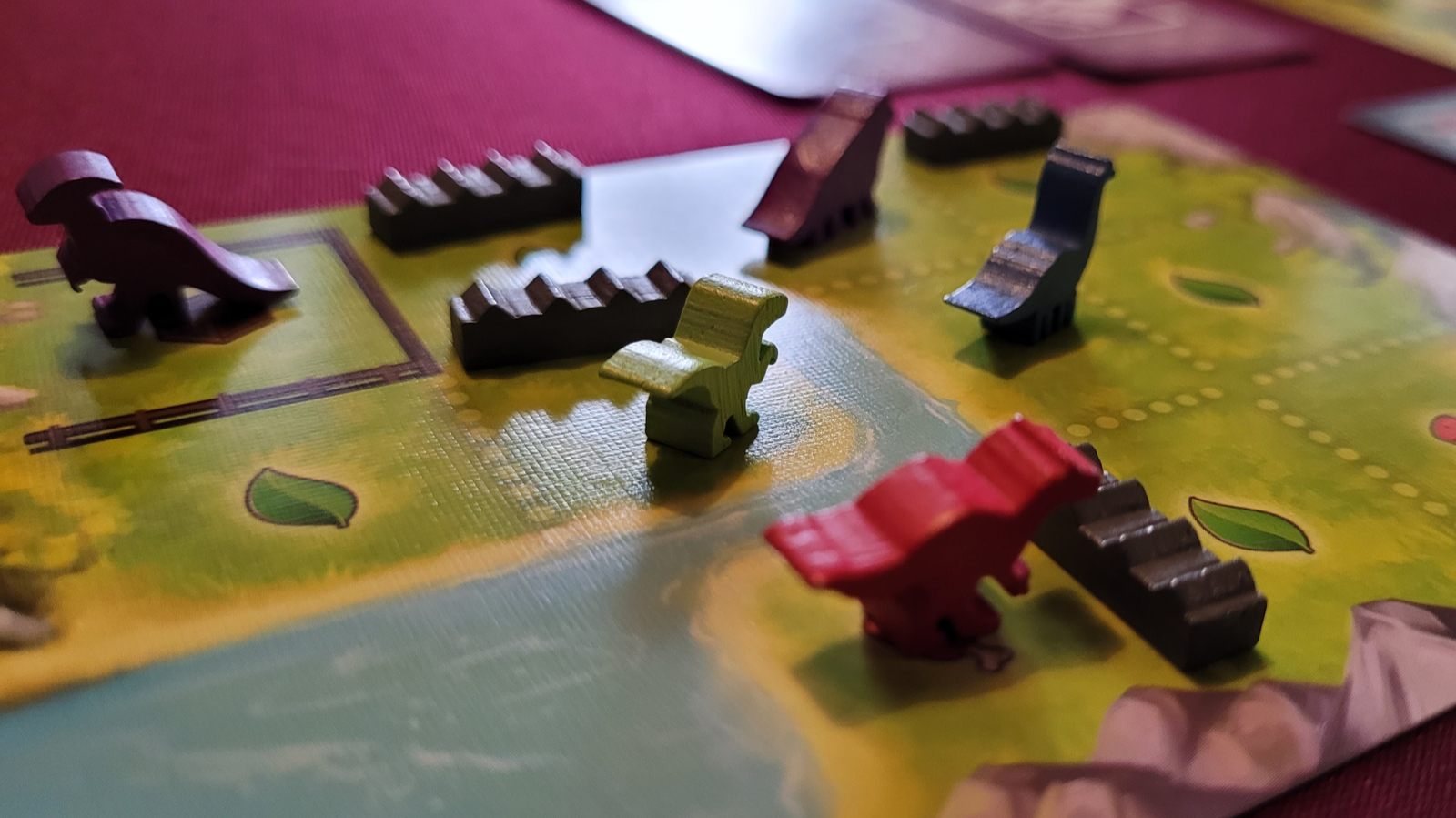
It took a little convincing for me to pick up Tiny Epic Dinosaurs. I already have two dinosaur-themed worker placement games that I like quite a bit (Dinosaur Island and Dinogenics), and I didn't enjoy the last Tiny Epic game I bought, Tiny Epic Mechs -- I thought it was overly gimmicky and possibly a signal that the series had jumped the shark. But, my affection for dinosaur-shaped meeples won out, and I ended up buying Tiny Epic Dinosaurs after all.

It's definitely a triumphant return to form for the normally very clever Tiny Epic series. Unlike most of the other games in this oddly crowded sub-genre, this one isn't about building a dinosaur zoo. Thematically it's about catching and breeding the animals and then selling them off, so it could just as easily be based on the 1962 John Wayne classic Hatari!, although that game might have a harder time finding an audience.

The worker placement mechanisms are straightforward and easy to understand, but still offer meaningful decisions as you agonize over what type of dinosaur to try to breed first, or struggle to to have enough food and space on your ranch for your expanding population. An interesting wrinkle that I haven't seen in other games of this type is that your resource collection is based on how many empty spaces you have on your ranch board, so the more dinosaurs you have standing around, the fewer units of food you're going to collect each turn. This makes the game a balancing act between saving up larger groups of dinosaurs for a better payday, or going for a quicker trade-in that might be worth fewer points but clears much needed space.

One of the main selling points of the Tiny Epic games is their compactness, and that is definitely true here -- this is a lot of game for how little space it takes up on the table. We recently played Tiny Epic Dinosaurs and Dinogenics back-to-back, and it was a little difficult to justify the fact that Dinogenics takes up easily ten times as much space for what amounts to a very similar game experience. However, I did find myself wishing that the Tiny Epic Dinosaurs components were maybe 25% larger than they are, especially the tiny print on the tiny cards that my aging eyes are starting to struggle with.

Rating: 5 (out of 5) This is easily my second favorite in the Tiny Epic series (after Tiny Epic Western), and the relatively low price point and shelf footprint make it easy to add to any game collection.

Thursday, December 6, 2018

Building a better dinosaur with Dinosaur Island


Dinosaur Island is almost exactly the game I wanted it to be. I really like engine-building games, where the goal is to use the game's options to build up a point-generating mechanism. This game lets you do just that, offering meaningful and thematic choices in the process: do I focus on tons of different dinosaurs, or do I balance them with other attractions like carnival rides and snack shops? Do I play it slow and safe with plenty of security, or do I allow the occasional dinosaur to escape its pen and eat a visitor or two, hoping to mitigate the damage later?

The game structure is complex but not complicated; I find that we rarely need to consult the rules while playing, which to me is a sign of a well-designed game. Each turn is broken up into four phases: in the first, dice are rolled to determine which DNA strands are available for the turn, then players go through a few rounds of worker placement, deciding whether to research new DNA, increase DNA storage so more can be stockpiled, or grab dinosaur "recipes" in order to create animals for their parks.

Next comes a buying phase, where players spend their cash on equipment upgrades, staff specialists, and secondary park attractions such as restaurants and gift shops. After that is the game's main worker placement phase, where players clone new dinosaurs, build larger habitats for them, increase security, and gather investment capital.


Finally comes the park phase, which is a delicate balancing act of attracting visitors and making sure they all have something to do in the park. Each dinosaur has an excitement value, which determines how many visitors line up outside your park. You gain income from all these visitors, but you only get points for the ones that find something to do in the park, whether it is actually looking at a live dinosaur, or thrilling to carnival rides with amusing names like "Jurassic Whirled."

Some dinosaurs (generally the large, carnivorous ones) are more exciting than others, so if you have a lot of these you will find yourself with more visitors than you have space (which is why you need thrill-rides and gift shops). Additionally, the visitors are drawn randomly out of a bag, which contains a number of "hooligans" who don't pay admission and take up valuable space in your park. And if you don't have enough security, dinosaurs will escape and eat your paying customers, which loses you points.

Event cards provide different global game effects, and the conditions that end the game are drawn randomly as well, so no two games are much alike. Even frequent players are forced to try out different strategies depending on what the global effects and end conditions are, and what resources are available from turn to turn,

You may notice that at the beginning of this review I stated "almost exactly the game I wanted it to be." My only quibble with Dinosaur Island (and it is a minor quibble at that) is the obnoxious graphic design. It's intended to evoke the early 1990s when Jurassic Park was first released, but I find all the pink and yellow just a little bit off-putting. Not enough to stop me from enjoying the game though.

Rating: 5 (out of 5) A terrific game with a lot of meaningful decisions to make, and a ton of replay value. And I guess the graphics aren't that bad...

Friday, June 22, 2018

The ants go marching on in March of the Ants


March of the Ants is not a game that would ordinarily catch my attention, but a good friend of mine did the artwork for the Minions of the Meadow expansion, which prompted me to back the Kickstarter for the expansion and pick up a copy of the base game. Well, that, and the giant centi-meeple...

Nepotism aside, the game is pretty good. It features elements of resource management and area control, with a tile-based board that unfolds gradually as the game progresses. Each player works to expand their colony of ants outward to collect resources while avoiding (or fighting off) the dreaded centipedes. Player turns involve a lot of meaningful decisions and the game gets going right away, avoiding a lot of the slow build-up that is common to resource management games.

The mighty centimeeple...
Cards are played for various effects, but mainly to evolve your particular species of ant by improving its head, thorax and abdomen, which gives you additional in-game abilities and results in an often bizarre Frankenstein-like mix of different ant parts.

The expansion adds several small modules to the game which can be mixed and matched depending on how much more complex players want the game to be. It includes aphids which players can herd to generate more food, parasites which add a bit more "take that" style player interaction, and predators that can be used to further antagonize your opponents, but at the risk of giving them more points if they manage to defeat them.

The game also includes a solo/co-op variant, which increasingly seems to be a must for Kickstarter games.

The graphic design leans towards readability over aesthetics (which is a welcome change from a lot of games from less experienced publishers), and the components are solid and of high quality, with nice bright colors that make everything easy to see and understand.

Rating: 3 (out of 5) The game mechanics and structure are extremely solid, but the theme leaves me a little cold, otherwise I would probably play this game more often.

Thursday, January 26, 2017

4theBirds: What the flock?


In the interest of full disclosure, I should mention that 4theBirds! was designed by a good friend of mine.

4theBirds is an abstract game similar to Pente or Connect Four, in which players attempt to place their pieces on the board in a specific pattern, either four in a row or in a square. There are, of course, numerous catches: not all of the spaces are connected to each other, players can displace some (but not all) of their opponent's pieces, and there are non-player pieces that can be added to the board, affecting player pieces in various ways.

The game's theme is a simple one of various birds jockeying for position in a tree. The tree is represented by the game board, a somewhat dizzying grid of numbered spaces, some connected by "branches" and others not. Each turn, a player rolls two dice to determine his choice of  two different spaces into which he may place one of his birds. Once he's rolled, he can choose to either place a bird on the board, or play one of six cards that do things such as move other birds around, place new non-player birds (Hawks and Crows), or re-roll the dice.

The game establishes a "pecking order" which allows each player to displace the birds of the player to his left, which makes for some interesting choices as players attempt to get their four birds in a row while at the same time pushing other birds out of the way and disrupting the other players' bird placements.

The aforementioned Hawks and Crows add a bit more chaos to the mix: the Hawks play on certain spots in between regular spaces, and cause all the nearby birds to scatter to other spaces, which in turn can cause further displacement. Crows play on regular spaces but are at the top of the pecking order, so they can displace all the player birds and get in the way of further placements. All it takes is a well placed Hawk or Crow and suddenly your careful plan is scattered like, well, like a bunch of birds.

It's a very simple game, but fun, with just the right amount of strategy set off by random chaos. And the colorful graphic design is a joy to look at.

Rating: 3 (out of 5) A little too simple for us to want to play all that often, but great for when we want a lighter, shorter game to play.

Wednesday, January 6, 2016

Relic Expedition: treasure hunting in style


My decision to buy Relic Expedition was based almost entirely on its graphic design. Normally I try to try out a game, or at least read some reviews, before buying, but in this case an ad included in the box for Lanterns: the Harvest Festival and a quick look at a demo copy at my local game store was all it took.

Granted, the game's 1930s adventure theme is one of my favorites (see Fortune and Glory), but beyond that, I found its typography, iconography, and color palette to be very appealing. Imagine my relief when it turned out to be a pretty good game, too.

Players race to explore the jungle and be the first to leave with the right combination of relics. The jungle is made up of random tiles that are placed as the players move; some tiles reveal relics or villages, while others unleash pits of quicksand or wild animals ranging from panthers that send you back to base camp, to mischievous monkeys that steal random items from your inventory.

Inventory management is a major part of the game. Each player can hold eight items, so early on it's easy to load up with helpful equipment such as machetes to cut through the jungle, bullwhips or vines to swing over quicksand, or bananas to distract those pesky monkeys, but eventually all that equipment has to give way to make room for relics. It calls to mind the greedy explorer who leaves all the food behind so he can smuggle out gold and jewels.

Deciding which relics to pick up is a crucial part of the game's strategy, since each player needs to collect a particular combination. In the base game it's either four of the same color, or four of the same type, but an expansion adds cards which give each player a more specific goal. So as you're wandering the jungle picking up relics, you have to decide which pattern you're going to go for, but also have the flexibility to change based on what you're finding. Every relic you carry means discarding a piece of equipment, which can lead to some agonizing decisions since most of the equipment either lets you move through the jungle more quickly, or avoid the wild animals which are the game's main obstacles.

The animals are easily the game's most charming components, consisting of meeples (wooden pieces in silhouette) of panthers, boars, snakes, and monkeys. Animals are placed on the board when certain jungle tiles come into play, and as part of their turn, each player rolls a die which allows the movement of all the animals of one type. Since the players control where the animals move, anyone who gets too far ahead will usually find themselves stalked by panthers or menaced by snakes.

Rating: 4 (out of 5) A delightful, if a bit simple, game with engaging game play and beautifully designed components.

Wednesday, January 28, 2015

Xeko: welcome to the jungle


Xeko was a great idea for a card game that was, sadly, very poorly formatted and marketed.

The game itself strikes a fairly good balance between being entertaining and educational. Players play cards representing different species of animals and plants into a grid on the table, representing the ecosystem. Cards must be played by matching colored symbols along the edges of the cards already in play, and when a card is first played, it comes into conflict with any adjacent opponent's cards. Interrupt cards can be played to affect the outcome of the conflict, but the eventual loser only loses cards from the top of their deck; the species card remains in play, symbolically representing the idea that every species finds its niche.

The game play is fun, and the educational element is there without being overbearing. The game introduces large concepts like ecological balance, as well as offering details about the particular species depicted on the cards, many of which are endangered. This would have been a great game to sell in gift shops at zoos and natural history museums (and maybe it was, I don't know).

The problem was that the game was released using the random booster pack model, in a fairly obvious attempt to grab the attention of kids playing Pokemon or Yu-Gi-Oh. This model works if there is a regular tournament community in place, giving players a place to visit and buy cards regularly, a steady stream of opponents, and a reason to keep up with new cards. But even the market of available customers for that type of game has shrunk to the point that it will only support a few games, rather than the dozens that were on offer throughout the 1990s.

Contents of the Xeko Mission: China starter set
Xeko didn't need to be a collectible card game, and I think it would have been a lot more successful at grabbing the attention of its intended audience if it hadn't been. They had some really nice starter products, with unusual and eye-catching box shapes: the one representing China's ecology was in the shape of a pagoda tower, and the one for Indonesia came in a really nice wooden box shaped like a crate.

If the game's publishers had focused on a self-contained game rather than trying for the largely tapped out collectible card game market, Xeko might still be around today.

Rating: 4 (out of 5) Xeko is a game that always takes us by surprise when we play, and manages to be very engaging despite its simplicity.

  • Xeko on BoardGameGeek.com

Date played: November 27, 2014

Wednesday, January 14, 2015

Evolution: whoever eats the most food wins

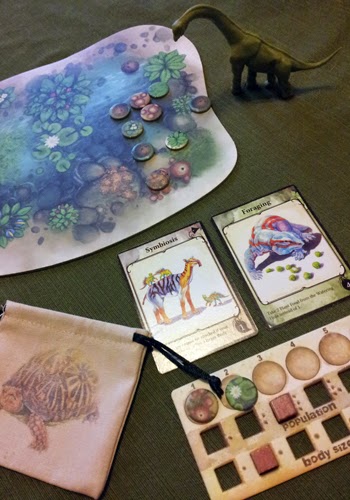
Evolution takes some of the basic elements of the ubiquitous resource management game and applies them to prehistoric evolution rather than the usual farming or civilization building. Players attempt to build up their species by giving them survival traits such as hard shells, long necks, or defensive herding, and also by increasing their size and population.

Cards representing these traits are the primary resource in the game. They can be played (in a limited number) on a player's species, or discarded to add to a species size or population. Each species is represented by a small board that tracks the species' size, population, and amount of food it's eaten that turn. A larger size protects the species from carnivores (but also provides more food for them), and a higher population eats more food, which is ultimately what wins the game.

In addition to evolutionary traits, each card is printed with a food value. At the start of each round, players secretly choose a card to play into the center of the table. The food values on those cards are added up, and the total is the amount of herbivorous food available for the turn. Players take turns taking food tokens from the center of the table until all their species are fed or the food runs out. Each species can eat food equal to their population, and if they don't get enough food, the population is reduced.

Among the trait cards players can assign to their species is carnivore, which allows that species to attack other animals (either the opponents' or, if necessary, the player's own) for food. Animals provide meat equal to their body size, and each carnivore attack reduces the population of the species being attacked.

The theme is interesting, and the cards and components are gorgeous, with great artwork and high production values. The animals pictured on the cards are often similar to those you might see on a trip to the zoo, but are unusual enough to evoke the idea of long-forgotten species at some ancient stage of evolution.

Rating: 3 (out of 5) The game play is a bit on the simple side, but the unusual theme and excellent presentation make up for it quite a bit.


Date played: November 22, 2014