Showing posts with label dinosaurs. Show all posts

Thursday, October 10, 2024

Chomp! A game about herding dinosaurs

Why do dinosaurs seem to have such an enduring appeal? I think it’s the idea that, once upon a time, there was a world teeming with thousands of varieties of fantastical, dragon-like creatures, untouched by human mediocrity. And that world wasn’t dreamed up by a novelist or game designer. It was real, at least as far as the reasonably dependable science of paleontology can tell us.

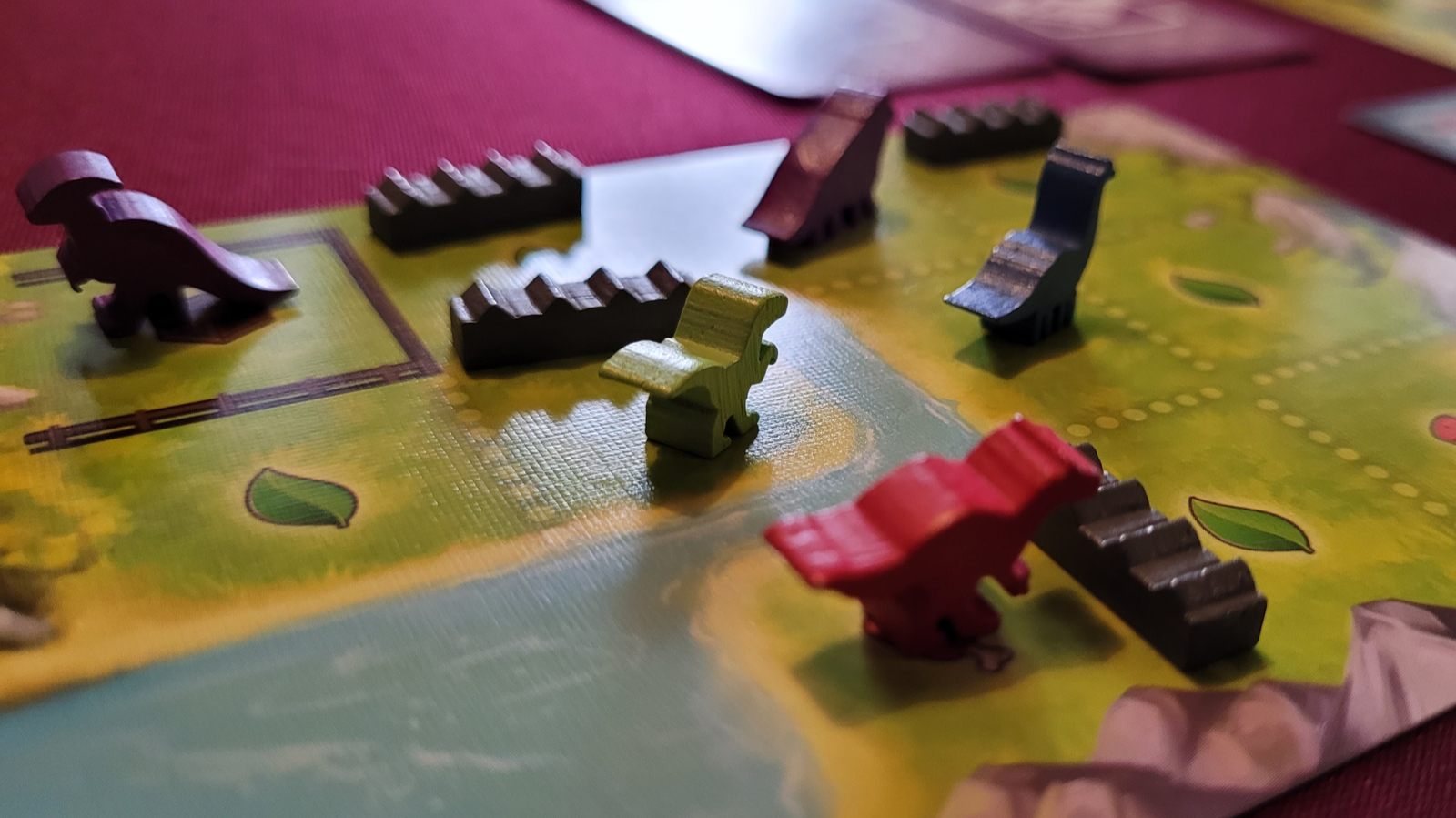
I’m not sure if Chomp, a small box tile laying game published last year by AllPlay, quite captures the majesty of prehistory, but it is a pretty fun little game.

The game consists of 36 double-sided tiles, plus a handful of tokens and a lovely dry-erase board (pen included!) for keeping score. The tiles depict herds of carnivorous or herbivorous dinosaurs in different sizes, lush vegetation, nests, watering holes, and tar pits in various combinations of two, three or four shapes. Sometimes the different elements on a tile are separated by mountains, sometimes not. The idea is to draw and place tiles in order to form larger herds of same sized dinosaurs, making sure they are adjacent to food sources – vegetation for the herbivores and watering holes populated by unwitting prey for the carnivores. But you have to keep an eye out for tar pits, as they are certain doom for your dinosaur herds.

It’s the tile placement that’s particularly interesting in this game. Tiles can be placed overlapping other tiles, as long as the grid is maintained and individual elements are completely covered. This means you can pivot your strategy more easily than in most traditional tile-laying games, perhaps placing a tile that’s good but not ideal in the hopes of covering up some or all of it later in the game. 

On the reverse side of each tile is a bonus scoring condition, granting extra end-of-game points for things like having the most of a particular size of dinosaur, or even having the most uncovered tar pits among your tiles. At the start of each player’s turn there will be three face up and three face down tiles to choose from. Players can choose either on their turn, balancing the need for more layout tiles with the ability to score extra bonus points.

The game goes for eight rounds, after which each player has to check each of their herds to see if they are made extinct by an adjacent tar pit. Remaining herds must then be fed from an adjacent food source, with carnivores eating herbivore herds if no other prey is available. All adjacent dinosaurs of the same size and type, no matter how many, count as one herd. Each herd only requires one adjacent food source, so the challenge is to maximize the tile placement for large herds to take advantage of a single source of food. The bonus tiles provide some guidance for which types of dinosaur herds to go for and how best to try to lay out your tiles.

Any herds who can’t eat are made extinct, after which all the surviving dinosaurs are counted up for points. Larger dinosaurs count for more points than smaller ones, but also take up more space on their tiles and so are theoretically more difficult to place efficiently.

Rating: 4 (out of 5) Like most tile-laying games, Chomp has a fun puzzle-like quality to it, and I really like the idea that you can cover up some or all of your previously placed tiles if your strategy is moving in a new direction.

Wednesday, February 8, 2023

Unmatched: Now that's an epic duel

“A quick temper will make a fool of you soon enough.” -- Bruce Lee

To the best of my knowledge, there is only one tabletop game that lets you determine the winner in a fight between Bruce Lee and a tyrannosaurus rex. That game is Unmatched, and it deserves your respect.

Unmatched began its life as a Star Wars game called Epic Duels, published in 2002 by Milton Bradley and sold primarily in the toy store market. As a grid-based tactical combat game, Epic Duels was quite a bit more interesting than the usual toy store fare of the time, with players invited to imagine match-ups between characters from across the Star Wars timeline (as it existed in 2002, anyway), and realize those battles with a unique game system using miniatures, dice and cards. It was an interesting little game, especially by the standards of the time, but its nature as a piece of mass market movie tie-in merchandise meant that it didn't stay in print for long.

Robin Hood fights off a pack of hungry velociraptors

Fast forward to 2019. The core structure of Epic Duels has been revised, refined, and freed from the chains of the Star Wars license. Each player takes control of a character drawn from a wide range of mythology, literature, and popular culture, featuring everything from the aforementioned Bruce Lee to King Arthur, Sherlock Holmes, Buffy the Vampire Slayer, the velociraptors from Jurassic Park, and even a selection from the more obscure side of the Marvel comics universe such as Moon Knight and Ghost Rider. The game then uses miniature movement and card play to imagine a duel between whatever unlikely combination of characters have been chosen.

Most games of this type such as Heroclix or Firefly Adventures use a reasonably large board or map printed with a grid to determine movement and distance. Unmatched instead employs a small board illustrated with a series of connected, color-coded circles to establish each character's position. Miniatures can move along the connections between circles, and the circle's color indicates areas where ranged attacks can be made, eliminating the pesky line-of-sight arguments that are the bane of most miniatures games' existence.

Character actions are determined by a deck of cards, unique to each character. Cards represent attacks, defenses and special abilities that can be employed throughout the game. When combat ensues, the attacker plays an attack card with a numerical value face down on the table, then the defender plays a defense card, also face down. Both cards are revealed simultaneously, and the defender takes damage equal to the difference between attack and defense. Most of the cards have an effect that takes place either before or after the attack, which spices up the game and gives players a lot of tactical options to consider, both when attacking and defending. Damage is tracked using a simple dial. It's a wonderfully elegant system that handles attack and damage in one play, and eliminates the egregious "luck factor" of dice rolling.

Apart from the simple yet elegant game play, each Unmatched set is a class act from start to finish. The game is sold in stand-alone sets of 2, 3 or 4 characters, which allows players to try out the game with minimal investment, and also to stick to only the characters that they find interesting. Are you a Marvel fan with no interest in Little Red Riding Hood or Bigfoot? No problem, Unmatched has you covered. The boxes all come with a high quality plastic tray for all the components (a rarity these days), and while the cards are plenty durable, the trays will even accomodate sleeved cards. The miniatures don't come pre-painted, but they do come with a wash applied that brings out the details of the figure, and also a colored ring for the base that makes it easy to tell each player's characters apart.

The artwork on the cards is all original (even for the characters from licensed properties) and consistently excellent, and the graphic design is slick, contemporary and (most importantly) easy to read. The rulebook is well organized (also a rarity these days), but honestly, once you have the basics down you will rarely need to look at the rules -- the game design really is that good.

Ghost Rider artwork from the "Marvel: Redemption Row" set.

Rating: 5 (out of 5) Not just a great dueling game, but a great card game and a great miniatures game all rolled into one.

Tuesday, January 17, 2023

Tiny Epic Dinosaurs: because you can never have too many dinosaur cloning games...

It took a little convincing for me to pick up Tiny Epic Dinosaurs. I already have two dinosaur-themed worker placement games that I like quite a bit (Dinosaur Island and Dinogenics), and I didn't enjoy the last Tiny Epic game I bought, Tiny Epic Mechs -- I thought it was overly gimmicky and possibly a signal that the series had jumped the shark. But, my affection for dinosaur-shaped meeples won out, and I ended up buying Tiny Epic Dinosaurs after all.

It's definitely a triumphant return to form for the normally very clever Tiny Epic series. Unlike most of the other games in this oddly crowded sub-genre, this one isn't about building a dinosaur zoo. Thematically it's about catching and breeding the animals and then selling them off, so it could just as easily be based on the 1962 John Wayne classic Hatari!, although that game might have a harder time finding an audience.

The worker placement mechanisms are straightforward and easy to understand, but still offer meaningful decisions as you agonize over what type of dinosaur to try to breed first, or struggle to to have enough food and space on your ranch for your expanding population. An interesting wrinkle that I haven't seen in other games of this type is that your resource collection is based on how many empty spaces you have on your ranch board, so the more dinosaurs you have standing around, the fewer units of food you're going to collect each turn. This makes the game a balancing act between saving up larger groups of dinosaurs for a better payday, or going for a quicker trade-in that might be worth fewer points but clears much needed space.

One of the main selling points of the Tiny Epic games is their compactness, and that is definitely true here -- this is a lot of game for how little space it takes up on the table. We recently played Tiny Epic Dinosaurs and Dinogenics back-to-back, and it was a little difficult to justify the fact that Dinogenics takes up easily ten times as much space for what amounts to a very similar game experience. However, I did find myself wishing that the Tiny Epic Dinosaurs components were maybe 25% larger than they are, especially the tiny print on the tiny cards that my aging eyes are starting to struggle with.

Rating: 5 (out of 5) This is easily my second favorite in the Tiny Epic series (after Tiny Epic Western), and the relatively low price point and shelf footprint make it easy to add to any game collection.

Friday, December 6, 2019

DinoGenics: there's a dinosaur cloning game for everyone

Crowdfunding, pre-orders and limited print runs are rapidly becoming the standard for game publishing, and it is because of this that I had to decide whether I wanted DinoGenics before I was able to play Dinosaur Island. Based only on information from their respective crowdfunding campaigns the two games look very similar, and honestly, how many dinosaur cloning games does one person need?

If I'd been looking at both games at the same time I most likely would have only chosen one, and that one would have been DinoGenics, based on its more conventional illustrations and graphic design -- the obnoxious look of Dinosaur Island remains one of the few things I don't like about the game. Unfortunately (or perhaps fortunately) I had to make a decision on DinoGenics after I had committed to buying Dinosaur Island, so I ended up with copies of both games. In the end I'm glad I did.

The two games are similar in that they are both worker placement games about building a zoo filled with cloned dinosaurs, but that's where the similarity ends. DinoGenics is a much more traditional worker placement game, with players competing for spaces on the board so they can get the resources they need to clone dinosaurs, build appropriate enclosures for them, and add enough support buildings to accommodate an increasing number of guests. And don't forget to feed those carnivores, or they'll break out of their enclosures and you'll likely spend a lot of your next turn making repairs...

The game design is solid if not overly innovative, but where DinoGenics really shines in in the quality of its components. The graphic design is excellent and does a much better job of evoking Jurassic Park than the much more stylized Dinosaur Island. The meeples are wood rather than plastic (in my opinion plastic meeples are a disturbing trend in game publishing and a scourge upon mankind), done in very nice greens, browns and greys that make it easy to tell the different types of dinosaurs apart. The cards and tiles are sturdy with high quality printing -- the only thing I don't like is that some of the text on the building tiles is very small and difficult to read.

If I had to choose between DinoGenics and Dinosaur Island, I would probably choose DinoGenics, although I do think the game play in Dinosaur Island is a bit more innovative. In the end the games are different enough that I'm happy to have both in my collection.

Rating: 5 (out of 5) This game features more traditional worker placement style game play than its competitor, but the much more lavish graphic design more than makes up for it.

Monday, September 23, 2019

Running and screaming with Jurassic Park: Danger

"Oh, yeah. Oooh, ahhh, that's how it always starts. Then later there's running and screaming."
-- Ian Malcolm (Jeff Goldblum), The Lost World: Jurassic Park
In the past few years there have been several great games such as Dinosaur Island and DinoGenics that were clearly inspired by the Jurassic Park franchise. Interestingly, those games are about building a successful, functioning dinosaur zoo, the one thing that doesn't happen in any of the films; they're always about the dinosaurs escaping and causing chaos. I guess it takes a legitimately licensed game like Jurassic Park Danger! to really understand what the franchise is all about.

It's a one vs. many game based on the first film in the series, where one player takes control of the escaped carnivorous dinosaurs while the others play as a selection of the humans trying to make their way through the malfunctioning park to the helicopter pad and escape.

Each human character has a unique deck of cards giving that player general options such as moving and hiding as well as a few that are specific to each character, such as Ray Arnold's "hold on to your butts" that allows him to turn the electric fences back on, or little Timmy's encyclopedic knowledge of dinosaur behavior. Human players have to carefully manage their cards, choosing the best moments to play certain cards; if a human player ever runs out of cards, their character is eliminated and removed from the game (but not to fear, that player gets a new character to play).

In addition to avoiding the wily dinosaurs, the human characters each have a goal they must accomplish before they can head for the helicopter pad. Most of them just have to go to a specific location to collect their goal token, but some have to perform a specific task: Muldoon the game warden has to distract the Velociraptor, for example. Sneaky Dennis Nedry starts play with his goal token already collected, so all he has to do is make a beeline for the chopper, but he's more likely to be attacked by a dinosaur than the other characters.

The dinosaur player's goal is simple: eat a certain number of humans before they can escape. The dinosaurs move via a deck of cards similar to what the humans have, and each dinosaur has a special ability that they can't use every turn, so their player has to employ some strategy to get the most out of each dinosaur.

With cardboard components and wooden meeples instead of sculpted miniatures, Jurassic Park Danger! has clearly been designed for mass market sale. In an industry that seems increasingly interested in marketing expensive, overproduced, made-to-order games for a small market of mail order consumers (a trend I'm as guilty of supporting as anyone), it's nice to see a cheap, accessible game that's a lot more interesting than we usually see in licensed mass market products.

It's not going to change your life or anything, but it's fun and simple and evokes the source material very well. This might be a good entry level game for younger gamers, people new to the hobby, or even for your regular gaming group if they need a break from Gloomhaven...

Rating: 3 (out of 5) not quite in the same league as most hobby board games, but close, and definitely worth the low price.

Thursday, December 6, 2018

Building a better dinosaur with Dinosaur Island


Dinosaur Island is almost exactly the game I wanted it to be. I really like engine-building games, where the goal is to use the game's options to build up a point-generating mechanism. This game lets you do just that, offering meaningful and thematic choices in the process: do I focus on tons of different dinosaurs, or do I balance them with other attractions like carnival rides and snack shops? Do I play it slow and safe with plenty of security, or do I allow the occasional dinosaur to escape its pen and eat a visitor or two, hoping to mitigate the damage later?

The game structure is complex but not complicated; I find that we rarely need to consult the rules while playing, which to me is a sign of a well-designed game. Each turn is broken up into four phases: in the first, dice are rolled to determine which DNA strands are available for the turn, then players go through a few rounds of worker placement, deciding whether to research new DNA, increase DNA storage so more can be stockpiled, or grab dinosaur "recipes" in order to create animals for their parks.

Next comes a buying phase, where players spend their cash on equipment upgrades, staff specialists, and secondary park attractions such as restaurants and gift shops. After that is the game's main worker placement phase, where players clone new dinosaurs, build larger habitats for them, increase security, and gather investment capital.


Finally comes the park phase, which is a delicate balancing act of attracting visitors and making sure they all have something to do in the park. Each dinosaur has an excitement value, which determines how many visitors line up outside your park. You gain income from all these visitors, but you only get points for the ones that find something to do in the park, whether it is actually looking at a live dinosaur, or thrilling to carnival rides with amusing names like "Jurassic Whirled."

Some dinosaurs (generally the large, carnivorous ones) are more exciting than others, so if you have a lot of these you will find yourself with more visitors than you have space (which is why you need thrill-rides and gift shops). Additionally, the visitors are drawn randomly out of a bag, which contains a number of "hooligans" who don't pay admission and take up valuable space in your park. And if you don't have enough security, dinosaurs will escape and eat your paying customers, which loses you points.

Event cards provide different global game effects, and the conditions that end the game are drawn randomly as well, so no two games are much alike. Even frequent players are forced to try out different strategies depending on what the global effects and end conditions are, and what resources are available from turn to turn,

You may notice that at the beginning of this review I stated "almost exactly the game I wanted it to be." My only quibble with Dinosaur Island (and it is a minor quibble at that) is the obnoxious graphic design. It's intended to evoke the early 1990s when Jurassic Park was first released, but I find all the pink and yellow just a little bit off-putting. Not enough to stop me from enjoying the game though.

Rating: 5 (out of 5) A terrific game with a lot of meaningful decisions to make, and a ton of replay value. And I guess the graphics aren't that bad...

Wednesday, March 16, 2016

Table for two: a trio of two-player games

As a gaming couple, we are always on the lookout for good two-player games. Granted, many multiplayer games work perfectly well with two, but more often than not they are designed with a larger group of players in mind.

We recently picked up a few new two-player games:


Star Wars: Empire vs. Rebellion is for the most part a re-skin of Cold War: CIA vs. KGB, and an entry into an emerging sub-category of games based on popular licensed properties and marketed more for their status as tie-in merchandise than for their game play. That's not necessarily a criticism, as it's easy to see that Star Wars is a much easier sell than 1960s global intrigue.

The game makes the transition from cold war to star war fairly easily, with a few minor changes and additions. Each round, an event card is played to the center of the table, representing an event from the original trilogy of Star Wars films such as "Duel on Cloud City" or "Locate the Rebel Base." Players secretly choose a strategy card to use for that round, which either gives them a boost towards winning the event, or an advantage in the following round. Players then attempt to score points for these events by playing cards that add up to a pre-determined value without going over.

Each player plays from their own deck of cards, which includes either the heroes or the villains of the Star Wars saga. These character cards have unique abilities that can be used when they are in play, and their value towards the total required to win the event is different depending on whether they have used their ability or not. Whether or not to use a character ability (and change your total) becomes one of the main strategic decisions in the game. Influence tokens, which are awarded upon winning an event and can be spent to re-use a card's ability, are another component that feeds the game's strategy and makes it different from Cold War.

Rating: 3 (out of 5) Not quite as simple and elegant as Cold War, but the Star Wars theme will most likely have a much wider appeal.


I'm a huge fan of Jurassic Park, Primeval, and all things dinosaur, so Raptor was a pretty easy sell for me. It's a two-player tactical movement game in which one player controls a team of scientists trying to gather baby velociraptors for study, and the other player controls the raptors and their outraged mother.

The board is made up of 6 square tiles, each with a 9x9 grid of spaces, plus two 1x3 end tiles on each side. Each tile has a different pattern of empty spaces and obstacles, so the board will be different for each game. The game starts with the mother and 5 baby raptor figures on the board, one on each tile, and four scientist figures, two on either end of the board.

Each player has a deck of 9 cards, each with a number from 1 to 9 and an action that player can perform. Players start with a hand of 3 cards, from which they simultaneously choose and reveal one card, comparing the two. The player with the lower number performs the action listed on the card, which are things like hide in the jungle or scare the humans for the raptor player, and reinforcements or move by jeep for the scientist player. The player with the higher number gets a number of action points to spend equal to the difference between the two cards. Action points are spent to move and attack.

Not knowing for sure what you're going to be able to do each round is the key feature of the game, and strategy consists of trying to anticipate what your opponent is going to do based on the figures' placement on the board. It's got a nice balance of randomness and strategic decision making, with simple, intuitive rules.

Rating: 4 (out of 5) A nice mix of tactical movement and card-playing, and I love the dinosaurs vs. humans theme.


Longhorn is another game we picked up on impulse based mainly on the genre. In this case, the wild west theme is largely tacked on, and the game itself is pretty abstract.

The board consists of 9 tiles, each with an effect and a random number of cows of different colors on it. There is a single pawn which represents both players. On each player's turn, that player takes all the cows of one color from the tile he is on, and then moves the pawn a number of spaces equal to the number of cows taken. Then it's the other player's turn to take cows an move the pawn. If a player takes the last cow from a tile, that tile's effect is resolved, with different effects including things like taking cows from adjacent spaces or the other player, getting extra points at the end of the game, or having to put cows you've taken back on the board.

It sounds simple, but as usual there is a bit more to it. The pawn can never be moved to an empty tile, and if there are no populated tiles to move to, the game ends. Cows are worth points based on the number of cows of that color still on the board at the end of the game, which means there is quite a bit of strategy involved in deciding which cows to take, and where to move the pawn so that your opponent's choices are limited.

It is interesting to note that Raptor and Longhorn are both by the same designer, Bruno Cathala (Raptor was co-designed by Bruno Faidutti).

Rating: 2 (out of 5) It's almost more of a puzzle than a game, and its one of the few games that we strongly disagree on; I think it's okay, but Katherine finds it really uninteresting.

Check out some of the other two player games we've reviewed.

Wednesday, January 13, 2016

Apex Therapod Deck Building Game: not for vegetarians


Apex: Therapod Deck-Building Game is a game about dinosaurs eating other dinosaurs, designed with a very specific audience in mind: solo gamers. It's not exclusively a solitaire game (it can be played with as many as 8), but there is very little direct player interaction, and the game is essentially a race to see who can take down the most fearsome dinosaurs before the inevitable asteroid strike.

That said, it is an immensely enjoyable and challenging game, with mechanics that, while fairly complex, run pretty smoothly and fit the theme extremely well. And the artwork on the cards is fantastic.

Each player chooses a species of carnivorous dinosaur to play, with choices ranging from classic favorites like Tyrannosaurus Rex and Velociraptor to lesser known beasts such as Sarcosuchus (a giant prehistoric crocodile). Each species plays somewhat differently, with their own strategies, strengths and weaknesses. Like most deck building games, each player starts with a relatively weak deck of cards, in this case eggs, hatchlings, and carcasses. Each player has their own unique Apex deck of stronger versions of their particular dinosaur species, cards which must be purchased over the course of the game.

The game starts with a row of cards called the game trail representing prey, and another representing evolutionary advances. Game play consists of playing out cards to hunt prey from the prey deck, and then spending the points gained to buy better cards for your deck, either general evolutionary advances from the table, or specific apex cards from your apex deck, which are made available by playing egg cards. The goal is to populate your deck with stronger cards, enabling you to hunt larger prey and eventually fight the boss dinosaurs and their minions, that are shuffled into the hunt deck.

At the start of the game, a certain number of boss dinosaurs and their minions are shuffled into the deck of prey, so that they appear randomly throughout the game. When a boss appears, all the other prey scatter (are discarded), and the clash of the titans commences. You have to play a lot of high-value cards over multiple rounds to have a hope of beating a boss, and failure results in trauma cards which are added to your deck and produce negative effects when drawn.

Much like the age of the dinosaurs, Apex has a built-in time limit in the form of a deck of environment cards representing tropical storms, droughts, dinosaur stampedes, and the Asteroid Strike and Extinction cards that signal the end of the game. Players score points based on the amount of prey they have consumed, but no player can win the game unless they've defeated at least one boss monster.

There is a lot going on, but it stops short of being overly complicated. The flow of turns and rounds is pretty smooth once you get accustomed to it. There's a brilliant press-your-luck ambush mechanic that allows you to set aside cards from your hand for later use, but forces you to place an Alert card in your discard pile where it will eventually get reshuffled into your deck. If you draw the Alert before you've played your ambush cards, they are discarded without effect and certain effects on cards in the game trail will trigger. It's a great idea that really translates the idea of an ambush predator coldly observing its prey before striking.

Rating: 5 (out of 5) An extremely well-designed game with a lot of deep, complex, and thematic game play, and gorgeous artwork.

Monday, April 20, 2015

Another look at Pirates vs. Dinosaurs


In my original review for Pirates vs. Dinosaurs, I summed up the game as being "solid and entertaining" and "A perfectly good pirate game, but not a very good dinosaur one." Having had a chance to play it a few more times since then, I feel the need to revise my opinion a bit. It's still not a very good dinosaur game, and additionally, I'm finding that the pirate part of it is just too random and lacking in strategy to be interesting over repeated plays.

What can I say? I was distracted by the game's great artwork and graphic design.

The first part of the game involves each player taking their chosen crew and equipment and searching the island for randomly placed landmark tiles that match the map tiles they have been randomly given. This is done via a random dice roll. compared against an arbitrary number based on what part of the island the player is currently searching. There aren't really any clues as to where to search, so you're really just guessing until you find all your tiles.

During this part of the game, complications arise in the form of the other players playing dinosaur attacks and other obstacle cards on you, forcing you to roll dice based on the number of crew you currently have, and the weapons you chose at the start of the game. This gives the game a "take that!" style of play similar to Munchkin, a game I have never cared for.

The only strategic decision a player really gets to make is at the very start of the game, when choosing what weapons and equipment to use, and even that is only really a question of whether you want to be better at fighting off dinosaur attacks, or finding your location tiles quickly.

Once a player has found all their location tiles, they move on to the second part of the game, which is a very simple "press your luck" game mechanic, drawing a number random tiles out of a bag based on the amount of remaining crew. Most of these tiles are worth random amounts of treasure, but some can be dinosaur attacks, ghost encounters, or volcano eruptions. Ghosts and dinosaur attacks cause the player to lose their hard-earned treasure, or worse, their remaining crew, who are needed to drag the treasure back to the boat. The volcano has escalating effects based on the number of times the volcano tile has been drawn, eventually sinking the island and spelling doom for any player who hasn't retreated to their ship. So the endgame is really about guessing when you think you have more treasure than your opponents will get, and then withdrawing from the island.

The majority of the game revolves around guesswork and random chance, with very few strategic decisions to make. Pirates vs. Dinosaurs is really about the experience of manipulating the game's components and looking at the nifty artwork, which wears thin after a few plays.

Read the original review.
Original rating: 3 (out of 5)
New rating (pass or fail): FAIL


Wednesday, January 14, 2015

Evolution: whoever eats the most food wins

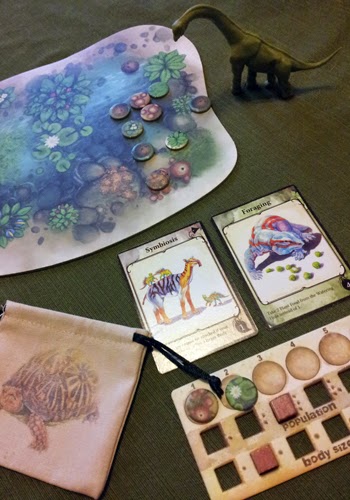
Evolution takes some of the basic elements of the ubiquitous resource management game and applies them to prehistoric evolution rather than the usual farming or civilization building. Players attempt to build up their species by giving them survival traits such as hard shells, long necks, or defensive herding, and also by increasing their size and population.

Cards representing these traits are the primary resource in the game. They can be played (in a limited number) on a player's species, or discarded to add to a species size or population. Each species is represented by a small board that tracks the species' size, population, and amount of food it's eaten that turn. A larger size protects the species from carnivores (but also provides more food for them), and a higher population eats more food, which is ultimately what wins the game.

In addition to evolutionary traits, each card is printed with a food value. At the start of each round, players secretly choose a card to play into the center of the table. The food values on those cards are added up, and the total is the amount of herbivorous food available for the turn. Players take turns taking food tokens from the center of the table until all their species are fed or the food runs out. Each species can eat food equal to their population, and if they don't get enough food, the population is reduced.

Among the trait cards players can assign to their species is carnivore, which allows that species to attack other animals (either the opponents' or, if necessary, the player's own) for food. Animals provide meat equal to their body size, and each carnivore attack reduces the population of the species being attacked.

The theme is interesting, and the cards and components are gorgeous, with great artwork and high production values. The animals pictured on the cards are often similar to those you might see on a trip to the zoo, but are unusual enough to evoke the idea of long-forgotten species at some ancient stage of evolution.

Rating: 3 (out of 5) The game play is a bit on the simple side, but the unusual theme and excellent presentation make up for it quite a bit.


Date played: November 22, 2014

Saturday, August 2, 2014

Pirates vs. Dinosaurs needs more dinosaurs

I like pirates. I think they work great as a storytelling genre, and clearly I'm not alone since pirates are well-represented in the gaming world.

I also like dinosaurs. Primeval is one of my favorite TV shows, and for all their flaws I'm a big fan of the Jurassic Park movies. Unlike pirates, dinosaurs are sadly under-represented on the board game shelves (but if you disagree I welcome your recommendations of good dinosaur games in the comments below).

I also like Arkham Horror. It's one of my favorite board games. So when I heard that Richard Launius, creator of Arkham Horror, was designing a game called Pirates vs. Dinosaurs, I thought "what's not to like?"


As it turns out, Pirates vs. Dinosaurs is not quite the epic struggle I was hoping for, but it's still pretty fun. It is essentially the classic pirate scenario of the treasure hunt on an unexplored island, where players control crews of pirates in a race to see who can be first to find the location of the hidden treasure, and then abscond with the most booty before the island is destroyed by a volcano. As if that wasn't enough, the island is also populated by bloodthirsty dinosaurs who will attempt to eat the pirates at every turn.

At the beginning of the game, after choosing a captain and first mate, each player chooses how to equip their pirate crew. Choices range from obvious items like shovels and rope to slightly more outlandish (but still pirate genre-appropriate) choices like a parrot or a cannon. They also choose whether to arm their crews with pistols n' pikes, which are more accurate but require more crew to use, or good old fashioned swords n' muskets, which are less dependable but give the player more dice to roll during combat.

After the crews are equipped, the hunt is on. Each player is assigned three tiles representing specific landmarks on the island. There are corresponding face-down tiles scattered throughout the island, and players must find the matching tiles for their three landmarks by spending time in different areas of the island, during which they are vulnerable to attack via Island cards, which are played on them by the other players.

Island cards represent mundane dangers such as mutiny or quicksand, and occasionally even positive effects players can play on themselves, like a trained monkey that will steal cards from the other players. More importantly, the Island cards include dinosaur attacks, from crafty velociraptors to stampeding triceratops to the dreaded Tyrannosaurus Rex. Naturally, attacking dinosaurs will trample or eat your crew, making them less effective in combat against further dinosaur attacks. Additionally, when you finally find the location of the treasure, you need crew to haul it back to your ship.

Once a player has located all the tiles on the board that correspond to their landmarks, they move on to the third stage of the game. From this point on, it becomes a risk management game: the player rolls the dice to determine how many tiles they draw from a randomized bag. Tiles can represent treasure of various values, but also ghosts which cumulatively cause crew and treasure loss, attacking dinosaurs, or an erupting volcano which counts down based on the number of volcano tiles that have already been drawn. How much treasure a player can haul away depends on how much crew they have left, and every draw risks ghosts, dinosaurs or volcanic eruptions, so players have to carefully decide when enough is enough and it's time to retreat to the ship.

The game ends when either all players have returned to their ships, or the island sinks as a result of the erupting volcano. At this point, the player whose crew survived with the most treasure is the winner.

As a pirate-themed treasure hunting game, Pirates vs. Dinosaurs is solid and entertaining, helped along by some excellent illustration and graphic design. However, the presence of the dinosaurs is a bit understated for me, with one exception being the Giant T-Rex, which is actually represented by a piece on the board and has an ongoing effect throughout the game.

Rating: 3 (out of 5) A perfectly good pirate game, but not a very good dinosaur one.

Date played: June 21, 2014

UPDATE April 20, 2015: Another look at Pirates vs. Dinosaurs

Wednesday, January 15, 2014

Everything is better with dinosaurs


Sometimes you just want to play a simple game. One that doesn't take 20 minutes to set up and four hours to play. Maybe you have half an hour to kill before it's time to leave for a movie, or you're waiting for everyone to show up for game night.

At the same time, maybe you also need to imagine that you are hunting dinosaurs for your dinosaur zoo.

The only solution is Dino Hunt Dice, a nifty little risk management game from Steve Jackson Games.

Players roll three dice at a time, chosen randomly from a cup. Each die has three symbols on it: a dinosaur, a fern leaf, and a footprint. There are three different colors of dice in the pool - green dice have fewer footprints and more dinosaurs, yellow have an equal number of each, and red are the most dangerous, with more footprints than dinosaurs.

Each dinosaur rolled scores one point. Fern leaves mean the dinosaur is hiding, and you roll the die again. A player can end their turn after any roll and bank their points, or they can keep pulling more dice out of the cup, rolling three at a time, but if you ever have three footprints showing on the dice you've rolled, your turn ends and you don't score any points for that turn.

It's an amusing little game and a great exercise in knowing when to quit. Plus it has dice with little dinosaurs on them, which is good enough for me.

Rating: 3 (out of 5) A very simple game and not something we'd spend a lot of time playing, but for what it is it's pretty fun.


Date played: December 29, 2013