Showing posts with label miniatures. Show all posts

Wednesday, August 13, 2025

Journey to the center of the Savage Core

Portions of the text for this review originally appeared in my Savage Core Expedition Journal project blog at OnTableTop.com.

As is often the case with skirmish games, the thing that initially drew me to Savage Core was the miniatures. I was shopping for wild west figures and stumbled into what might have happened if Jules Verne and Edgar Rice Burroughs had worked together to design a line of miniatures. The Savage Core is an underground primeval jungle populated by superintelligent apes, lost Atlanteans, ice age cavemen, dinosaurs, and more.

The game looked interesting too, so I wasted no time in placing an order. In fact, I got so distracted by thoughts of pulp adventure that I completely forgot to order the cowboys I went there for in the first place...

A game of Savage Core is a head-to-head battle, with around seven figures per side. A player's force revolves entirely around their faction’s Boss, an individual character who has six game stats and a unique set of “tricks,” special abilities that can each be used once per game and are themed to that character. Your other six models (in a normal game) are “Bods,” nameless minions whose stats might vary slightly between one faction and the next but who don’t have any particular abilities of their own.

A game round starts with each player rolling for initiative to determine who will go first. Each player then gets a chance to play one of their tricks, which can be anything from devastating area attacks to causing an opposing figure to get lost in the jungle, only to reappear on a later turn.

The first player moves all their models, then the second player moves, then the first player makes all their attacks, then the second player. Going first isn't an advantage, as the second player will have the opportunity to move out of range before you get a chance to make any attacks. The only thing that can possibly help with this is the fact that movement distance for each figure is random, with each model rolling a d10 and adding their Clip (movement) value. So if you move into position for a great ranged attack, you can at least hope that they don't roll high enough to get away. It might sound fun in theory but in practice it can be pretty aggravating.

Combat in Savage Core is resolved first by an opposed roll using the relevant stat (Moxie for ranged or Buff for close combat) plus a d10 roll to see if the target is hit. After all hits have been determined, the targets roll for each successful hit to see if they’re wounded. Bods die after one wound, but Bosses can take four or five before they go down. Damage is resolved at the end of the round, so if one of your characters gets eliminated they’ll still get a chance to attack before they go.

By far the most interesting thing about Savage Core is Double Trouble. On any round that both players roll the same number for initiative, it triggers a random encounter taken from a list that can include anything from a wave of lava creeping across the board to a ravenous T-Rex stomping out of the bushes and eating any models it comes into contact with. Double Trouble is what got me interested in the Savage Core rules set in the first place, and it is easily the most fun and interesting thing about the game.

These encounters add a lot of flavor and enjoyable chaos, but they don’t happen nearly often enough in an average game. We were lucky to get one on our first turn, but in our previous match we didn’t get one until the last round, when it was too late for it to have any appreciable effect. And it’s certainly possible to go a whole game without having one at all. There is a scenario in the rule book called “Rumble in the Jungle” that has a Double Trouble encounter happening every single turn, but that seems like a bit too much.

I do like how simple the game is -- there's not a lot you have to remember, with only one named character on each side, and the six once-per-game abilities still provide a fair amount of flavor and variation between the different characters. It’s not like Shatterpoint, where you really have to stay on top of the synergies between characters, or Knight Models’ Batman, where each character has so many complicated special abilities that it’s impossible to keep track of it all.

On the other hand, the game can (and does) swing wildly based on the egregious amount of die rolling. Successful hits only result in damage half the time (even less for ranged attacks), which can be frustrating. Additionally, most of the the more powerful and interesting trick cards require a seemingly arbitrary die roll in order to work, and there is generally no way to mitigate these rolls. And don’t get me started on rolling for movement...

It might just need an attitude adjustment to make peace with the randomness of it all and enjoy Savage Core for what it is. But this is still a miniatures wargame that require a hefty level of preparation in the form of assembling and painting models and terrain -- the game play needs to be substantial enough to justify all that work.

Rating: 3 (out of 5) There are a few great concepts here, and the setting and miniatures are magnificent, but the core mechanics revolve around completely arbitrary die rolls a little too much.

Tuesday, June 18, 2024

Final judgment on the Judge Dredd Miniatures Game

I’m a huge fan of the Judge Dredd universe (well, maybe not the Stallone film) and I love miniature skirmish games, so I I really want to like this one.

The miniatures themselves are great. The resin material Warlord Games uses strikes just the right balance between flexible and durable, and it holds a high level of detail. In the five years since the game’s initial release, Warlord have expanded the range of figures to include a pretty good cross section of characters and vehicles from the Judge Dredd comics.

The game’s presentation is excellent. The rule book is beautifully designed, full color with a ton of artwork. The starter set comes with great looking plastic tokens rather than cardboard, plus a full color double-sided 3 foot by 3 foot map to play on. If you don’t believe me, check out OnTableTop’s unboxing videoOnTableTop’s unboxing video, it went a long way towards convincing me to buy the game.

My history with this game has been a little...conflicted. My normal pattern with miniatures games is that I get interested in a game, buy the rules and enough miniatures to try it out, and then if I like it I buy more miniatures and then either play again, or forget about the game for a year or more. That’s what happened here: I bought the Judge Dredd starter set in 2021, played several times over a period of about three months, and never played again. I seem to recall enjoying the first few games but then changing my mind, finding the last few games a little tedious and unsatisfying. So I decided to get the game and miniatures out of mothballs to make a final assessment on whether I want to continue with it or not.

The rule book, while beautiful to look at, is often vague and hard to follow. It was clearly written by someone who absolutely loves the source material, perhaps too much so. The rules are frequently bogged down in colorful descriptions of the setting and characters, what miniature gamers refer to as “fluff,” and while this sets the stage for the game, it also means that you can often find yourself wading through paragraphs of irrelevant background when trying to find a rule or clarification. It was enough of a problem that I went so far as to create a rules summary sheet to help with finding basic rules during play.

Unfortunately, my memory of the game play being a little tedious turned out to be more or less correct. The core of every skirmish game is combat between characters, so a good game needs a good system to resolve that combat. The vast majority do this via dice rolls: when my character attacks, I roll the dice, applying modifiers based on the abilities of the characters involved, and often the surrounding terrain. This can be a roll against a static target number, but in most games it’s an opposed roll, with my opponent and I both rolling the dice to see whether the attack hits or is successfully defended against.

In Judge Dredd, landing a blow is a multi-step process. First the attacker rolls, then compares the result to the target’s Cool rating to see if the target is pinned or not. Then the target rolls to see if they can dodge the attack. Then, if the target doesn’t dodge, the attacker rolls again to see how much damage is done, followed by the target rolling again to see how much of that damage they get to avoid. One attack, four rolls. Four chances to fail.

The target of the attack can come away unscathed, or pinned, and/or stunned or injured. If they’re pinned, they have to roll on their turn to see if they lose one of their two actions or not. If they’re stunned or injured, all of the six statistics that determine how far they can move and how many dice they get to roll in different situations are reduced.

Whew.

I don’t mind a complicated game if the payoff is worth it. In this case that would be an exciting story unfolding on the table, but that’s not what happened in here. Instead, the combat just seemed like a slog, and there wasn’t much else going on in the game. We played two games in a row this time around; the first game ended somewhat abruptly so we decided on a second game with more characters on each side, but towards the end we were both feeling like the game was dragging on, which brings us to my second issue with this game.

At its most basic level, a skirmish game will often come down to “everyone move to the center of the board and fight.” This can be fun, but the novelty of straight up combat wears off quickly. The best games get around this by using scenarios that introduce alternate objectives or win conditions that give players more to do than just pound the hell out of each other. It can be something entirely mechanical like controlling different geographical points on the board (Star Wars Shatterpoint does this very well), or something more story based like rescuing a captive or searching for a treasure.

The Judge Dredd rule book includes three simple scenarios, designed to introduce the game to new players using only the miniatures included in the box. Beyond that are six more that are meant to be the core of the game, offering different setups and objectives to give the game some variety. Unfortunately, these scenarios (at least the two we played, “Ambush” and “Heist”) don’t seem very well thought out. While they offer some interesting ways to start the game by starting one side in the middle rather than each side on opposite edges, the objectives for each player were uneven, making the game too easy for one player, to difficult for the other, and not much fun for either. Our first game ended really abruptly, and the other went on for so long that we called it without finishing.

The game uses cards as a way to inject variety and flavor into the game. Each player starts with a handful of “Big Meg” cards that introduce an unpredictable game effect such as a bystander stumbling into the path of the battle or a circumstance giving a free move or other action. These were sometimes fun but more often than not just annoying and egregious. In the end they didn’t make the game any better.

With the game not really working for me as-is, I am left with a few options. I could just give up on the game all together, but the miniatures are great and I love the Judge Dredd setting – I keep trying to come up with excuses to buy more of the figures even though I don’t like the game. I could try to house rule the game to get rid of its more tedious aspects. That seems like a lot of work, especially when there are so many great miniatures games out there that work fine right out of the box, but it would allow me to keep using the game’s great counters and dice. On the other hand, there are several “miniatures agnostic” games such as 7TV that allow you to use whatever miniatures you want – that seems more like the right direction to head in if I want to keep gaming in Dredd’s world. 

Rating: 2 (out of 5) The game isn’t as much fun as it should be, but the fact that I can find a use for the figures without the rest of the game keeps it from being a total loss.


Tuesday, April 30, 2024

All roads lead to Gangs of Rome

I'm always on the lookout for games that try to solve the "everybody move to the center and fight" problem, and the even worse "everybody hide behind something and shoot for the rest of the game" problem. When I first heard about Gangs of Rome, it sounded like it focused on dynamic movement rather than just getting into an advantageous spot. But the real draw was the way the game incorporated non-player characters in the form of the mobs that wander the streets, and also the incola, individual characters who do things like fling scorpions at your fighters. Additionally, I liked that the setting isn't about military battles but rather on back alley skirmishes.

I bought some figures and terrain, played a few games, and found the game to be fun but a little fiddly, with a lot of small counters cluttering the table. I got distracted by other games, then heard that they were working on a second edition so I put Gangs of Rome on pause until the new version came out.

After playing with the new rules, I have to say they are a vast improvement. The designers have eliminated all the fiddly stuff but kept the things that make the game interesting: dynamic movement and an environment crowded with non-player characters who have a meaningful effect on the game. The revised rules use an interesting action economy system that is quite different from the usual "each model can do one or two actions" that is standard for most miniatures games. In Gangs of Rome, when a fighter activates they can choose to do between one and four actions. The player has to declare what the actions will be, using tokens to mark them on the board. For example, a player might declare "Marcus will move to this spot, then climb the scaffolding, then move into base contact with Rufus, then make a melee attack against Rufus." That player then rolls to see how many of the actions can be resolved. If any planned actions go unresolved, the fighter accumulates stress, which reduces his ability to act until it is cleared.

Combat is nice an simple with opposed rolls and very little on-the-spot math, making battles between fighters quick and decisive. But the real innovation in Gangs of Rome is in the way the game simulates the crowded city streets, via the mobs and the incola.

Mobs are large bases of five figures each. A standard game uses between three and six, placed around the board at the start of the game. The mobs make two important contributions to game play. First, if a player's gang fighter makes an attack within view of the crowd, there is a chance they will react, either by being scared (moving away from the action), or by getting angry, in which case they will move towards and attack the nearest player-controlled miniature. It forces you to be careful about when and where you attack your opponent, and reinforces the idea that this is a living, breathing city rather than an empty battlefield.

The second feature of the mob involves the ability for player figures to blend in with the crowd. If a player's miniature is in contact with a mob base, they can temporarily remove themselves from the board, reappearing on the following turn in contact with the same or a different mob base. It can be used as a sneaky way to hide and also move around the board undetected, and is another way the game makes the environment seem alive.

At various points during their turns, players can be given the opportunity to move a mob, or force a reaction, rolling to see if the mob is scared or angry and possibly getting them to attack an opponent's character. This is a change from the game's first edition, where the mobs moved in random directions and often had no real effect on game play. This way, players can attempt to use the mobs defensively or offensively -- it makes them seem more like part of the game.

The incola (citizens of Rome) add another level of interest to the game's environment. These are individual non-player characters who wander the board in a similar manner to the mobs with different effects ranging from calming down angry mobs to stealing player characters' weapons. My personal favorite is Rufinus the scorpion thrower, who flings scorpions at anyone who passes near, inciting mobs and inconveniencing player characters.

Gangs of Rome is the only miniatures game I've played where I feel like the environment is a critical part of the game. It's an impressive feat of game design, given that the enviroment is a living, breathing city crowded with colorful characters outside the players' direct control.

Rating: 5 (out of 5) This is one of the most truly immersive miniatures games on the market today.

See my battle report at OnTableTop.com for a detailed view of the game. 


Monday, March 25, 2024

Star Trek Away Missions: Is it a board game with miniatures or a miniatures game with a board?

First, let’s talk about the miniatures

When the game was first announced, Star Trek: Away Missions came under a bit of criticism over the cartoony style of the miniatures, and I must admit that I initially decided to pass on the game for that reason. Miniatures gamers tend to obsess over scale, with a weird need for all of the miniatures in our collections to be interchangeable or at least consistent – it’s a fairly unreasonable demand that I suspect comes from the same part of the brain that compels some people to collect Funko Pops or Lego minifigures.

However, I was given a chance to take a closer look at the game, first via an OnTableTop.com Let’s Play and later from an open box that the owner of my local game cafe kindly let me paw through. I determined that the game play looked pretty interesting, and the figures were growing on me. The fact that the game definitely plays much more like a board game than a tactical miniatures game (although it has plenty of elements of both, which we’ll get to shortly) helped me to stop comparing the figures to “proper” miniatures, and as it turns out, they have been an absolute joy to paint – you can see some of my efforts on my OnTableTop project blog.

Now let’s talk about the game

There is an emerging category of game that draws heavily on the elements of both miniatures and board games to produce something that is (hopefully) more tactical than your typical board game, but less complicated and labor-intensive than your typical miniatures game. The idea is nothing new, going back at least as far as HeroQuest and Aliens (both published in 1989). Games of this type tend to occupy a sliding scale with “board game with miniatures as playing pieces” at one end and “miniatures with a pre-printed board” at the other, with notable examples including Monolith’s Conan and Mythic Battles, Gale Force Nine’s Firefly Adventures and Aliens: Another Glorious Day in the Corps, and Osprey’s Wildlands and Judge Dredd: Helter Skelter. Star Trek: Away Missions definitely leans towards the board game side of this spectrum, but it does have some tactical elements to it.

The game takes place immediately after the Battle of Wolf 359, the Borg attack on the Federation seen in the Star Trek: the Next Generation fourth season episode “The Best of Both Worlds, Part 2.” The premise of the game is that the players are directing crews to investigate and salvage damaged Federation and Borg vessels in the aftermath of the battle. The board is made up of tiles depicting the interior of a Federation ship on one side and a Borg ship on the other – they are functionally the same but it does allow for some variety between games, as certain goals will be in different places depending on which side players decide to use.

Once the board is set up, the players each begin the game with a crew of four or five characters, and two separate decks of cards, one for missions and one for support cards. The mission cards describe requirements that usually involve moving a character with a particular skill to a specific area of the board and then passing a test by rolling dice. Combat may occasionally break out (also resolved using dice), but for the most part it is a mission solving game, which is in keeping with Star Trek’s themes and ideas of non-violent solutions to problems – the best Star Trek stories are about the heroes cleverly avoiding war and combat, and it’s nice to see that reflected in the game.

The game is played over three rounds, during which players move their characters around the board in an attempt to fulfill the requirements of their mission cards. Support cards can be played to help things along, make it an interesting mix of tactical movement and “right place, right time” card play. Three rounds doesn’t seem like a lot, but in practice it’s plenty of time for a satisfying game, and makes for a nice time limit to keep the game from dragging on for too long.

The characters in the base game, as well as those in the six expansion packs that have been released so far, are all organized into pre-made teams with only a very minor amount of customization available. The game attempts to make up for this by making the mission and support card decks customizable. The idea is that after you play a few games you can pick and choose which missions you want to try to attempt with each crew, and which support cards you think will be of the most use. It’s a concept that should be very familiar to players of trading card games such as Magic: the Gathering, but I think it’s one of this game’s few weak links. It requires players to spend time choosing cards before the game even starts – something that is expected in customizable games but seems a little out of place in what is being presented as more of a traditional board game.

All in all, Star Trek: Away Missions is a nice mix of board game and tactical miniatures game, leaning into the strengths of each type of game. And you will end up finding those goofy looking miniatures charming, I promise...

Rating: 4 (out of 5) With its emphasis on mission solving elements rather than combat, this really does seem like the best choice for a Star Trek miniatures game.

Tuesday, February 20, 2024

Leaping and evading in Star Wars: Shatterpoint

Over the past 10 years or so there have been several new Star Wars miniature games, but for the most part I've avoided them, owing to what I must admit is a cognitive bias known as the "sunken cost fallacy." I invested heavily in, and have a large collection of, the pre-painted collectible Star Wars Miniatures Game published by Wizards of the Coast between 2005 and 2010, and was irrationally resentful of any new game that dared to suggest I should have to buy new versions of miniatures I already had. As a result I avoided getting into Imperial Assault or Star Wars: Legion (X-Wing wasn't a problem because I never bought into the WotC starship game).

So when Star Wars: Shatterpoint was announced, I didn't really pay much attention. At least, not right away. A few weeks into the release I started seeing images of the miniatures, which are gorgeous but done at a much larger scale than any of the other miniatures games I play, except for maybe Knight Models' Batman. Most of the terrain I already have would be too small, and I wouldn't be able to mix and match them with any of my older Star Wars miniatures. But wait! The core set for Shatterpoint comes with its own set of great looking plastic terrain! I started looking into the rules, and it looked like the game played differently from any other games I have. And those large miniatures were growing on me...

All my objections to the game seemed to be melting away, so I bought the core set and a few expansion packs, and sat down to start assembling and painting. Normally I don't really like putting together miniatures -- like most people I can't seem to open a tube of superglue without getting it all over my fingers, and assembling gaming models is usually an exercise in patience, small motor skills, and figuring things out without the benefit of instructions. Not so much with the Shatterpoint models. I actually found myself enjoying the assembly process, no doubt thanks to the larger size and especially the helpful step-by-step assembly guides.

I don't mind assembling terrain, but normally I don't really enjoy painting it. Again, the Shatterpoint pieces defied expectation by providing a nice surface with a lot of interesting details for the paintbrush to pick out. Even if I never got the game to the table, I was having a lot of fun with the model kit aspect of it all.

The Shatterpoint rules are...interesting. It was clearly designed to be a competitive tournament game. The rules are written in a bizarre legalese that understandably wants to be consistent and clear but often ends up explaining the simplest concepts in the most complicated way possible. However, there is a good game design in there, and after a few games we did manage to find it.

Most skirmish-level miniatures games (games where each side usually has between 5 and maybe 15 models that represent individual characters) tend to follow a familiar pattern of "everybody run to the middle and fight" -- players spend the first few turns moving their models into position, and the rest of the game rolling dice to see if they can hit each other. Additionally, most games tend to focus on eliminating your opponent's models as the primary path to victory, which makes sense but at the same time can be demoralizing once you start losing, as you watch your forces slowly dwindle away.

Shatterpoint gets away from both of these clichés by using area control as its primary focus. Rather than eliminating your opponent's pieces, the goal of the game is to gather your models around Objective tokens which are placed on the board in a simple grid pattern. Controlling an objective at the end of your turn gains you momentum, in the form of a marker which moves back and forth along a track like a tug-of-war. If you move the marker close enough to your end of the track, you win that struggle and the momentum tracker resets. If you win two out of three struggles, you win the game.

The trick is that as each new struggle begins, the objectives you need to control move, and after the first struggle their position randomly changes every turn. You can predict where they might be, but you can't know for sure where your models need to be at any given time. The game encourages a lot more movement than you normally see in skirmish games, and this is reinforced by the terrain that comes with the game -- it takes the form of small buildings and gantries that create a multi-level playing field that forces a lot of interesting tactical choices and looks great on the table.

The game's combat resolution system supports the idea of fluid action as well. Like most of Asmodee's Star Wars games, Shatterpoint uses proprietary dice -- the attacker rolls, looking for a number of "hit" results, and the defender rolls, looking for results that will cancel the hits. It's a very common system that many skirmish games use, but Shatterpoint adds what on first glance looks like a flowchart. For each successful "hit," the attacker is given a choice of results that can include damage to the opposing model, but also more dynamic results like pushing the target away or allowing the attacker to move or reposition. It makes combat more interesting, and further supports the idea that the game is about movement and position more than it is about inflicting damage on the enemy.

Shatterpoint does a great job of emulating the high-energy action of the Clone Wars animated series, no mean feat for a turn-based strategy game. Players who are used to more traditional skirmish games will need to adjust their expectations (and their tactics) a bit, but if they can, they'll find a unique and refreshing game.

Rating 5 (out of 5) From assembling and painting the models to actually playing the game, Shatterpoint has been a joy from start to finish.


Tuesday, September 12, 2023

Another bug hunt -- Aliens: Another Glorious Day in the Corps

Aliens, James Cameron's 1986 sequel to Ridley Scott's horror masterpiece Alien, is one of my all time favorite movies. The scenario of a group of strung-out marines trapped in an enclosed environment with a horde of bloodthirsty monsters is ideal fodder for gaming, so it's no surprise that the film has been mined for game material since it came out, both official (Aliens, Legendary Encounters: ALIEN) and unofficial (Argo, Nemesis, Space Hulk).

Leading Edge's Aliens (sometimes known as This Time It's War) game has long been one of my favorites. It has a simple, elegant tactical movement system and tense game play that effectively simulates the action from the film. The only thing wrong with it is its low production value, with bland graphic design, paper maps, and cardboard standees in lieu of miniatures (the publisher did offer upgrade packs of metal miniatures, but they were way outside of my price range in 1989).

So when Gale Force 9, publishers of the excellent Firefly board game, announced that they were doing an Aliens game, I got very excited. My hope was that they would do something similar to the Leading Edge Aliens, or even a reskin of their own Firefly Adventures, a cooperative tactical movement game that does some innovative things with non-player controlled enemies.

Somewhat surprisingly, Aliens: Another Glorious Day in the Corps isn't really either of those things. It's similar to Leading Edge's Aliens in that it is a cooperative game where the players control Ripley and the marines in an attempt to survive and escape rather than defeat all the Aliens (an impossible task). It's similar to Firefly Adventures mainly in that the rule book is confusing and poorly organized, managing once again to make a relatively simple game seem overly complicated. But that's pretty normal for rule books these days.

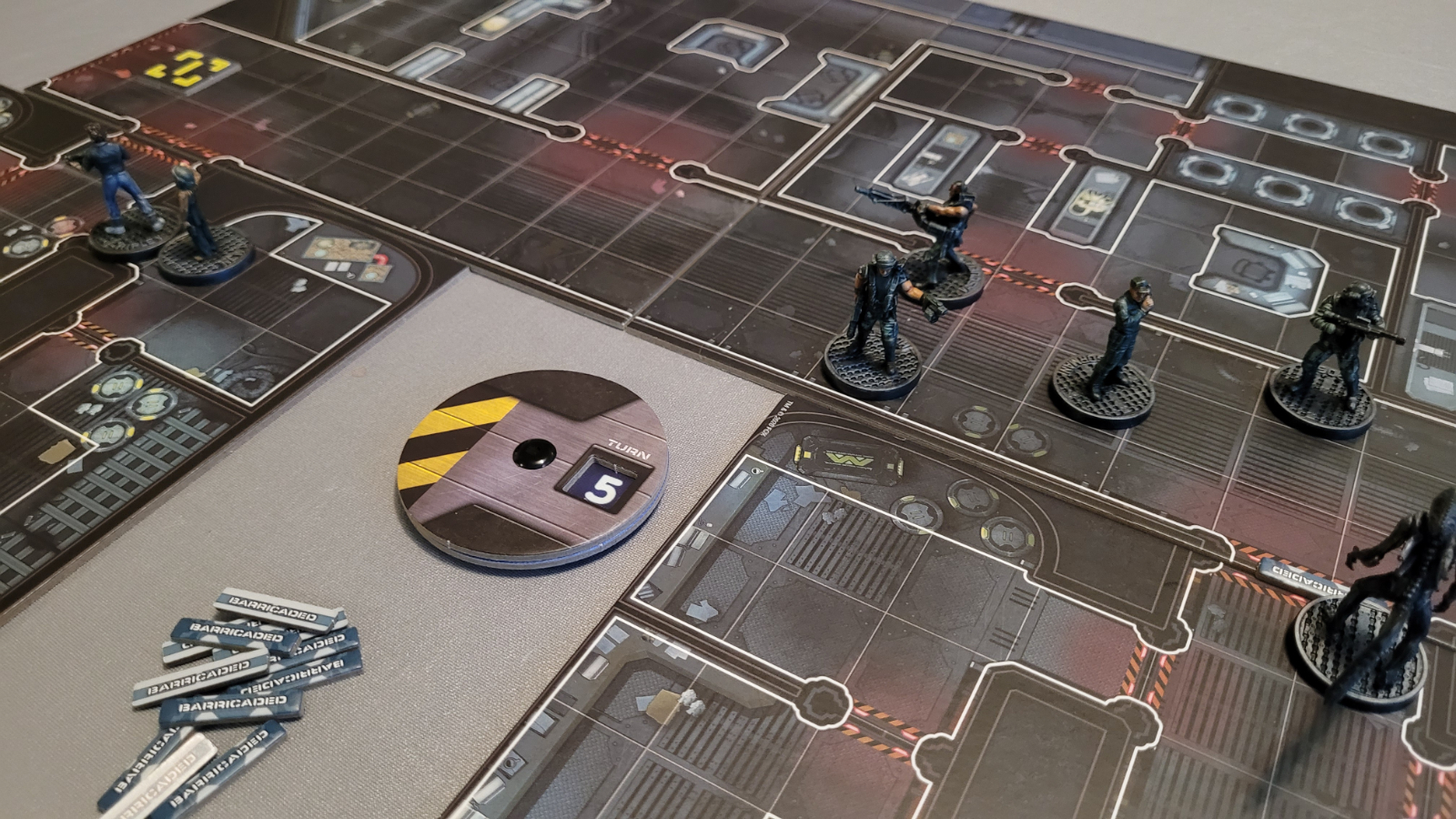
The components are definitely light years ahead of the Leading Edge game, with heavy cardstock boards and detailed plastic miniatures. There have been a fair number of complaints in various forums online about the fact that the miniatures require assembly, without any warning on the box, but they include detailed instructions and I didn't find it particularly difficult. The only poor design decision here is that the Aliens have long, spindly hook-shaped tails that were a little challenging to attach, get in the way during play, and make the miniatures difficult to store (remember Barrel of Monkeys?). They're nice looking miniatures though, and as far as I know, this is the first time the actual human characters from the film have been represented by official 28mm gaming scale figures.

The game uses miniatures, gridded tiles, cards and dice to recreate the key scenes from the film. Each player takes control of a single character, and any remaining characters remain in the game as "grunts" that the players can order around, but without complex game info to keep track of. This means you always have the same number of characters on the board, but your team has more interesting abilities if you have more players. Of course, that also means the game will be more challenging.

While the game is played out on a grid with miniatures, the core game element is the Endurance Deck, a stack of 60 cards representing weapons, equipment, events, and hazards. The deck is used as a timer (when the deck runs out the players lose the game), a currency to pay for game effects (by discarding cards from the deck), a way to generate random effects and give players extra tactical choices (by drawing or revealing cards). It also contains a few Hazards, negative effects that must be resolved when the card is drawn or revealed. It's very similar to the way the old Star Wars Customizable Card Game worked, but honestly the idea is so good that someone should be using it.

At the end of every turn, the players draw several "Blip" cards to determine where the Aliens appear. Aliens start out as blip tokens, unseen until they move into proximity to the human characters, at which point the tokens are replaced by one or more Alien miniatures. It's a neat effect that mimics the tension-building motion trackers from the film, and allows for some uncertainty as you don't know how many Aliens are approaching until they're in the room with you.

The details of the different scenarios allow for some variety, but ultimately the goal is always to escape the board with as many survivors as possible. This leads to some agonizing tactical decisions: do I take the time to weld that door shut, or just run for it? Do I keep my marines near the door to cover each other and all escape together, or is it better to risk some of them so that others can get out for certain?

If anything, my only complaint is that if too many Aliens are on the board all at once it can get to be a bit of a grind, both with the sheer number of Aliens you're moving around each turn, and also with the repetitive rolling to try to shoot Alien after Alien. But it's a good game that definitely simulates the action and tension of the film.

Rating: 3 (out of 5) I'm docking this game one star for the murky, hard to follow rule book, and another in acknowledgement that my overwhelming affection for the source material makes this game more fun for me than it might be for others.

Friday, March 10, 2023

Batman Miniature Game: Gotham's tiny reckoning

I won't lie to you, the Batman Miniature Game by Knight Models is not an easy game to get into if you're a North American gamer. The publisher is based in Spain, and has a reputation for being difficult to work with, so you don't see it on many store shelves, or even in many US-based online stores. On top of that, the game is currently in its third edition, with some pretty drastic rules changes between editions, and the game's introductory set is frequently out of print and usually pretty expensive, and the current version of the game relies on the use of a smartphone app that is buggy and incomplete. Now pile on the usual barriers to entry for tabletop miniatures games such as the time it takes to assemble and paint the miniatures and terrain, and it starts to seem like the bridges into Gotham City are barricaded, just as they were in 2012 Batman film The Dark Knight Rises.

The game's rulebook can be downloaded for free from their website, as can all of the cards you need to play (which will also allow you to bypass the aforementioned app), so as long as you have a robust printer and are able to get your hands on some miniatures and terrain, you can play the game, but it's an awful lot of DIY work in this age of self-contained, pre-packaged games like Conan or Mythic Battles: Pantheon.

But, once you get past all that, there is a really interesting game here.

Like most games of this type, each player assembles a force of 7-10 characters. In this case each team consists of a hero, a sidekick, a handful of henchmen such as thugs or policemen, and possibly one or two free agents to round everything out. Forces are generally limited to a particular faction, so Batman can't team up with the Joker, but there are a few neutral characters such as Catwoman who can join anyone's team.

The game is played out over 4 rounds, which doesn't seem like much, but there is quite a bit each character can do on their turn, so the time goes by quickly and the game usually feels finished by the end of round four. At the start of each round, each player chooses four of their characters to assign Audacity markers to. Characters without those markers will only get one action during the round (usually either a move or an attack), but those with Audacity will get three actions: one move, one attack, and one special action, which usually represents a character's unique ability, such as Batman using his grappling hook or Harley Quinn distracting her opponents with clownish antics.


The real meat of the game, and the thing that makes it more than just the usual slugfest, is the Objectives system, enacted in the game by Objective cards in a player's hand, and Suspect tokens on the board. Each player starts the game with a deck of 20 cards which form their objective deck. These cards are what adds story elements to the game, representing goals and maneuvers such as gathering evidence, stealing loot, taking or rescuing hostages, or (especially in the Joker's case) generally causing chaos.

Objective cards frequently interact with Suspect tokens, which represent civilians, loot, bombs, or anything that needs to have a physical presence on the board. During their turn a character can forego an attack to instead interact with a Suspect token, either placing one on the board, removing one of the opponent's, or moving them into strategic positions.

Objective cards are also the way each player scores points in the game, often making combat with the other player's miniatures secondary to fulfilling the conditions a card might call for. A lot of miniatures games have tried to add card-based mechanisms as a way to spice things up, but this is the most integrated and interesting system I've ever seen. The cards are an integral part of the game rather than a tacked-on extra.

My only major complaint about the game (other than how difficult to find and expensive the miniatures are) is that characters tend to have far too many special abilities. This might seem obvious for a super hero game, but I often find it difficult to keep track of the large number of game effects and when they're supposed to resolve, and sometimes trying to figure out how different abilities interact with each other can lead to some head-scratching moments.

While it is pretty complicated and tends to take a long time to play (we've had games go on for five or more hours), the game really does feel like a Batman story unfolding on the table.

Rating: 3 (out of 5) I'm marking it down a point due to the fairly unreasonable barriers to entry, but the game play itself is a solid 4 out of 5.

Wednesday, February 8, 2023

Unmatched: Now that's an epic duel

“A quick temper will make a fool of you soon enough.” -- Bruce Lee

To the best of my knowledge, there is only one tabletop game that lets you determine the winner in a fight between Bruce Lee and a tyrannosaurus rex. That game is Unmatched, and it deserves your respect.

Unmatched began its life as a Star Wars game called Epic Duels, published in 2002 by Milton Bradley and sold primarily in the toy store market. As a grid-based tactical combat game, Epic Duels was quite a bit more interesting than the usual toy store fare of the time, with players invited to imagine match-ups between characters from across the Star Wars timeline (as it existed in 2002, anyway), and realize those battles with a unique game system using miniatures, dice and cards. It was an interesting little game, especially by the standards of the time, but its nature as a piece of mass market movie tie-in merchandise meant that it didn't stay in print for long.

Robin Hood fights off a pack of hungry velociraptors

Fast forward to 2019. The core structure of Epic Duels has been revised, refined, and freed from the chains of the Star Wars license. Each player takes control of a character drawn from a wide range of mythology, literature, and popular culture, featuring everything from the aforementioned Bruce Lee to King Arthur, Sherlock Holmes, Buffy the Vampire Slayer, the velociraptors from Jurassic Park, and even a selection from the more obscure side of the Marvel comics universe such as Moon Knight and Ghost Rider. The game then uses miniature movement and card play to imagine a duel between whatever unlikely combination of characters have been chosen.

Most games of this type such as Heroclix or Firefly Adventures use a reasonably large board or map printed with a grid to determine movement and distance. Unmatched instead employs a small board illustrated with a series of connected, color-coded circles to establish each character's position. Miniatures can move along the connections between circles, and the circle's color indicates areas where ranged attacks can be made, eliminating the pesky line-of-sight arguments that are the bane of most miniatures games' existence.

Character actions are determined by a deck of cards, unique to each character. Cards represent attacks, defenses and special abilities that can be employed throughout the game. When combat ensues, the attacker plays an attack card with a numerical value face down on the table, then the defender plays a defense card, also face down. Both cards are revealed simultaneously, and the defender takes damage equal to the difference between attack and defense. Most of the cards have an effect that takes place either before or after the attack, which spices up the game and gives players a lot of tactical options to consider, both when attacking and defending. Damage is tracked using a simple dial. It's a wonderfully elegant system that handles attack and damage in one play, and eliminates the egregious "luck factor" of dice rolling.

Apart from the simple yet elegant game play, each Unmatched set is a class act from start to finish. The game is sold in stand-alone sets of 2, 3 or 4 characters, which allows players to try out the game with minimal investment, and also to stick to only the characters that they find interesting. Are you a Marvel fan with no interest in Little Red Riding Hood or Bigfoot? No problem, Unmatched has you covered. The boxes all come with a high quality plastic tray for all the components (a rarity these days), and while the cards are plenty durable, the trays will even accomodate sleeved cards. The miniatures don't come pre-painted, but they do come with a wash applied that brings out the details of the figure, and also a colored ring for the base that makes it easy to tell each player's characters apart.

The artwork on the cards is all original (even for the characters from licensed properties) and consistently excellent, and the graphic design is slick, contemporary and (most importantly) easy to read. The rulebook is well organized (also a rarity these days), but honestly, once you have the basics down you will rarely need to look at the rules -- the game design really is that good.

Ghost Rider artwork from the "Marvel: Redemption Row" set.

Rating: 5 (out of 5) Not just a great dueling game, but a great card game and a great miniatures game all rolled into one.

Wednesday, May 20, 2020

Judge Dredd: Helter Skelter -- miniatures on a board game budget


I love miniatures games. I enjoy the strategic and tactical thinking involved, but even more, I love the tactile nature of moving the figures themselves around in an environment, whether it's fully realized three dimensional terrain or just a printed map.

I also love a wide variety of different genres and intellectual properties, so unfortunately the work and investment that most miniatures games require means I can't play in every world I want to. That's why I'm especially intrigued by miniature/board game hybrids such as Monolith's Conan, with their potential for the depth of a miniatures game contained in a much more manageable (and affordable) box.

This is what drew me to Judge Dredd: Helter Skelter. I'm a big fan of  2000 AD (the weekly comic book that Judge Dredd appears in), but not quite willing to commit to a full fledged Dredd miniatures game, although the new one from Warlord Games has some great looking figures. As a self-contained boxed game, Helter Skelter looked like a great alternative.

The game takes some inspiration from an old Judge Dredd comic book story for it's background: holes have been opening in the fabric of reality, allowing characters from other dimensions to converge on Judge Dredd's Mega-City One. It's a clever idea that allows the game to include four player factions, each based on a different cast of characters from 2000 AD comics.

The game design is terrific. It uses a printed board with irregular areas marked out to handle movement, rather than using a grid or needing a tape measure. The board artwork is functional, clearly indicating important concepts such as cover and line of sight, and it's also beautifully designed and gorgeous to look at. The miniatures, while not fully pre-painted, come with a wash applied, so it's easier to see the figure details, and colored rings for the bases making it clear which figures belong to which faction.


At the start of the game each player is given 10 location cards that match up to the numbered spaces on the board. Five of these are secretly chosen and assigned to the player's five characters, to determine where on the board they will enter play. The other five cards are given to an opponent, and determine where they place their five "shards of reality," colored tokens that can be collected for victory points. 

Movement and combat are handled using cards. Each player uses a deck of cards unique to their chosen faction, with cards representing actions their different characters can take such as moving, attacking, or defending. The bulk of the game is managing your cards so you can move your figures to where they need to be, make effective attacks against opposing characters, pick up shards of reality tokens, and still have cards left to defend with when it's your opponent's turn. Collecting a shard of reality or eliminating an opponent's character are each worth one point, and the first player to get to five points wins.

It's a great rules system, providing all the core elements that a miniatures game needs without getting bogged down in the complicated exceptions and situational rules that can plague games like Heroclix or X-Wing. But there's one thing missing: a sense of narrative, an interesting story that unfolds on the tabletop. Most games of this type (such as Monolith's Conan or Leading Edge's Aliens) have this firmly ingrained by being scenario driven, and that's something that's missing here.

Sure, Helter Skelter provides a back story that explains why the different groups of characters are there and what they're doing, but there really isn't much story once the game starts. Collecting a shard of reality or eliminating an opponent's character are each worth one point, and the first player to get to five points wins. There aren't any additional scenarios offering different victory conditions, so most games tend to be pretty similar, with the only variety being which faction each player is using and which of the two boards they're playing on.

The lack of story certainly isn't a deal-breaker. The extremely elegant design and excellent graphics go a long way towards making up for it, and it's something that could easily be added by official expansions or even house rules. I certainly hope so; a game design this good deserves some more depth.

Rating: 4 (out of 5) A great design and beautiful production that's a bit let down by a lack of variety and replayability.

Thursday, December 26, 2019

Toy soldiers, part 3: Core Space

When I was a kid Star Wars toys were all the rage. One thing that the developers of the original Star Wars action figures back in the 1970s got absolutely right was that the space ships, vehicles and especially the environments were at least as important as the characters, so they scaled their toy line in such a way that they could include play sets representing locations from the films for kids (and adults) to place the characters in.

Environment is at the heart of Core Space, a game developed by the makers of the Battle Systems line of cardboard miniatures terrain. Their sci-fi series, representing space station corridors, futuristic cities, and planetary outposts, was their most recent (and most successful) product to date, so naturally when they decided to create a game to go with their terrain, it was going to have a space opera theme.

While they could have gone with a standard skirmish game, they opted instead for something with a lot more narrative and adventure to it. Players control crews of scoundrels and pirates in what is essentially a sci-fi dungeon crawl, creeping around in labyrinthine space stations searching for cash and equipment (and yes, the loot is even stored in futuristic treasure chests). While players can opt to attack each others' crews, that would take precious time away from searching for goods and interacting with non-player civilians who might provide useful information or even be persuaded to join the crew.
If it sounds too easy, there's the inevitable catch: the galaxy the game takes place in is under attack from an enigmatic race of killer robots, and a few turns into the game those robots start appearing on the board, their actions controlled by a simple but very effective AI that governs where they move and who they attack. As the game progresses, more advanced (and deadly) models start appearing, and the tension ramps up. The game turns into a "press your luck" situation where you know you should be moving all your crew back to the airlock, but wait, there's a cargo crate we didn't look in yet...

The rules are simple and cinematic, using proprietary dice and an easy measuring system for combat, and there are lots of options for non-combat actions like interacting with civilians, opening and closing doors, using computers and even breaking and jumping through windows. And the fact that the game is designed specifically for the Battle Systems terrain means it gets the most out of it.

The game really shines when played in a series of linked missions over several games, using an experience system that allows crew members to improve their abilities and equipment over the course of the campaign. It even allows for improvements to the crew's space ship, allowing it to do things like scan the station for information or even defend the airlock from off-screen.

Rating: 5 (out of 5) a well designed game with rich, familiar-yet-different characters and a setting that can't help but be fully immersive thanks to the ingenious terrain.

Friday, December 20, 2019

Toy soldiers, part 2: Gaslands

Gaslands is another in Osprey Publishing's line of miniatures rule books that exist on their own, without a particular line of miniatures or accessories to go with them. In this case, the game is about post-apocalyptic vehicle combat, so naturally it is designed to be played with Matchbox cars.

The game uses a template-based system for movement (similar to X-Wing) and a rather ingenious way to simulate speed, with cars in higher gear getting to move more often in a turn. The rules are simple and straightforward, aided by an over-arching "rule of carnage" that states that if any rule is unclear or open to multiple interpretations, always go with the option that does the most damage.

The simple rules make it a fast-paced game, which is what you want from a game about speeding cars. Each round is split up into "gear phases" in which cars moving at that gear or higher get to move and then attack (either by ramming or shooting). Going faster gets your vehicle more chances to act, but it also reduces your choice of movement template, which could see your car unexpectedly careening into a bit of terrain, or even off the board all together.

Players are presented with a number of options for creating their cars, including different types of vehicles such as buggies, motorcycles, performance cars, pickup trucks, and even the dreaded War Rig. Cars are then festooned with armaments ranging from basic machine guns to land mines and oil slick sprayers. There is even one faction armed with mad science lighning projectors and EMP pulses, and another that uses jury-rigged catapults to lob bits of junk at their enemies.

While the game is undoubtedly a lot of fun to play, the real joy for most players is in customizing their toy cars, adding machine guns and rams along with dents, scratches, rust and weathering. An entire community has popped up on places like Etsy, providing accessories for players to stick to their toy cars, and in most Gaslands forums there is a lot more discussion about modeling the cars than there is about actually playing the game.

One of my criticisms of Ronin was the lack of accessories such as stat cards, but that's less of an issue with Gaslands, mainly because the game is a lot more popular and there are numerous online resources providing everything from plastic movement templates and custom engraved dice to reusable blank vehicle cards.

Rating: 5 (out of 5) A terrific high-octane vehicle combat game. It may take a bit of prep time if you want to create custom cars to play with, but that really is half the fun (at least).