Showing posts with label superheroes. Show all posts

Tuesday, January 28, 2025

Marvel D.A.G.G.E.R. and the importance of perceived value

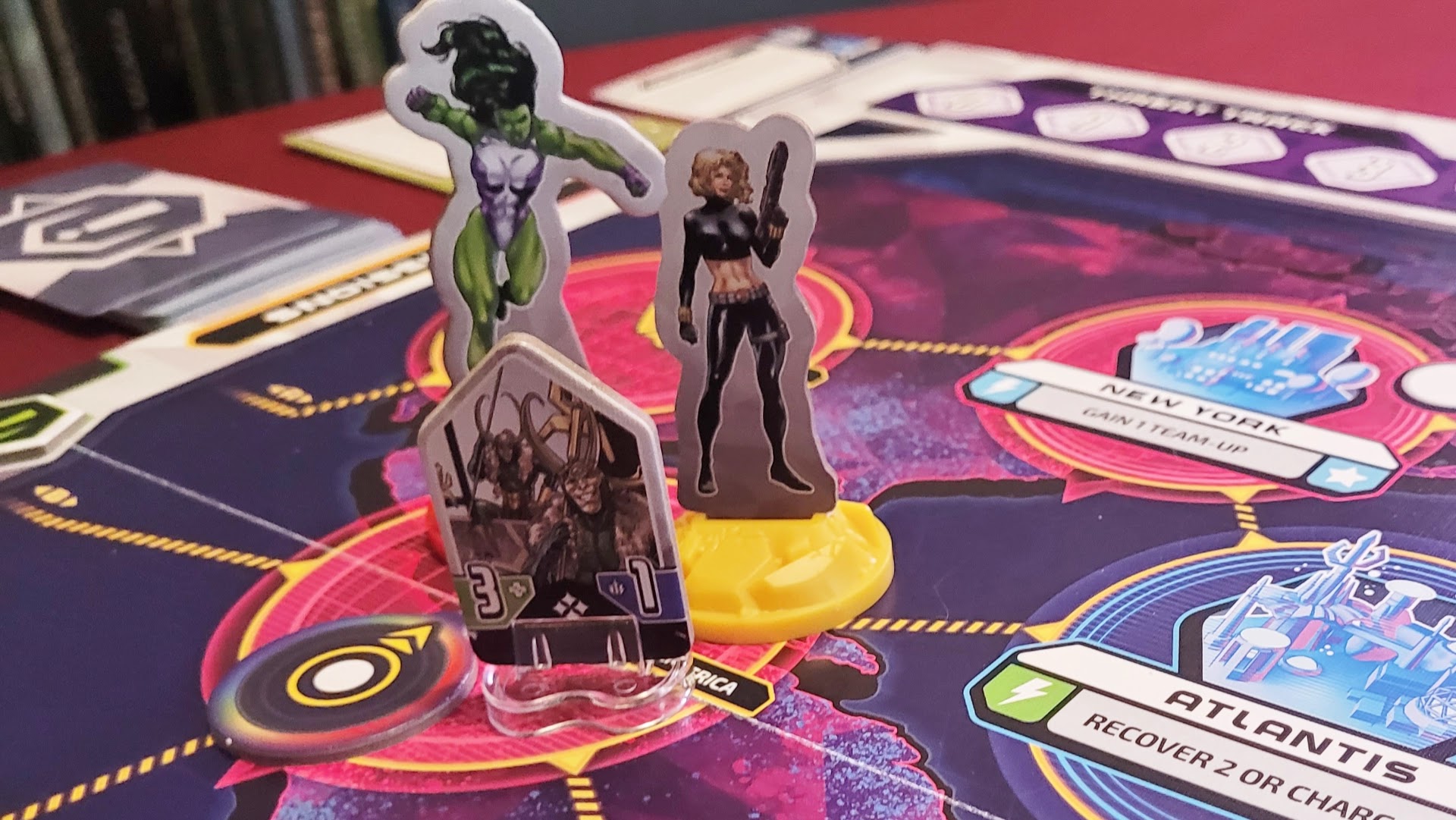
Marvel D.A.G.G.E.R., a cooperative board game in the same vein as Arkham Horror or Pandemic, was released by Fantasy Flight Games in 2023, with very little fanfare. There wasn't much marketing for it that I can recall -- the first time I remember seeing it was in a local store, and while the game looked interesting, I balked at the $90 price tag, which (if the prevailing discussion on BoardGameGeek upon its release is any indication) is what many potential buyers did. I eventually picked up a used copy for a much more reasonable price.

The game itself is quite engaging. It does indeed play a lot like Pandemic or Arkham Horror/Eldritch Horror -- players take on the roles of Marvel superheroes attempting to stop one of four powerful supervillains from destroying important locations such as New York City, Wakanda, and Atlantis. Each villain has its own particular way of spreading their minions across the board, giving the heroes foes to fight and tasks to perform in a race against time.

Over the course of the game, the players will have three villain-specific missions to solve. These usually involve moving to a specific location and passing a dice-rolling test, or doing a particular action a set number of times. Each hero also has their own side mission, which will reward them with an in-game bonus if they complete it, and the game will deal out more general side missions such as defeating less powerful supervillains. Meanwhile, at the end of each turn a threat tracker counts down based on how many locations have been destroyed, and how many villains are in play -- this tracker acts as a timer, giving the players a limited number of turns to complete each mission.

Once all the main missions have finished (pass or fail), the heroes enter into a final showdown with the villain, which plays out differently depending on who you're fighting.

There are 20 different heroes to chose from...sort of. The game leans into the legacy aspect of many of Marvel's characters, where a new personality will take over a well-known identity like Captain America or Spider-Man. Each hero card is double-sided, featuring a different version of the hero (or a similar hero) on each side: Sam Wilson or Steve Rogers, Iron Man or War Machine, Hulk or She-Hulk, and so on. You choose which one to start with, but if you character is incapacitated during the game (which happens often), you flip the card over as the other version of the character steps in to take over.

In addition to heroic identities, each player begins with one of six aspect cards. These are descriptors such as Protection, Vigilance, or Justice that put a different spin on the game's four basic actions. It adds a lot of interesting variety to the game and should substantially increase replayability, as players will be able to try out all the different hero/aspect combinations.

Thematically it's very similar to the Marvel Champions card game, carrying over the hero/aspect idea as well as the structure of heroes acting cooperatively to defeat a game-controlled villain. But Marvel Champions tends to emphasize the individual players acting based on the strengths and weaknesses of their deck, while Marvel D.A.G.G.E.R. requires a much more Pandemic-like, teamwork driven approach.

It doesn't quite have Arkham Horror or Eldritch Horror's depth of story, but that's not really a problem. Most players will be familiar with the back stories of the Marvel heroes and villains in the game, and if they're not, the game includes a handy booklet detailing each character's biography. One of my biggest problems with Eldritch Horror was the breakneck pace of the game -- I never felt like I had time to just explore the world and its storylines. With Marvel D.A.G.G.E.R. I already know the characters, so I'm happy to focus on being in the moment and defeating the villain. The sense of urgency is fun rather than stressful.

So what went wrong with Marvel D.A.G.G.E.R.? While it is still in print and available from the publisher, the consensus seems to be that it is a failed product and not likely to receive any further support in the form of expansions or promotion. Well, as mentioned before, the first problem is the price. Board games have gotten steadily more expensive over the years since, say, Arkham Horror second edition or the original Pandemic came out. Some of that is just general inflation, and a lot of it is being blamed on post-pandemic supply chain issues, specifically drastic increases in printing and especially shipping costs.

The game has a generous amount of content, with hundreds of full-color cards and counters, but it does feature cardboard standees in place of the plastic miniatures that have become fairly standard issue for this type of game. Although the truth is likely a lot more complicated, there is a perception that cardboard is less expensive than plastic, and therefore a game featuring standees instead of miniatures should cost less. In reality, the vast bulk of a game's cost is (or at least, should be) down to its design and development.

I think it's possible that a lot of the game-buying public has grown accustomed to Kickstarter games that tend to be lavish productions but also labors of love from small companies or individual designers -- the asking price of these games covers their production costs but not necessarily the hourly labor that went into creating the game's ideas and mechanisms. Put another way, when people are assessing the value of a game, they're often only looking at the relative amounts of cardboard and plastic. In any case, Marvel D.A.G.G.E.R.'s asking price was just more than the market would bear.

Cloak & Dagger by Rick Leonardi. © Marvel.

The other problem with Marvel D.A.G.G.E.R. is the title -- it's terrible. It doesn't give you any idea of what the game is about. While the game's logo explains that D.A.G.G.E.R. stands for "Defense Alliance for Global and Galactic Emergency Response," it seems like they could have come up with something less clinical and more exciting. Besides, Marvel's Dagger isn't even in the game...

Rating: 4 (out of 5) If you've ever thought that Pandemic or Arkham Horror would be more fun with Marvel superheroes, this game is probably a good bet for you, and a lot of online retailers have it for a much more reasonable $50 or less.

Friday, March 10, 2023

Batman Miniature Game: Gotham's tiny reckoning

I won't lie to you, the Batman Miniature Game by Knight Models is not an easy game to get into if you're a North American gamer. The publisher is based in Spain, and has a reputation for being difficult to work with, so you don't see it on many store shelves, or even in many US-based online stores. On top of that, the game is currently in its third edition, with some pretty drastic rules changes between editions, and the game's introductory set is frequently out of print and usually pretty expensive, and the current version of the game relies on the use of a smartphone app that is buggy and incomplete. Now pile on the usual barriers to entry for tabletop miniatures games such as the time it takes to assemble and paint the miniatures and terrain, and it starts to seem like the bridges into Gotham City are barricaded, just as they were in 2012 Batman film The Dark Knight Rises.

The game's rulebook can be downloaded for free from their website, as can all of the cards you need to play (which will also allow you to bypass the aforementioned app), so as long as you have a robust printer and are able to get your hands on some miniatures and terrain, you can play the game, but it's an awful lot of DIY work in this age of self-contained, pre-packaged games like Conan or Mythic Battles: Pantheon.

But, once you get past all that, there is a really interesting game here.

Like most games of this type, each player assembles a force of 7-10 characters. In this case each team consists of a hero, a sidekick, a handful of henchmen such as thugs or policemen, and possibly one or two free agents to round everything out. Forces are generally limited to a particular faction, so Batman can't team up with the Joker, but there are a few neutral characters such as Catwoman who can join anyone's team.

The game is played out over 4 rounds, which doesn't seem like much, but there is quite a bit each character can do on their turn, so the time goes by quickly and the game usually feels finished by the end of round four. At the start of each round, each player chooses four of their characters to assign Audacity markers to. Characters without those markers will only get one action during the round (usually either a move or an attack), but those with Audacity will get three actions: one move, one attack, and one special action, which usually represents a character's unique ability, such as Batman using his grappling hook or Harley Quinn distracting her opponents with clownish antics.


The real meat of the game, and the thing that makes it more than just the usual slugfest, is the Objectives system, enacted in the game by Objective cards in a player's hand, and Suspect tokens on the board. Each player starts the game with a deck of 20 cards which form their objective deck. These cards are what adds story elements to the game, representing goals and maneuvers such as gathering evidence, stealing loot, taking or rescuing hostages, or (especially in the Joker's case) generally causing chaos.

Objective cards frequently interact with Suspect tokens, which represent civilians, loot, bombs, or anything that needs to have a physical presence on the board. During their turn a character can forego an attack to instead interact with a Suspect token, either placing one on the board, removing one of the opponent's, or moving them into strategic positions.

Objective cards are also the way each player scores points in the game, often making combat with the other player's miniatures secondary to fulfilling the conditions a card might call for. A lot of miniatures games have tried to add card-based mechanisms as a way to spice things up, but this is the most integrated and interesting system I've ever seen. The cards are an integral part of the game rather than a tacked-on extra.

My only major complaint about the game (other than how difficult to find and expensive the miniatures are) is that characters tend to have far too many special abilities. This might seem obvious for a super hero game, but I often find it difficult to keep track of the large number of game effects and when they're supposed to resolve, and sometimes trying to figure out how different abilities interact with each other can lead to some head-scratching moments.

While it is pretty complicated and tends to take a long time to play (we've had games go on for five or more hours), the game really does feel like a Batman story unfolding on the table.

Rating: 3 (out of 5) I'm marking it down a point due to the fairly unreasonable barriers to entry, but the game play itself is a solid 4 out of 5.

Wednesday, May 27, 2020

Marvel Champions: do we need another hero?

As an avid player of Legendary, I wasn't all that interested when Fantasy Flight Games announced that they would be publishing Marvel Champions, the latest in their line of Living Card Games that has included Call of Cthulhu and Lord of the Rings. As it is I feel like I've barely scratched the surface of the available content for Legendary, so why would I need more than one Marvel super hero card game? And besides, I really don't have time for another game where you have to build decks.

However, as I started to find out more about the game, I got more interested. It looked like the structure would be similar to FFG's Lord of the Rings: the Card Game, but refined and streamlined, and the deck building could be reduced to simply choosing a hero and what the game calls an "aspect," a theme such as aggression, protection, leadership, or justice. I was intrigued enough to give it a try.


The game's similarities to Lord of the Rings are very apparent, with the focus on narrative and the primary player decision being whether to spend your turn fighting adversaries or progressing the story (in this case, thwarting the main villain's evil scheme). It's cooperative, with each player taking on the role of a hero and teaming up to foil one of a variety of villains whose actions are controlled by the game. The cards are divided into allies & support cards that stay in play and events that have a one-time effect, and there's even one card, Nick Fury, that is clearly a direct translation of the Gandalf card from Lord of the Rings. 

Despite the similarities, however, Marvel Champions has enough unique elements to make it more than a simple re-skin. The game uses an ingenious system to reflect the classic "secret identity" trope: your deck is built around a single character with a double-sided card: hero on one side, and civilian identity on the other. Many cards will only work with one side or the other, with attacks and other proactive actions associated with the hero side, and recovery and support actions with the civilian side. The way the villains behave also depends on which identity is active -- if you're in heroic mode they'll attack you, but if you're hiding out in your civvies they'll work on progressing their evil scheme, which if completed will cause the heroes to lose the game.


In addition to the main villain and his assorted thugs, each hero brings their own set of cards representing their arch-enemy and personal obligations, which may be shuffled into the villain deck at various points during the game, which really adds to the sense of story.

So how is it different from Legendary? Well, apart from being a somewhat different style of game (Legendary is a deck building game where players build a deck during the game, while in Marvel Champions players begin the game with a deck representing their chosen hero), the sense of story is more developed and personalized in Marvel Champions. In Legendary, players choose five heroes at the start of the game, and then spend the game buying cards associated with those heroes, looking for useful combinations of cards but not necessarily focusing on a single character -- the sense is that the players are unseen tacticians guiding the action. In Marvel Champions, you are playing as a particular character such as Spider-Man or Captain Marvel, using their unique allies and abilities to foil the villain. I enjoy both games for different reasons, and don't see a reason to choose one or the other.

Rating: 5 (out of 5) a unique and compelling game that plays well right out of the box but also supports a level of expansion and customization that should keep most collectible card game players happy.

Monday, November 11, 2019

Marvel Strike Teams: a superhero dungeon crawl


On first glance, Marvel Strike Teams looks like another variant in Wizkids' Heroclix line of games. It has many similarities, both thematic and mechanical, but a number of differences that make it an interesting game in its own right.

Like Heroclix, Marvel Strike Teams is a tactical superhero battle game. It uses a grid system for movement and range, and characters find their powers and abilities decreasing in effectiveness as they take on damage, which is a hallmark of the Heroclix system.

Unlike Heroclix, Strike Teams is a one vs. many style game, with one player taking on the role of a supervillain and his minions, and the others each controlling a single hero and working cooperatively to foil the villain's dastardly plans. It's also much more mission oriented, with victory centered on accomplishing certain in-game goals (such as rescuing hostages or finding macguffins rather than just trying to obliterate your opponent's forces. In spite of the superhero theme, the game structure is that of a classic "dungeon crawl," with heroes creeping through rooms and corridors in search of treasure and a quick exit.


The game is designed to be played campaign style over multiple game sessions, with both the heroes and the villains gaining experience and improving their abilities between games, another thing that sets it apart from the one-off battles of Heroclix and makes it seem more like a D&D-style dungeon crawler.

But the really innovative thing about Strike Teams is that it uses a diceless system for combat. Players instead use resource management and damage control to accomplish their side's goals during the game.

Each round, characters are given a certain number of action points, which can be spent to move, heal damage, use special powers, and most importantly, attack and defend. Action points can be saved up from round to round (up to a pre-set maximum), so game play is a balancing act between moving, attacking, and saving aside points to defend your character against attacks.

It's very different from most battle games (including Heroclix), which use random dice rolls to determine the outcome of combat. Sure, most of those games will include game mechanics to mitigate the randomness such as rerolls, bonuses, and extra dice, but there is always the chance that an attack will go badly due to random chance that is outside the player's control.

Monolith's Conan game is probably a closer comparison in terms of the level of strategic resource management and focus on scenario goals over outright fighting, but even it uses dice to resolve combat.

With only a handful of characters to choose from in the base game an one small expansion, Strike Teams lacks the epic scope of what Heroclix can offer with its thousands of different figures over multiple franchises. It's a pity there aren't more expansions planned for Strike Teams, because mechanically it's a much more interesting game.

Rating: 4 (out of 5) A terrific alternative to battle games like Heroclix, but unfortunately its lack of commercial success will limit this game to only a handful of characters and limited replayability.

Friday, August 5, 2016

What took us so long to get into Legendary: A MARVEL Deck Building Game?


I'm not really sure why it took me so long to buy into Legendary: a MARVEL Deck Building Game. I'm a big fan of the superhero genre, and of deck building games in general. It could be that I already had several editions of the DC Comics Deck Building Game, although the two games aren't really very similar. I picked up Legendary Encounters: an ALIEN Deck Building Game on the first day it was released, and it remains one of my favorites. I also bought the Predator edition, and have plans to pick up the forthcoming Firefly and Big Trouble in Little China editions as soon as they are available. Maybe that's what finally got me to pull the trigger on the original Marvel edition.

It's interesting coming to the original Legendary game after playing both Encounters versions. They are recognizably the same game with only minor structural changes. Where Alien and Predator both use scenarios based on the films to structure the cards that players play against, Marvel uses different combinations of super villain masterminds, lower-level villain groups, and plots pulled from decades of comic book storylines.

Legendary's basic approach is a little abstract. Rather than each player taking control of a specific hero or a team of heroes, they instead start with a simple deck of cards representing SHIELD agents. Players then gradually add cards to their decks representing signature moves from a pre-selected group of superhero characters (usually five), so the game isn't so much "I control Wolverine and you control Spider-Man" as it is all of the players orchestrating Wolverine and Spider-Man's battle against the various villains menacing the city.

Plot cards provide all manner of interesting variants on the basic rules, creating different win conditions and sometimes making the villain cards behave in different ways. Each plot is presided over by a Mastermind villain who brings his own henchmen and tactics to the game, and with near-infinite combinations of plots and Masterminds, you can guarantee that no two games will ever be alike.

The Marvel version of Legendary really puts you in the middle of a superhero battle, so much so that it's all the more interesting that the game system seems so well suited to the Alien and Predator franchises too. Best of all, since the core Legendary game is more or less compatible with the Encounters editions, you can have the Avengers try to fight off an invasion of acid-blooded Aliens, or see how Wolverine matches up against the Predator...

Rating: 5 (out of 5) Legendary is a robust game system with a huge amount of replay value, especially if you're brave enough to start mixing and matching the different editions.

Friday, August 21, 2015

How I learned to stop worrying and love the DC Comics Deck Building Game

The first time I tried the DC Comics Deck Building Game was at a game convention in 2013, and I didn't really like it all that much. I thought it was overly simple and not very interesting.

This was about a year and a half after DC Comics launched the "New 52," a complete reboot of all their comic book titles. I had been an avid DC Comics reader since the 1980s, but I didn't really care for the changes they made to their characters and storylines with the New 52, so I wasn't really very happy with DC at all, and my dissatisfaction was probably leaking through and interfering with my enjoyment of the game.

A friend reintroduced me to the game in January of this year, and this time I enjoyed it quite a bit. Maybe it was the fact that I was playing it with friends instead of convention demo staff, or maybe my irritation with DC Comics had subsided. Maybe it's just that I got to play as my favorite DC character (Superman). In any case, I did like the game enough to pick up a copy of the base game and the Heroes Unite and  Forever Evil expansions.

I still think it's a simple game, but I don't see that as a negative. As deck building games go, this one is about as easy to play as it gets: Each player chooses a hero with a unique game ability to play, and starts with a deck of basic Punch and Weakness cards. The main deck is shuffled, and five cards are played out, which represent heroic allies, villainous opponents, equipment, and super powers, all of which are bought by playing cards from your hand for their power value (just like any deck building game). The object of the game is to use the cards in your hand to buy better cards for your deck.

Additionally, there is a stack of super-villains, each of which must be defeated, again by playing cards from your hand. The super-villains tend to cost a lot more power than cards from the deck, and as each new super-villain card is revealed, it attacks all the players with a negative game effect. I particularly like the super-villain stack idea, as it gives the players something to work towards (building up higher-power cards to defeat the super-villain) and it gives the game a time limit, as the game ends when the last super-villain is defeated.

Rating: 4 (out of 5) Not a complex game by any means, but it's great for casual play with non-gamers, or as a light warm-up before settling in for something more involved.

Tuesday, July 15, 2014

Mwahahaha! -- Mine is an evil laugh


Mwahahaha! is, according to the box, "a card game of mad scientists and global domination." Players take on the roles of comedic mad scientist supervillains such as Herr Ubervoldt, Baron Morbidodictus, or Professor Kontiki, and the game play consists primarily of accumulating resources used to power doomsday weapons with an eye towards using them to threaten ever-increasing population centers.

The game really seems to understand the circular futility of being a mad scientist: successfully threatening a population gives you more resources, so you can use to build a bigger doomsday weapon that you can then use to threaten a larger population, in order to get even more resources to build an even bigger doomsday weapon...you get the idea.

Each player starts with a doomsday device to work on, such as an interstellar portal, a weather machine, or a giant robot, which requires a certain number of different types of raw materials to get working. Players gain a small number of raw materials each turn, and in order to get more they can either build up a criminal empire via location cards that represent front businesses, or they can hire minions to go steal what they need from the other players (or some combination of the two). The device's raw materials requirements are scaled depending on how large a population you plan on threatening with it, either a city, a state, a country, or the whole world.

Success or failure when issuing a threat is determined by the dice. If a city, state or country population refuses to be intimidated, you have the option of triggering your doomsday device, unleashing man-eating plants or blasts from a giant orbital laser, and failure to make good on your threat results in a Humiliation counter that reduces your effectiveness on future threat rolls.

However, if you fail to successfully threaten the World, you can't trigger your device, as it would destroy the world and you with it. But hopefully the population of the world won't call your bluff...

Mwahahaha! is a fun game with a light, cartoony tone that should appeal to fans of Dr. Horrible's Sing Along Blog or '80s James Bond movies. The game's main downfall, however, is its poorly written rule book, which makes it seem a lot more complicated than it actually is.

Rating: 2 (out of 5) A pretty fun game that gets its humorous tone just right, but it definitely involves more random luck than strategy, and the badly organized rule book makes it difficult to pick up and play.


Date played: May 27, 2014

Thursday, July 3, 2014

More than heroes


Superheroes seem to spend most of their time fighting, whether it's fighting with their arch-villains or each other. It is no surprise then that most superhero games tend to be player vs. player combat games such as Heroclix or the Vs. System trading card game. There appears to be little room for nuance in the world of superhero gaming, which is unfortunate because some of the best stories ever told can be found in the pages of superhero comic books.

The Marvel Heroes Strategy Board Game is something of an anomaly. Originally published in Italy, it was brought to the English language game market in 2006, when Heroclix was at the height of its popularity. Under other circumstances, Marvel Heroes might have received more attention for its 20 fully painted plastic miniatures of characters such as the Hulk, Captain America, Thor, and Wolverine, but Heroclix had flooded the market with little plastic superheroes, so Marvel Heroes got lost in the shuffle and wound up having a very short shelf life, with the publisher unable to justify the high cost of the Marvel Comics license.

It is unfortunate that the two games couldn't coexist, because they couldn't be more different from one another. Marvel Heroes offers a welcome break from the relentless battles of Heroclix, with story-based game play focused on mission solving, and  players only tangentially in opposition to one another. Each player assumes control of a team of heroes, either the X-Men, Avengers, Fantastic Four, or Marvel Knights (a collection of the normally solitary heroes Spider-Man, Daredevil, Elektra and Dr. Strange). Players also control the arch-nemesis of one of their opponents, either the Kingpin, the Red Skull, Magneto or Dr. Doom.


The game combines resource allocation with a healthy measure of superhero combat. Players must spend their plot points to ready their heroes and play cards representing allies and other resources, and then send their heroes into New York City to tackle Headline cards that represent incidents such as bank robberies, earthquakes and kidnapped scientists. During each headline the player must fight a villain played by their opponent, and at certain times they must face their arch-nemesis directly.

It gets past the problem of "who gets to play the heroes" by having each player play as their own team of heroes as well as the arch-villain of their opponent, and so combines the best aspects of "race to the finish" type games and head to head battle games. Players are given plenty of strategic decisions to make during the game, as certain heroes are better suited to go after certain headline cards, and many have combat or support abilities that can help or not depending on what is happening in the game. And with your opponent actively controlling your arch-nemesis as well as the minor villains you face, it never feels like you're just up against a random assortment of cards. Different scenario cards offer variant win conditions to keep the game fresh and replayable.

Marvel Heroes reminds us that, while epic battles are fun to watch, it is the stories that make superheroes interesting.

Rating: 4 (out of 5) A game with a lot of strategic and narrative depth, that scratches the superhero itch while offering a lot more than just a mindless slugfest.


Date played: May 10, 2014

Monday, June 30, 2014

The thrill of the chase


Over the years, collectible games like Magic: the Gathering have gotten a bit of a bad rap for what is perceived as the "scam" of selling cards or miniatures in randomized booster packs, thus "forcing" players to spend a ton of money in order to get the cards or miniatures they need to play. I take issue with that idea for two reasons. First of all, no one can force you to buy something you don't want. But more importantly, building up a collection of game pieces with which to customize your deck of cards or army of miniatures is a huge part of the experience of these games.

I think the thing that has soured a lot of players on the idea of chasing cards by buying booster packs is simply the rising cost of those packs. The cost of a pack of 15 Magic: the Gathering cards has risen from $2.25 in 1993 to $4.00 today, and a Heroclix booster pack, $8 for four figures in 2002, is now $15 for five figures. In fairness, the average cost of a movie ticket or a comic book has more than doubled since 1993, but I can see where the thrill of collecting might diminish a bit when players are shelling out $100 or more every few months to maintain their collections.

All of which brings us to Marvel Dice Masters, a collectible dice game that combines elements of card games like Magic with colorful, custom-printed dice featuring characters from Marvel Comics. The game is sold in a starter set that includes all the basic dice needed for two players, plus dice representing Marvel characters such as Iron Man, Captain America and the X-Men, and booster packs containing two random dice with their accompanying cards that explain their abilities in the game. The booster packs retail for a mere 99 cents, substantially cheaper than a pack of Magic or Pokemon cards.

Since its release in April the game has been incredibly popular, so much so that the publisher is struggling to keep up with demand. The game's success seems to prove my point that maybe it's not the collectible format that players have grown weary of, but the amount of money they're talking themselves into spending on it.

The game itself is very similar to Wizkids' earlier Quarriors. Players begin with a bag full of basic dice that represent energy, which is spent acquiring more and better dice that represent characters who do battle with the opponent's dice. But Quarriors takes its game structure from deck building games like Dominion, with players all choosing from a common pool of dice, and their characters never staying in play for more than one round. Dice Masters uses the the collectible game model, with each player bringing their own "team" of dice, using combinations and strategies that have been thought out before coming to the table.

Each player begins with 8 "sidekick" dice in their bag, and an assortment of dice with corresponding cards representing Marvel characters (as well as iconic items such as Captain America's shield and Thor's hammer) on the table in front of him. There are also an assortment of action dice in the center of the table, that both players have access to. On his turn, a player draws and rolls 4 dice from his bag. These dice can come up as either one of four types of energy, or a generic sidekick character. The energy is used to add character dice to the player's bag from among those he's brought to the game. When the character dice are eventually drawn and rolled, they can come up as energy to spend, but also as characters that are used to attack the opponent's dice, or the opponent directly if he has no defenders available. The goal is to reduce your opponent's life total to zero from a starting value of 10-20, depending on the scale of the game.

Marvel Dice Masters is a lot of fun, with entertaining game play to back up the great looking dice. I find myself less interested in the more competitive team building aspect of the game; when we play, we always just take turns choosing the dice we're going to use. I must admit that I wouldn't mind at all if it were sold in a boxed set like Quarriors, but I really don't mind the collectible aspect of the game. I still enjoy the thrill of the chase.

Rating: 4 (out of 5) There's not quite enough depth to this game to warrant a 5, but it is a lot of fun, and definitely offers more strategy than the more random Quarriors.


Date played: May 3, 2014

Wednesday, March 5, 2014

With great power comes increasing complexity...


Heroclix is a tabletop miniatures game of superhero combat. It evolved from Mage Knight, using that game's ingenious click-dial and a simplified version of its rules, eliminating its tape measure guided movement and randomly placed terrain in favor of maps with printed terrain and a grid for movement.

One of the major selling points of both Mage Knight and Heroclix was that they were much simpler than the more involved fantasy miniatures games such as Warhammer, with each figure's game information printed right on the base (color-coded and read with the aid of a simple reference card), which could be clicked down to keep track of damage and changes to the character's abilities over the course of the game.

What really set Heroclix apart from Mage Knight was the fact that it featured recognizable characters, first from the Marvel Comics universe, with DC Comics following soon after. Finally, players could answer age-old questions like "who would win in a fight between Superman and the Hulk?"

Hundreds of collectible figures were released, with frequent new versions of popular characters such as Spider-Man, Wolverine and Batman, and a brief foray into the world of independent comics brought more obscure characters such as Hellboy, Judge Dredd, and even the cast of the City of Heroes online computer game to the table.

Heroclix is a great game. It's fast paced, and has a lot of strategic depth. There are a lot of tactical decisions to make during a game, and games are seldom predictable due to the random element of rolling dice when your figure makes an attack. The collectible aspect of the game is a turn-off for some: figures are released in random booster packs, with rare figures usually being more powerful. But for others, collecting the figures is half the fun. Most of the fun for me is pitting different groups of heroes against each other, such as Marvel's Nextwave (from the comic by Warren Ellis and Stuart Immonen) vs. the Avengers from the recent movie.

Even though it is one of my favorite games, I don't play Heroclix very often. While it started out as a refreshingly simple game, over the years it has gotten gradually more complicated, as the game's designers struggle to add new elements in order to keep longtime players interested, a phenomenon known in the world of collectible gaming as "power creep." Because of that it has become difficult to teach, and its current complexity makes it difficult to pick up and play every once in a while, much like any collectible game.

Many local game stores offer weekly tournaments, where players can get together and play in structured events, but that offers its own set of challenges. In order to stay competitive, tournament players need to keep up with the most recent figures released for the game, and there is just too much new product coming out on a regular basis. The only way to really enjoy Heroclix at the store tournament level is to focus on it to the exclusion of all else, and quite honestly I just haven't got the financial resources or attention span to do that.

I don't keep up with the game any more, but it still catches my eye when I see a new Heroclix product at the game store. The game's publisher has released figures from Lord of the Rings and even spaceships from Star Trek that use the same rules but are closed off from the more high-powered superheroes of the regular Heroclix universe (with Star Trek it is a question of scale as much as anything else). They've also started releasing fixed sets of figures with no randomness or rarity, and every once in a while I'll pick one of those up and convince my wife or one of our friends to spend the afternoon playing.

Rating: 4 (out of 5) Heroclix is a very immersive game that drives me to distraction. It would rate a 5 if not for two major barriers to playing regularly: somewhat overly complex rules, and a flood of product that is impossible to keep up with.


Date played: February 2, 2014