Showing posts with label cooperative. Show all posts

Tuesday, January 28, 2025

Marvel D.A.G.G.E.R. and the importance of perceived value

Marvel D.A.G.G.E.R., a cooperative board game in the same vein as Arkham Horror or Pandemic, was released by Fantasy Flight Games in 2023, with very little fanfare. There wasn't much marketing for it that I can recall -- the first time I remember seeing it was in a local store, and while the game looked interesting, I balked at the $90 price tag, which (if the prevailing discussion on BoardGameGeek upon its release is any indication) is what many potential buyers did. I eventually picked up a used copy for a much more reasonable price.

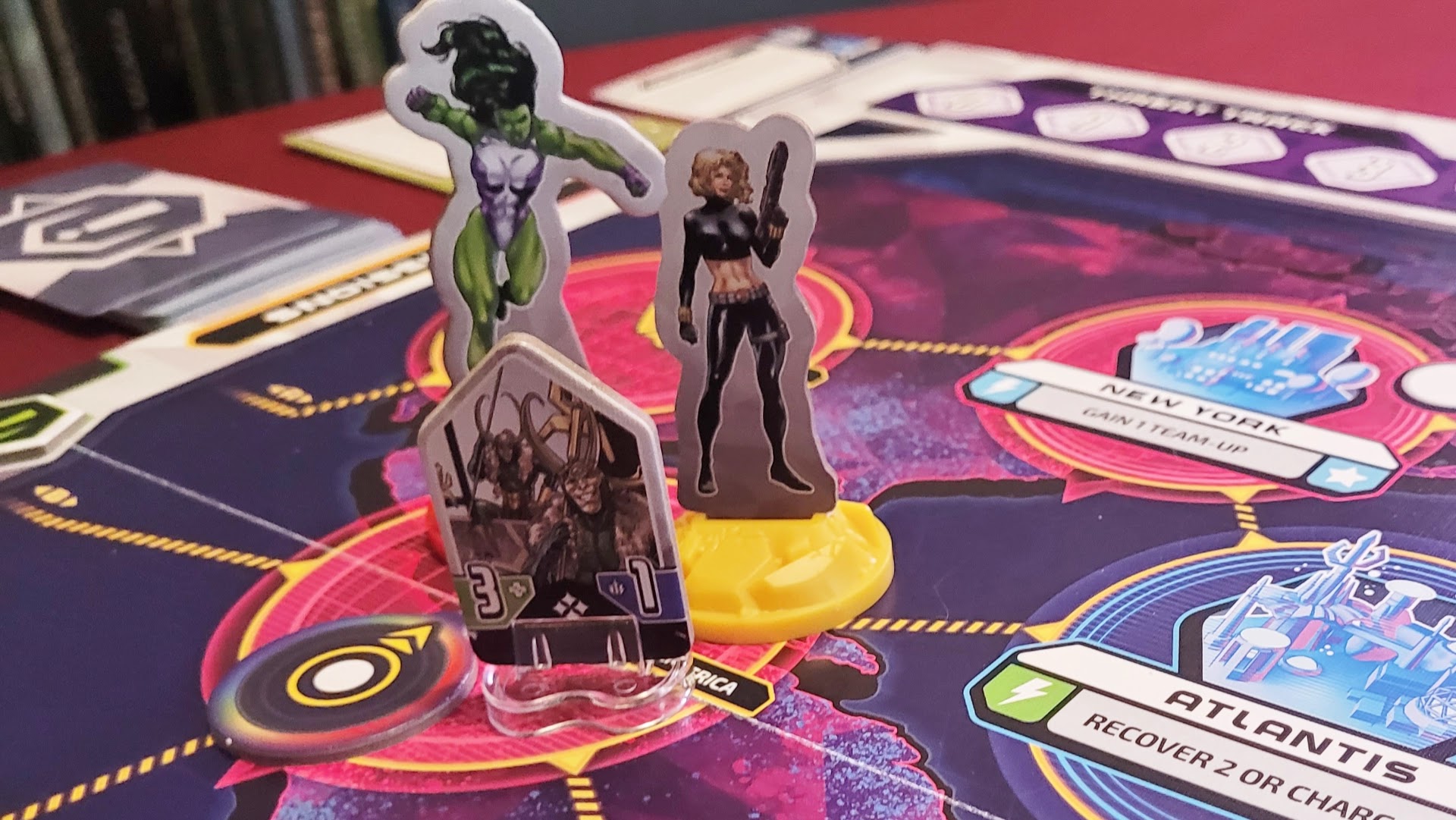
The game itself is quite engaging. It does indeed play a lot like Pandemic or Arkham Horror/Eldritch Horror -- players take on the roles of Marvel superheroes attempting to stop one of four powerful supervillains from destroying important locations such as New York City, Wakanda, and Atlantis. Each villain has its own particular way of spreading their minions across the board, giving the heroes foes to fight and tasks to perform in a race against time.

Over the course of the game, the players will have three villain-specific missions to solve. These usually involve moving to a specific location and passing a dice-rolling test, or doing a particular action a set number of times. Each hero also has their own side mission, which will reward them with an in-game bonus if they complete it, and the game will deal out more general side missions such as defeating less powerful supervillains. Meanwhile, at the end of each turn a threat tracker counts down based on how many locations have been destroyed, and how many villains are in play -- this tracker acts as a timer, giving the players a limited number of turns to complete each mission.

Once all the main missions have finished (pass or fail), the heroes enter into a final showdown with the villain, which plays out differently depending on who you're fighting.

There are 20 different heroes to chose from...sort of. The game leans into the legacy aspect of many of Marvel's characters, where a new personality will take over a well-known identity like Captain America or Spider-Man. Each hero card is double-sided, featuring a different version of the hero (or a similar hero) on each side: Sam Wilson or Steve Rogers, Iron Man or War Machine, Hulk or She-Hulk, and so on. You choose which one to start with, but if you character is incapacitated during the game (which happens often), you flip the card over as the other version of the character steps in to take over.

In addition to heroic identities, each player begins with one of six aspect cards. These are descriptors such as Protection, Vigilance, or Justice that put a different spin on the game's four basic actions. It adds a lot of interesting variety to the game and should substantially increase replayability, as players will be able to try out all the different hero/aspect combinations.

Thematically it's very similar to the Marvel Champions card game, carrying over the hero/aspect idea as well as the structure of heroes acting cooperatively to defeat a game-controlled villain. But Marvel Champions tends to emphasize the individual players acting based on the strengths and weaknesses of their deck, while Marvel D.A.G.G.E.R. requires a much more Pandemic-like, teamwork driven approach.

It doesn't quite have Arkham Horror or Eldritch Horror's depth of story, but that's not really a problem. Most players will be familiar with the back stories of the Marvel heroes and villains in the game, and if they're not, the game includes a handy booklet detailing each character's biography. One of my biggest problems with Eldritch Horror was the breakneck pace of the game -- I never felt like I had time to just explore the world and its storylines. With Marvel D.A.G.G.E.R. I already know the characters, so I'm happy to focus on being in the moment and defeating the villain. The sense of urgency is fun rather than stressful.

So what went wrong with Marvel D.A.G.G.E.R.? While it is still in print and available from the publisher, the consensus seems to be that it is a failed product and not likely to receive any further support in the form of expansions or promotion. Well, as mentioned before, the first problem is the price. Board games have gotten steadily more expensive over the years since, say, Arkham Horror second edition or the original Pandemic came out. Some of that is just general inflation, and a lot of it is being blamed on post-pandemic supply chain issues, specifically drastic increases in printing and especially shipping costs.

The game has a generous amount of content, with hundreds of full-color cards and counters, but it does feature cardboard standees in place of the plastic miniatures that have become fairly standard issue for this type of game. Although the truth is likely a lot more complicated, there is a perception that cardboard is less expensive than plastic, and therefore a game featuring standees instead of miniatures should cost less. In reality, the vast bulk of a game's cost is (or at least, should be) down to its design and development.

I think it's possible that a lot of the game-buying public has grown accustomed to Kickstarter games that tend to be lavish productions but also labors of love from small companies or individual designers -- the asking price of these games covers their production costs but not necessarily the hourly labor that went into creating the game's ideas and mechanisms. Put another way, when people are assessing the value of a game, they're often only looking at the relative amounts of cardboard and plastic. In any case, Marvel D.A.G.G.E.R.'s asking price was just more than the market would bear.

Cloak & Dagger by Rick Leonardi. © Marvel.

The other problem with Marvel D.A.G.G.E.R. is the title -- it's terrible. It doesn't give you any idea of what the game is about. While the game's logo explains that D.A.G.G.E.R. stands for "Defense Alliance for Global and Galactic Emergency Response," it seems like they could have come up with something less clinical and more exciting. Besides, Marvel's Dagger isn't even in the game...

Rating: 4 (out of 5) If you've ever thought that Pandemic or Arkham Horror would be more fun with Marvel superheroes, this game is probably a good bet for you, and a lot of online retailers have it for a much more reasonable $50 or less.

Wednesday, September 18, 2024

Call it what you want, it's Star Wars Pandemic

Pandemic took the board gaming world by storm when it came out in 2008, quickly unseating Settlers of Catan as the go-to game for bringing new players into the hobby. Its success is down to several factors: it's an enjoyable, well-designed game, the theme is relatable and not too nerdy (no wizards, space ships or tentacle monsters), and the cooperative nature of the game opened it up to a whole new group of players who may have been traumatized by too many overly competitive games of Monopoly when they were children. Additionally, 2008 was the start of a board gaming renaissance that saw board games move out of the toy and hobby stores to become a mainstream product with wide market visibility. You can now buy Pandemic at my local grocery store.

Re-skins with different themes were a logical way to expand the game's appeal, and although it hasn't got anywhere near as ridiculous as all the tie-in versions of Clue or Monopoly, a Star Wars edition of Pandemic was probably inevitable. What's weird is that it isn't called Star Wars Pandemic or Pandemic: Star Wars. It's just Star Wars: The Clone Wars, with a surprisingly small "Pandemic System" logo in a bottom corner of the box.

Other than the Fall of Rome version I haven't played much Pandemic -- the theme just never particularly appealed to me. I can't really talk too much about how Star Wars: The Clone Wars is different, but I can say that it is definitely, recognizably Pandemic. The world map has been replaced by a map of the Star Wars galaxy (although probably not a particularly accurate one), players play Jedi Knights rather than aid workers, and the diseases are now armies of battle droids. The way the cards work is a little different too, with a mission system replacing the set collection from the original game.

When setting up a game of Star Wars: The Clone Wars, players choose a boss villain to play against, either Darth Maul, Count Dooku, General Grievous or Asajj Ventress. Each boss comes with their own unique deck of 6 cards that dictate how they will behave in the game, so players will need to adjust their strategies depending on which villain they are facing.

A deck of location cards determines where groups of battle droids will appear throughout the game. If a planet would ever have more than three, it instead gets a blockade ship that must be destroyed before any battle droids. Additionally the threat meter advances by one -- if the meter ever goes past six, the players lose the game, so managing the number of battle droids is critical.

The main innovation over regular Pandemic is the addition of missions that the players need to work together to accomplish in order to win the game. Each game starts with a certain number of mission cards based on the desired difficulty level, anywhere from three to six or more, with two missions revealed at a time. Missions generally involve going to a particular planet with a lot of a certain kind of resource, either clone troopers or ships. Once the required number have been completed, the boss villain shifts into finale mode, giving the players one final objective in order to win.

The game evokes its theme very well, with Jedi Knights fighting off armies of battle droids as they swarm across the galaxy. If I wasn't already familiar with the basics of Pandemic I would think it had been designed specifically as a Clone Wars game. The missions help with this feeling -- episodes of the Clone Wars television series were often about the heroes trying to achieve some objective while the war rages in the background, and that's just the feeling you get as you try to mitigate the swarming droids while trying to get your missions done.

It's a good Star Wars game, and a good version of Pandemic. Like most cooperative games it can fall victim to the "bossypants" syndrome, where the player with the most experience (or the most aggressive personality) tells everyone else what to do rather than letting them decide for themselves. But, just like the original Pandemic, the game play is easy to understand, with a fair amount of strategic depth and meaningful decision making -- it should be a great game for Star Wars fans who might not be dedicated board gamers...yet.

Rating: 4 (out of 5) A great use of both the Star Wars theme and the Pandemic game mechanisms.

Thursday, January 12, 2023

Detective: finally a great mystery game

I've been on the hunt for a mystery solving game that's not as random and egregious as 211B Baker Street but with more game to it than Sherlock Holmes Consulting Detective, which is very story-driven but feels more like a Choose-Your-Own-Adventure than a board game. A few years ago I thought I might have found it with Deadline, but that turned out to be a little too "gamey," offering up the worst of both worlds.

Several years later, my patience has finally paid off with Detective: A Modern Crime Board Game, a game that combines just the right amount of compelling storytelling and light but effective game mechanisms.

The core game consists of five linked cases in which a stolen watch blossoms into a multigenerational murder mystery. Players work cooperatively, with a relatively small pool of resources that must be stretched to the limit in order to read as many clues as possible. However, some clues can lead up irrelevant blind alleys, so the players need to be analytical and careful about where they let the investigation take them.

The main game mechanism is a small board that tracks the hours of the day, the total number of days spent on the case, and the various locations that the players will need to move between in order to chase down clues. Time is an important resource in the game: following up on clues takes time, and so does moving between locations. Players can go into overtime, but it will negatively impact their final score.

Most of the clues are read via cards, but the game also has an online element, a website that players must use to log forensic evidence and answer a series of final questions about the case once all the available time has been used up. Additionally, the cases in the core game include clues that require players to look up background information and maps of the area where the story takes place. Normally I don't really like board games with a digital component (if I want to play a computer game then I'll play a computer game), but in this case it's not too obtrusive and can actually improve the immersion, as it's easy to imagine actual detectives using online resources to help solve their cases.

Of course, the fact that the game is intensively story driven means that there is little replay value (unless you have a very bad memory), but honestly I think the experience of solving the five cases is well worth the cost of the core box. The core game is a little intense as a starting point, but the publishers have since released a lighter introductory set (Detective Season One) and there are several additional cases available to add value to the game, as well as a few reskins: Vienna Connection (set during the cold war) plus Dune and Batman themed versions.

Rating: 4 (out of 5) a great mystery solver with a deep story and just the right amount of game.

Tuesday, January 10, 2023

Oltréé: the sweet spot

There is a sweet spot with cooperative games. Once you've removed competition with the other players, the challenge comes in successfully ganging up on the game itself. If the game is too easy there's no challenge, but if it's too hard it can be frustrating -- no one likes to lose all the time. Of course, difficulty is subjective, but the best cooperative games occupy that narrow Goldilocks "just right" zone.

Oltréé is just such a game. It's a fantasy adventure game co-designed by Antoine Bauza (creator of Tokaido and rapidly becoming one of my favorite game designers), based on a French roleplaying game first published in 2013. Players take on the roles of rangers charged with reclaiming the land after a devastating war, with tasks including rebuilding a central fortress and wandering the nearby countryside investigating strange incidents and assisting the local inhabitants. At the same time, the events of a predetermined scenario play out, giving the players additional tasks to perform and also acting as a built-in timer for the game.

At the start of the game, the players each choose a unique Ranger character to play, and are then given an Assignment which gives them a series of tasks to perform and determines the particular mix of Incident cards that will come into play throughout the game, offering further challenges and rewards.

Central to the game is the Adversity marker. At the start of each player's turn, they roll a die to see how far the marker moves along it's circular track. The space it lands on determines what new challenge awaits -- it can be an Incident that needs to be investigated, a Problem that needs to be solved, an Event that has a global effect, or the next chapter in the Chronicle, the ongoing story that plays out over the course of the game. 

The game then becomes a study in crisis management, similar to Arkham Horror or Pandemic but without quite so much stress and panic. Players need to move around the board, managing the number of Incidents and Problems in play -- too many unresolved incidents will result in a loss of Prestige, which loses the game for the players if it drops to zero. Problem cards limit the resources available to the players, which are needed to add buildings and fortifications to the fortress, which in turn make solving Incidents easier.

All the while, the players' efforts are occasionally interrupted by events from the Chronicle, which usually require tasks such as a dice test or the construction of a particular building. The Chronicle builds to an eventual conclusion in the form of an especially difficult dice test, made easier depending on the amount of progress that has been made on the original Assignment card. It is the interaction between different combinations of Assignments and Chronicles that should lead to a level of replayability that story-driven games like this usually don't have.

Rating: 5 (out of 5) With its simple but elegant components (including some gorgeous illustrations by Vincent Dutrait), intuitive game play, and compelling stories, Oltréé is a joy to play.

Monday, November 11, 2019

Pandemic: Fall of Rome -- a disease of invaders


Pandemic has taken Settlers of Catan's place as the foremost gateway into hobby gaming, and with its simple yet challenging design, engaging cooperative theme, and deep market penetration, it's earned it. In an effort to get the game to even more tables, Pandemic's publisher has re-skinned the game in a plethora of different flavors, changing the threat to a flood in Rising Tide or Lovecraftian horrors in Pandemic Cthulhu.

We've only played Pandemic once or twice, and never got around to buying a copy for our game library, so we decided to pick up the Fall of Rome version, which replaces spreading disease vectors with invading armies of barbarians intent on sacking ancient Rome. Since we have little experience with the original Pandemic we can't really compare the two, but that might be better as we can look at this version of the game on its own merits.

It's easy to see why Pandemic has been such a successful game. The rules are simple but allow for a good amount of meaningful decision making, and watching the board fill up with counters representing the barbarian hordes gives the game a great sense of drama. Players can command Roman legions to fight off the barbarians, but the real strategy is in collecting sets of cards that can be turned in to make peace with individual barbarian tribes. This doesn't stop them from attacking, but it makes it possible to convert barbarians into Roman soldiers to help fight off their former allies.

Players are also given a handful of special cards that offer great advantages in the game, but at a price. Each time one of these cards is spent for its more powerful effect, it moves the decline marker closer to the eventual collapse of Roman society from within, which gives the game another clock to race against.

The engaging game play is coupled with some terrific artwork that helps sell the idea that these are cultured Roman citizens fighting off invading armies and their own decline, rather than just colored cubes on a piece of cardboard.

Rating: 4 (out of 5) A robust and well-designed game that we will play often, and it's usually an easy sell to our non-gamer friends and family too.

Tuesday, June 11, 2019

Burgle Bros: crime pays, as long as you don't get caught

Burgle Bros. is an entertaining and well-designed game about robbing an office building. Players take on the roles of a colorful cast of criminals (I'm sure they're well-meaning) and work together to find a hidden safe on each of three floors of the building, and then escape to the roof. If anyone is caught by a wandering guard, the whole team loses the game.

Each floor of the building is represented by a 4x4 grid of face down tiles. Players reveal them by moving onto them, or they can play it safe by spending extra movement to peek ahead at an adjacent tile before moving. Movement between tiles is somewhat hampered by wall pieces that are placed between certain tiles (depending on the game setup). The tiles represent different locations in the building, some helpful and some not. Alarms can be tripped, computer rooms can be hacked, but the ultimate goal for each floor is to find two tiles: the safe, and the stairs to the next level.

Once the safe is found, the combination needs to be cracked by rolling dice and matching the numbers to those printed on the tiles in the same row an column as the safe (so even if you get lucky and find the safe and the stairs right away, you still need to explore at least some of the other tiles). The player who opens the safe draws a loot card, which will most likely do something to make movement more difficult, and a tool card, which generally gives a helpful ability.

Lest this all seem too easy, each floor has a wandering guard and a deck of cards that randomly determines his destination. The guard takes the shortest path to his destination tile, then draws another destination and continues moving. If a guard moves onto a player's tile (or vice versa), the player has to discard a stealth token or be caught! Players start the game with three tokens, and once they're gone, if the guard catches you again the whole team loses the game.

It's as much a puzzle as it is a game, with the primary strategy being how to move around the tiles without being caught by the guard. Some tiles set off an alarm when you move on to them, which can be used tactically to change the direction the guard is moving (when an alarm goes off, the guard immediately changes his destination to the tile with the alarm). The characters chosen by the players each have a unique ability as well -- some can move through guards or slow them down.

The graphic design and artwork have a refreshing retro 1960s look, and the "crime caper" theme makes for a nice change from fighting orcs or being driven mad by Lovecraftian horrors.

Rating: 4 (out of 5) You know it's a good cooperative game when after you lose you immediately start talking about what you could have done differently, and then set up to play again.

Monday, January 28, 2019

Firefly Adventures: Brigands and Browncoats -- just act casual


2018 was the year of the skirmish game for us. We spent a lot of time playing 7TV, Doctor Who: Exterminate, and Mythic Battles: Pantheon, and even more time painting miniatures and building terrain for them. On the surface, Firefly Adventures: Brigands and Browncoats looks like another boxed skirmish game, but it really isn't -- at least, not entirely.

Like Firefly: the Game and Doctor Who: Time of the Daleks, Firefly Adventures shows that Gale Force 9 are masters at building engaging games around licensed properties, rather than simply slapping a licensed theme on an otherwise generic game design, and that they have a deep understanding and respect for the material the game is based on.

It's a cooperative game where every player plays a character from the Serenity crew, which should immediately appeal to fans of the television show. The game controls the bad guys using a simple but elegant AI that dictates what they do based on criteria such as where the closest player character is, or in some cases a pre-determined patrol route. This is interesting, but it is the game's two core concepts that really set it apart from other games of this type, and also makes playing it feel like an episode of the show.

The first of these is the idea that player characters switch back and forth between acting casual or acting heroic at various points in the game, sometimes by choice and sometimes not. A casual character can move freely about the board without attracting the attention of the bad guys, making it easier to sneak into buildings and even talk to the non-player characters. However, many actions such as attacking or breaking down doors require characters to act heroic, which attracts the attention of the bad guys, causing them to move and attack any heroic characters they can see. Each state is represented by a separate miniature, one in a casual pose and the other in a more action-packed one.


The other game mechanic that makes this game more interesting and thematic is the turn structure. Rather than just moving in turn, characters' movements are dictated by a time-based system, with different actions taking up specific amounts of time (called "moments" in the game). Each character has a counter that is moved along a track based on what actions they take, and the character at the back always takes the next turn. This is where the strategy and decision making gets really interesting, as you have to weigh the actions you want to take against how far along the time track you will move, and what characters will act before you get another turn.

The game also has a card and dice-based system to govern both breaking into buildings and talking to non-player characters. You draw a card on each attempt that gives you two choices of possible actions to take, some of which might be easier but force you to act heroic and attract the attention of the bad guys.

Game play is scenario driven, with different board setups and win conditions, which really makes it feel more like a role playing game with no game master than a tactical skirmish game. Tactics usually involve sneaking around trying to avoid a fight rather than all-out combat, and the goal is usually to escape the board with an objective instead of just defeating all opponents. There's even a campaign mode where you try to collect as much money and equipment as possible over several games.

One other thing I have to mention is the game's ingenious terrain, a series of small pre-built boxes designed to look like the converted shipping crates that make up so much of the background of the television show. The game box bottom itself is printed to look like a larger building. It's a clever way to introduce 3-D terrain, and also important for a game where staying out of the bad guys' line of sight is often the best strategy.

The only real complaint I have is that the rule book is poorly organized, making looking up rules somewhat difficult during play. As skirmish games go it's fairly simple, but there are always going to be times when you need to refer to the rules.

Rating: 4 (out of 5) A fun, innovative game that feels much more cinematic than most "move and shoot" games, only marred by a poorly organized rule book.

Wednesday, January 9, 2019

You can't win them all: Planet of the Apes

I like cooperative games, I love adventure games, and I'm a huge fan of the Planet of the Apes, movies, so this game should have been a shoe-in for me. Unfortunately, despite some really nice production value and a very well-considered application of theme, this game just isn't very interesting to play.

The game plays like a combination of Reiner Knizia's Lord of the Rings board game with some Yahtzee thrown in. Players are confronted with of a row of cards based on the prominent events of the film, each requiring a particular combination of dice rolls in order to pass. A player's turn involves rolling dice in the hopes of getting the right combination, with a bit of card play to change dice facings. Success moves the marker representing Charlton Heston's Taylor along a path which serves as a timer, with an ape marker moving along the same path. If the ape makes it to the end before Taylor does, the players lose.

It's a simple enough game, but it relies on a lot of luck to get the dice rolls and the have the cards you need to progress, so it can be frustrating when you lose on what amounts to a bad roll or draw. In the end, this game is really just about rolling dice, with very little in the way of meaningful or interesting decisions to make.

The Planet of the Apes theme is nicely applied, with the cards calling back to iconic scenes from the film, and the idea of having players take on different aspects of Taylor's psyche rather than separate characters is an interesting solution to the problem of the story really only having one main character.

It's really too bad the game isn't better.

Rating: 2 (out of 5) The great use of theme actually makes this otherwise dull game all the more frustrating.

What we'll play instead: Lord of the Rings: the Board Game and Elder Sign are both similar and a lot more fun. Doctor Who: Time of the Daleks is another very similar game that uses its theme well and offers more interesting and immersive game play.

Tuesday, October 9, 2018

Follow the clues in Deadline

When I picked up Deadline, I was hoping for a mystery-solving game somewhere in between 221B Baker Street and Sherlock Holmes Consulting Detective.

While not quite as simple as Clue, Baker Street spends too much of a player's turn on uninspired game mechanics: roll to move, then read the clue for the location you find yourself in (if you're not stuck in the game's too-long spaces between locations), which is frequently a misleading word-puzzle that has no relation to the story being told. Consulting Detective, on the other hand, offers a much more intense, story-rich experience, but is extremely light on game mechanics, so much so that playing it feels more like a collective Choose Your Own Adventure than a board game.

Deadline is indeed somewhere in between the two, but in this case that didn't turn out to be nearly as interesting as I'd hoped.

The game features 12 separate cases, with clues provided via a sealed pack of cards, one for each case. Each case starts with a few clues revealed, and each clue card depicts a series of icons, 1930s gumshoe staples such as a pack of cigarettes, a glass of whiskey, a bundle of money, and so on.

Players play cooperatively, each with their own hand of cards drawn from a common deck of lead and plot twist cards. Leads, which compose the majority of the deck, feature the same icons in various combinations. Game play involves players taking turns playing down cards in an effort to match all the icons shown on the clue they're working on: once they do, the clue card is turned over, revealing information which may or may not point to the mystery's solution, and also indicating new clue cards which may be added to those available to be worked on.

The catch (and there's always a catch) is that new leads can only be played by overlapping the symbols at the bottom of the cards, and players aren't allowed to talk specifically about the cards they have in their hands, so you can't stop a player from overlapping a particular icon, even if you have a better play in your hand. Once a player can't play any more lead cards, they have to play a plot twist if they have one, which is usually a negative effect. Too many failures mean that clues start getting removed from the case. Play continues until the clues run out.

The first card played can be any card, but the second must have at least one overlapping icon. Blanks are wild and can cover or be covered by any icon.

This next card can be played on either end of the chain, overlapping the hat on the left or the cigarette and the gun on the right, depending on what icons the players need to solve the current clue.

This card isn't playable to the chain at all, since it isn't possible to match all three symbols, or play on either end of the chain.

It's a weird game system that doesn't really feel connected to the story, and isn't particularly interesting or satisfying on its own. Plus, you still have to interpret the clues correctly in order to solve the mystery, which frequently comes down to the players' best guess. And the cases (at least the ones we've played so far) aren't very compelling stories either.

In short, Deadline's game mechanics don't really mesh with the storylines at all, you end up with the worst parts of Baker Street and Consulting Detective:  a mystery that the players have to solve using as few clues as possible, and a largely unrelated and uninteresting symbol-matching card game.

Rating: 2 (out of 5) Not a terrible game by any means, just not a very interesting or compelling one.

1/12/2023 Note: on a much later reviewing I've noticed that in the final example above, the card in question could actually be played to the right end of the chain (the cigarette pack icon). Still a mediocre game though...

Monday, June 22, 2015

Another look at Eldritch Horror

When we originally reviewed Eldritch Horror, it was still very new to us. Like most players, we approached it as an evolution of (and perhaps even replacement for) Arkham Horror, and we were dazzled by the streamlined game play and improved graphic design. At the same time, we praised it for being different enough from its predecessor that the two could peacefully coexist.

Having played Eldritch Horror several more times since then, we've got a better sense of what we do and don't like about the game. It is overall a much smoother game when compared to Arkham Horror, taking out some of Arkham's more tedious game elements such as needing to keep track of money to buy equipment.

However, in some areas it oversimplifies, such as with the character skills. Eldritch Horror gives players set skills with the ability to improve them, which takes time away from other, more urgent game tasks. Arkham Horror groups character skills into sets of two that relate to one another, such as Sneak and Speed, and allows players to adjust these somewhat at the beginning of every turn, with the catch that, for example, if you increase your character's Sneak it is at the expense of their Speed. This makes skill improvement into a strategic decision, where in Eldritch improving skills is semi-random and turn-consuming.

We played Arkham Horror recently for the first time since getting Eldritch, and one thing that struck me was how much more depth there is to the older game, almost overwhelmingly so. Granted, we have several hundred dollars invested in Arkham expansions, and to compare that to just the Eldritch base game isn't even remotely fair. But part of the point of this blog is to assess these games within the context of our game collection, so we have to look at the whole package. I have no doubt that Eldritch will soon have at least as much expansion content available, but do I really want or need to invest in all that content, when Arkham already has more expansions than I can handle?

The answer would be yes, if we preferred Eldritch to Arkham, even more so if we intended Eldritch to be a replacement, or truly found it to be different enough that we would play both regularly. But I don't think that is the case. For all its clunkiness, we are finding that we prefer Arkham. The games are similar enough that we're playing Eldritch instead of Arkham, and not having as much fun with it. Which isn't to say that one is a better game than the other, and in all honesty I would probably recommend Eldritch over Arkham for most new players.


One of the things we find frustrating about Eldritch Horror is its almost overwhelming sense of urgency. The game presents players with a detailed world with lots of places to explore, but then moves along at such a breakneck pace that you never have time to explore it. For example, the board features several locations featuring expedition sites such as central Africa, the Himalayas, and the Egyptian Pyramids, but in all the games we've played we've never felt like we had time to visit any of them, because we're given so little time to achieve the game's victory conditions.

This brings up another comparison, this one possibly less obvious: Fortune and Glory, Flying Frog's game of 1930s pulp adventure. Most online criticism of Eldritch Horror has focused heavily on comparing it to Arkham Horror, which is natural due to the games' common subject matter and publisher. I know this contradicts what I say in my earlier review, but in a lot of ways, Eldritch Horror has more in common with Fortune and Glory, with a similar early 20th century setting, and even more similar world-spanning game play. A major difference is that Fortune and Glory lets you slow down and enjoy the game's setting a little bit.

While it lacks a sense of impending Lovecraftian doom, Fortune and Glory does have a cooperative mode in which players team up against the Nazis or the Mafia, and with the Rise of the Crimson Hand expansion it even adds a sinister, Lovecraft-style cult for players to fight against. Additionally it's a bit more versatile, with a competitive game option where players race to be the first to recover a certain number of fortune points, and it's easily scalable for longer or shorter games by adjusting the amount of fortune needed to win, in either the competitive or cooperative modes.

The bottom line on Eldritch Horror for us is that, if it existed in a vacuum we would probably play it regularly. But we can't help but look at its similarities to Arkham Horror and Fortune and Glory, both of which we enjoy more.

Read the original review.
Original rating: 4 (out of 5)
New rating (pass or fail) FAIL

Wednesday, December 3, 2014

Play fearless moster hunters in A Touch of Evil


I first started looking at A Touch of Evil as a possible substitute for Arkham Horror. I was looking for a game with a similar cooperative "us vs. the monsters" feel to it, but maybe a bit simpler, with a shorter playing time. The early 19th century theme, clearly inspired by Tim Burton's Sleepy Hollow as well as many of the old Hammer Horror vampire movies, was also appealing, as it is a setting that doesn't see much use in board games.

As it turns out, A Touch of Evil actually has more in common with Talisman than Arkham Horror, and plays like a combination of the two. Players have a choice of playing cooperatively or competitively, but the only real difference is that the competitive game is a race to see who can defeat the villain first, while in the cooperative game the players work together to defeat a villain that is much more difficult to kill.

Players choose from an assortment of fearless monster hunters such as the Soldier, the Noblewoman, or the Outlaw, each with different skills and abilities. The basic game play is similar to games like Talisman or Runebound: players move around the board and draw cards to see what happens, with the eventual goal of building up their strength so that they can face down the main villain, chosen from among such gothic horror staples as the Vampire, the Headless Horseman, or the Werewolf.

There are a few game elements that set A Touch of Evil apart from other, similar games, helping to reinforce the gothic horror theme. One is that, in addition to a general deck of Event cards that players draw at various times, there are also Mystery cards that are drawn at the end of each round, most of which benefit the villain and move the game's storyline and time limit forward. There are also separate decks for each of the board's major locations, so that visiting the Manor or the Windmill offers a different experience than a trip to the Olde Woods.

Another major game element is the Village Elders, six characters who are each given a Secret at the beginning of the game. Players can spend Investigation (the currency of the game) to peek at the Elder's secrets - some are harmless, some are positive and help the players, while others will reveal that the Elder in question is actually an Evil Elder, in league with the villain!

When a player is ready to face down the villain, they can choose two Elders to help out. But if they choose one that turns out to be evil, that elder helps the villain instead, making it more difficult to vanquish.

The game's photo artwork has been polarizing for a lot of players, but, just like with Fortune and Glory (by the same publisher), I think it contributes to the cinematic atmosphere, which emphasizes the fun and adventure as much as it does the gruesome horror. The included soundtrack CD of cheesy but fun music also helps with the gothic horror movie feeling.

Rating: 5 (out of 5) Part Arkham Horror and part Talisman, with a much shorter play time and options for cooperative or competitive games.


Date played: October 31, 2014 (that's right, we played it on Halloween!)

Tuesday, May 20, 2014

Less than the sum of its parts


Both officially and unofficially, The Lord of the Rings has inspired countless table top games with its somber elves, greedy dwarves, sprawling forests and underground tunnels.. It's a great story and a fantastically detailed setting.

Wizkids Games came up with a fairly innovative game with Quarriors in 2011. Dubbed a "dice building game" it combines the build as you play strategies of deck building games (popularized by Dominion) with custom dice. It's a great game, but its goofy, cartoonish setting is a bit of a turn-off for me.

So The Lord of the Rings Dice Building Game (also by Wizkids) should have knocked it out of the park, combining the game play and nifty dice of Quarriors with Tolkien's tried and true characters and setting. Alas, no.

Like many Lord of the Rings games, this one is cooperative, with players working together to defeat the forces of Sauron, here represented by custom dice which come into play gradually over the course of the game. Borrowing a concept from Decipher's Lord of the Rings Trading Card Game, the quantity of Sauron dice that enter play depends on the number of dice the players add to their pools. Additionally, the Ring spreads corruption, rendering certain dice unusable.

The game's length is determined by a deck of location cards, simulating the journey through Middle-earth that is central to the Lord of the Rings story. As each new card is flipped over, more dice become available for the players to use, but more are added to Sauron's pool of dice as well.

On their turns, each player must decide whether to use their dice to clear away corrupted dice (which helps everyone), assist the other players in fighting Sauron's forces, or score points for themselves. It's a mostly cooperative game, and if Sauron gets too far ahead everyone loses, but there is still an individual winner based on points scored.

So far it's a lot like Quarriors, but with Lord of the Rings characters and the added complication of Sauron, who acts as a kind of extra player, controlled by the game and out to ruin everyone's day. Unfortunately, this is where the game falls apart. Sauron's minions have to be defeated before players can advance to the next location, but this can take a long time and will usually drag the game out, making it take far too long to play for the amount of interest it holds.

Adding the Sauron dice and the cooperative element to the core Quarriors game mechanic was an interesting and very thematic idea, but it just doesn't bear out, and I think the game suffers from trying to be too familiar and too different at the same time.

Rating: 2 (out of 5) Other than the Lord of the Rings theme, this game fails to improve on Quarriors, and takes too long to play without adding any meaningful interest or complexity.


Date played: March 17, 2014

Monday, May 12, 2014

Expected journeys

At its heart, J.R.R. Tolkien's The Lord of the Rings is about journeys: Frodo and Sam's journey from the Shire to Mordor, and, to a lesser extent, Aragorn's journey from a northern ranger to king of Gondor. So it follows that any board game that's really going to capture the flavor of the story should involve moving from one place to another, and overcoming obstacles along the way.

Two of Fantasy Flight's Lord of the Rings board games do just that, in surprisingly different ways.

The first, originally titled simply Lord of the Rings but in its current version subtitled The Board Game, was designed by Reiner Knizia in 2000 and is widely considered to be one of the very first cooperative board games. Players assume the roles of the intrepid hobbits Frodo, Sam, Merry, and Pippin (and even Fatty Bolger, the forgotten fifth hobbit from the book, if you have five players) on their epic journey across Middle-earth.


Each stage of their journey is undertaken on a separate board, with a primary movement track, separate smaller tracks that the players can choose to try to progress along in order to retrieve allies and other advantages, and a list of consecutive events representing brushes with the forces of Sauron. Progress along each board is made via two methods: drawing random tiles and playing cards. Tiles are drawn at the beginning of each player's turn and can represent player movement or movement along the event path, with each event consuming player resources or moving the forces of Sauron closer to the players.

A master board keeps track of each hobbit's proximity to the corrupting influence of Sauron. If a hobbit gets too close he is eliminated from the game, unless he carries the Ring, in which case the game is lost. The players have to work together, pooling their resources to stay a step ahead of Sauron and complete their journey to Mount Doom.

Rating: 4 (out of 5) We've been playing this game for a few years now and have yet to make it all the way to Mount Doom, but the engaging and thematic game play keep us coming back.


Date played: March 15, 2014


Lord of the Rings: the Confrontation (also designed by Reiner Knizia) is about Frodo's journey to Mount Doom as well, but in a very different way. It's a two-player game very similar to the classic Stratego, with one player controlling the Fellowship of the Ring and the other controlling evil minions of Sauron such as Saruman and the Ringwraiths.


Each player gets nine playing pieces, placed in such a way that the other player can't see which piece is which. The Fellowship player's goal is to move Frodo across the board to Mount Doom, while the Sauron player must try to block and eventually defeat him. The game's strategy lies in sacrificing some characters in order to make a clear path for Frodo, or box him in so he can't escape.

Playing pieces are only revealed when they move into an enemy's space, and they affect each other in different combinations. Combat between pieces is normally a simple contest of numbers, but some Fellowship characters will automatically defeat certain Sauron characters, and many of the Sauron pieces have unusual methods of moving across the board. Additionally, each player has a hand of cards that can be played to add an unexpected element to the clashes between characters.

The out of print "deluxe edition" (as well as the current edition by Fantasy Flight) includes a set of alternate characters for each side, which adds some variety to the game play.

It should be mentioned that the artwork for The Confrontation is especially stunning, setting the stage for the upcoming Lord of the Rings: the Card Game.

Rating: 3 (out of 5) An entertaining game with some terrific artwork, but not quite as engaging as many of the other Lord of the Rings games out there.


Date played: March 16, 2014

Thursday, February 13, 2014

It may not be Indiana Jones, but it's the next best thing


Raiders of the Lost Ark changed my life when I saw it in 1981, at the tender age of 9. Like any kid growing up in the late '70s and early '80s, I was a massive Star Wars fan, but Indiana Jones appealed to me even more. The 1930s setting was far enough away that it felt otherworldly, but close enough that I could relate to the characters. It's a few years before WWII, so you have the Nazis as a credible threat, but the narrative isn't taken over the military structure of a war story. I loved the color and texture of it all, with Indy's brown leather jacket and bullwhip set against the deep green of the jungle or pale tan of the desert.

It is a source of continual frustration to me that there are no good Indiana Jones tabletop games. However, "Indiana Jones-like" has become a fairly well-represented sub-genre in the games industry, and Fortune and Glory is at the top of the heap.

Players in Fortune and Glory take on the roles of treasure hunters and adventurers cast firmly in the Indiana Jones mold. The board is a map of the world, and the game involves traveling the globe in search of ancient artifacts. It can be played competitively as a race to gain a certain amount of fortune before the other players, or cooperatively to secure powerful treasures before the Nazis or the Mob get their hands on them.

When a player lands on a space containing an artifact, they must face a number of dangers such as perilous bridges, airplane chases, and shady nightclubs. They can be faced one by one, with time to recover in between, or players can barrel through, but they risk losing all the glory they've earned if they fail. The dangers are generally overcome by passing dice tests, and failure results in a cliffhanger which must be resolved on the following turn.

Once a player recovers an artifact, they have to sell it in one of the many cities on the board, which are fraught with their own dangers but also offer opportunities to gain allies and gear. All the while, a Zeppelin wanders the board depositing Nazi soldiers that must be fought, and villains such as Colonel Stahl and "Icebox" Eddie occasionally appear to fight the players or steal artifacts out from under them.


The game doesn't just scream "1930s pulp adventure," it screams "1980s movie about 1930s pulp adventure." The decision to use photographs of people in costume only serves to enhance the idea that you have somehow stumbled into an adventure movie that never happened. It even comes with its own soundtrack CD of original music.

Rating: 5 (out of 5) An excellent adventure game that really is the next best thing to being in an Indiana Jones movie.


Date played: January 26, 2014

Thursday, February 6, 2014

I've got a sinking feeling


In Forbidden Island, 2-4 players cooperate in their attempt to rescue four treasures and then escape from an island that is rapidly sinking into the sea. The island is represented by a grid of tiles depicting various locations, and a deck of cards with matching locations is used to determine which ones are lost to the water and when. Certain locations are more important than others, as there are only two possible tiles from which to rescue each of the four treasures, and only one helicopter pad for the players to escape the island from. Additionally, players need to make sure to retain clear paths between the tiles so they can move their pawns from one to another.

Players can control the rate at which the different locations sink by spending time during their turn "shoring up" locations. They can also play sandbag cards (if they have them) to rescue a sinking location in an emergency. Each player also gets a unique Adventurer card which gives them a special ability such as the Navigator, who can move other players on his turn, or the Diver, who can move through flooded areas.

As the game progresses, the number of locations that sink each turn increases, which does a great job building the tension and instilling the players with a sense of urgency. It really is thrilling when the group manages to rescue all four treasures and get off the island, and it can be devastating when the helicopter pad or the last treasure location sinks, making it impossible for the players to win. We sometimes get loud when playing this game.

The artwork on the cards and tiles is beautiful to look at, and the game components are of relatively high quality. Plus, it comes in a metal tin with a nice, solid plastic tray that keeps the parts sorted (a rarity among new games these days). All for less than $20 retail.

We play Forbidden Island fairly often, and we find that it is especially good for introducing non-gamers to the hobby. The beautiful artwork and components and the cooperative strategy will usually keep them interested, and can often work as a gateway into more complex games.

Rating: 4 (out of 5) A terrific, high quality game that is also very accessible to new gamers, but interesting for experienced players as well.


Date played: January 26, 2014

Friday, January 31, 2014

There is a whole wide world outside of Arkham


Put simply, Eldritch Horror is Arkham Horror on a global scale. In Arkham Horror, players are concerned with gates to other worlds opening and sinister creatures coming through them. In Eldritch Horror, the gates are just a small part of a much larger problem, as players take on the roles of investigators scouring the globe, desperately trying to stay one step ahead of the Ancient Ones and their unfathomable plans for the world.

It's easy to imagine that at one time Eldritch Horror may have been developed as Arkham Horror 3.0. The themes and game play are very similar, and a lot of the rules feel like attempts to streamline Arkham Horror. This could have been seen as the only option for a game that is slowly collapsing under the weight of all its expansions. Whether that's true or not, the game's designers wisely chose to make Eldritch Horror a separate but closely related game.

Eldritch Horror does an excellent job of being different, yet similar. The game takes a more global view of the Cthulhu mythos, which is more in line with Lovecraft's original "The Call of Cthulhu," a story which spanned locations from Louisiana to New Zealand. The whole scale of the game is larger, with locations representing cities and regions, players using influence to gather assets (rather than buying items with money), and encounters depending on whether a location is a major city, a site of archaeological interest, or an area of significance to the Ancient One (chosen from among four different options at the start of the game).

Each Ancient One's nefarious plans are represented by a series of cards detailing tasks that must be accomplished by the players in order to move the game forward. One down side we've discovered in our (admittedly limited) game play so far is that it is far too easy to get distracted by side quests and just exploring the world. Many of the side quests cause the players to lose if they are not resolved, so they can't just be ignored. The game's Doom track (similar to Arkham Horror and Elder Sign) creates a time limit which does a great job of increasing the dramatic tension, but it also means that spending too much time exploring can cost you the game.

Comparisons to Fortune and Glory, Flying Frog's globe spanning game of 1930s adventure, seem inevitable, and while Eldritch Horror is certainly similar, the grim Lovecraftian tone of it is enough to make it feel like a different gaming experience.

Rating: 4 (out of 5) We're enjoying the game so far, but we've only played it a handful of times and we haven't managed to win yet, so our opinion of the game could change after we spend some more time playing it.


Date played: January 19, 2014

UPDATE June 22, 2015: Another look at Eldritch Horror

You don't always have five hours to play Arkham Horror


Arkham Horror is one of our all time favorite games, but we will be the first to admit that playing it demands something of a commitment. It's a huge game with a ton of components, and it takes a long time to play, especially if you have a lot of players. There are eight expansions for the game, three of which extend the board, and playing with even a few of them adds quite a bit of complexity. I can't imagine trying to play with all of them at the same time.

These things are what make Arkham Horror such an amazing, immersive experience to play, but they can also be very daunting. Sometimes you want a trip into Lovecraft country, but maybe you don't want to stay there all day. For that, there is Elder Sign, a nifty little dice game that plays a lot like a scaled down version of Arkham Horror.

Players take on the roles of familiar Arkham Horror characters combating a selection of otherworldly Ancient Ones, but this time the tentacled monstrosities are menacing a museum rather than an entire town. Six cards are played to the middle of the table, representing different locations within the museum. Each one features a series of tests which must be passed by rolling a handful of dice with different symbols depicting investigation, combat, forbidden lore, and terror. If the dice you roll match the symbols required by the test, you move on to the next one; if you fail, you get to roll again, but you lose one die from your pool for each subsequent attempt.

If you pass all the card's tests, you win whatever reward it indicates. These can be equipment or spell cards, gateways to other worlds, or treasured Elder Sign tokens, which the players as a group need to amass a certain number of in order to win the game. Failure (by running out of dice) can lose your investigator health or sanity, add monster tokens to the table, or add Doom tokens to the Ancient One's card; if the Ancient One amasses a predetermined number of Doom tokens, it awakens and challenges the players to a probably hopeless battle for the fate of the world.

Like any good cooperative game, Elder Sign is difficult, but not impossible. We played two games with Yog-Sothoth as our Ancient One; we lost the first one, but we managed to win our second game, although we went through six characters over the course of the game.

Rating: 4 (out of 5) Elder Sign has all the basic elements and theme of its more complex older sibling, but is a lot simpler to play. It will never replace Arkham Horror, but it is an excellent alternative.


Date played: January 17, 2014

Friday, January 3, 2014

Desperation and paranoia


Battlestar Galactica: the Board Game is a cooperative game in which players take on the roles of the crew and passengers of the beleaguered Galactica, struggling to excape the Cylons and get the last survivors of the human race to a safe haven.

There are four types of characters: military leaders, political leaders, pilots, and support personnel, and the game setup forces the players to choose a balance of the four types. An Admiral, responsible for directing the fleet's movement, is chosen from among the military leaders, and a President is chosen from the political leaders and given access to a special deck of cards that can help the fleet by boosting morale and increasing other resources that dwindle over the course of the game.

Players work together to defend against the Cylons get the fleet to safety. But there's a catch: one or two of the players (depending on the total number playing) are secretly Cylons, working against the fleet towards their own victory conditions. And even the catch has a catch: the Cylon players may not even know they're Cylons until halfway through the game.

Viewed simply as a cooperative survival game, Battlestar Galactica has some great mechanics for fighting off waves of Cylon Raiders and struggling to hold on to valuable resources like food, fuel and population. But the addition of the "who's a Cylon?" twist is what makes the game brilliant, and is also why it reflects the desperation and paranoia of the television series so well.

Our game had five players. The characters chosen were William Adama (military leader), Gaius Baltar, Tory Foster (both political leaders), Sam Anders (pilot), and Galen Tyrol (support). Adama was given the Admiral title, and Baltar the dubious honor of being President. The Admiral and the President both have a tremendous amount of power in the game, with the Admiral able to control how quickly the fleet reaches its destination (victory for the human players) and the President able to manipulate the fleet's resources. So if either one ends up being a Cylon, the fleet is in serious trouble.

Naturally, in our game both the President and the Admiral were Cylons.

Neither player would tell the rest of us whether they were Cylons from the beginning or the mid-game point, but they both played their roles so subtly that we never really knew for sure until close to the end. We even locked poor Sam Anders in the brig for a while, suspecting that he might be a Cylon, which left us without a pilot to help fight off the constantly attacking raiders.

Our game was pretty hopeless: we were down to either running out of population, or having Cylon Centurions overrun Galactica, and having an Admiral stalling our fleet's progress and a President not doing anything to help, we didn't stand much of a chance. Most people who play this game will agree that it is much harder to win as the humans, but that's one of the things that makes it exciting, and so much like the television series.

Rating: 5 (out of 5) The only reason we don't play Battlestar Galactica all the time is that it really needs 5-6 players for a satisfying game.


Date played: December 7, 2013

Monday, December 9, 2013

The mother of all cooperative games


I've been a fan of H. P. Lovecraft since high school, and Katherine and I have played Call of Cthulhu: the Card Game since it was originally released as a collectible card game. But for some reason, it was a long time before we made the jump into Arkham Horror. We eventually tried it out at a convention several years ago, and bought the game the next day. Since then we've obsessively bought all the game's expansions, and we play it whenever time allows.

Arkham Horror is an incredibly immersive cooperative game, where all the players work together to save the sleepy New England town of Arkham from the ravages of an Ancient One, a horror from beyond time chosen at the start of the game from among several possibilities. The Ancient One chosen has an effect on game play, some subtle, some very overt, which is one way in which every game of Arkham Horror is different.

Players choose from among the many heroic characters who are drawn to the danger and mystery of Arkham. Characters run the gamut from rough and tumble adventurers to tweedy librarians, and each has its own set of advantages and disadvantages in the game, and trying out all the different characters is another reason it is so easy to play this game over and over again.

The object of the game is to work cooperatively to close all the gates to other worlds that are opening throughout Arkham. Players move their characters around the board, seeking clues and encounters at different locations, occasionally travelling through a gate to another world where they try desperately to hold on to their sanity. New gates open every round, so it's a race against time to close them all before the Ancient One awakens.

On the surface Arkham Horror seems really complex. The board is huge and there are a ton of counters, cards, and dice. But once you get into the rhythm of the game, it isn't that difficult, and it's easy to get caught up in the adventure and tension as more and more gates open, spilling bizarre monsters into the streets of Arkham.

Four our game we randomly chose Yibb-Tstll, from the Kingsport Horror expansion, as the Ancient One. It's a horrid looking  creature with dozens of eyes, and so during the game, our ability to evade monsters is made more difficult.

When it's just the two of us, we usually play two characters each, as we've found that the game is virtually impossible with only two heroes. We usually deal out a few random characters for each of us to choose from. Katherine ended up with Patrice Hathaway (the violinist) and Wendy Adams (the street urchin), and I got George Barnaby (the lawyer) and William Yorick (the gravedigger).

Our game had its highs and lows, as they usually do. Poor Patrice Hathaway was devoured while in another dimension, to be replaced by Daisy Walker, the librarian. When a character is removed from the game (a constant danger), its player gets to choose a new character and carry on until either the gates are all closed and the game is won, or the Ancient One awakens, in which case the players must fight a near hopeless battle to try to destroy it.

A good cooperative game needs to be difficult to win, to justify the players being able to work together and also to give them a sense of accomplishment if they win. Players will quickly lose interest if the game is too easy, but if it's hard to win, they'll keep playing as long as the game also engages their imagination, which Arkham Horror certainly does.

We managed to win our game by closing all the gates, but only barely...

Rating: 5 (out of 5) Incredibly immersive, with a vast amount of replay value. It takes 3-4 hours to play, and we have occasionally played two games in a row, not ready for the experience to end after one game.


Date played: November 29, 2013