Showing posts with label skirmish. Show all posts

Wednesday, August 13, 2025

Journey to the center of the Savage Core

Portions of the text for this review originally appeared in my Savage Core Expedition Journal project blog at OnTableTop.com.

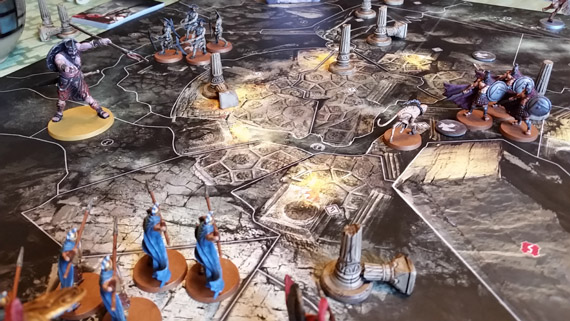
As is often the case with skirmish games, the thing that initially drew me to Savage Core was the miniatures. I was shopping for wild west figures and stumbled into what might have happened if Jules Verne and Edgar Rice Burroughs had worked together to design a line of miniatures. The Savage Core is an underground primeval jungle populated by superintelligent apes, lost Atlanteans, ice age cavemen, dinosaurs, and more.

The game looked interesting too, so I wasted no time in placing an order. In fact, I got so distracted by thoughts of pulp adventure that I completely forgot to order the cowboys I went there for in the first place...

A game of Savage Core is a head-to-head battle, with around seven figures per side. A player's force revolves entirely around their faction’s Boss, an individual character who has six game stats and a unique set of “tricks,” special abilities that can each be used once per game and are themed to that character. Your other six models (in a normal game) are “Bods,” nameless minions whose stats might vary slightly between one faction and the next but who don’t have any particular abilities of their own.

A game round starts with each player rolling for initiative to determine who will go first. Each player then gets a chance to play one of their tricks, which can be anything from devastating area attacks to causing an opposing figure to get lost in the jungle, only to reappear on a later turn.

The first player moves all their models, then the second player moves, then the first player makes all their attacks, then the second player. Going first isn't an advantage, as the second player will have the opportunity to move out of range before you get a chance to make any attacks. The only thing that can possibly help with this is the fact that movement distance for each figure is random, with each model rolling a d10 and adding their Clip (movement) value. So if you move into position for a great ranged attack, you can at least hope that they don't roll high enough to get away. It might sound fun in theory but in practice it can be pretty aggravating.

Combat in Savage Core is resolved first by an opposed roll using the relevant stat (Moxie for ranged or Buff for close combat) plus a d10 roll to see if the target is hit. After all hits have been determined, the targets roll for each successful hit to see if they’re wounded. Bods die after one wound, but Bosses can take four or five before they go down. Damage is resolved at the end of the round, so if one of your characters gets eliminated they’ll still get a chance to attack before they go.

By far the most interesting thing about Savage Core is Double Trouble. On any round that both players roll the same number for initiative, it triggers a random encounter taken from a list that can include anything from a wave of lava creeping across the board to a ravenous T-Rex stomping out of the bushes and eating any models it comes into contact with. Double Trouble is what got me interested in the Savage Core rules set in the first place, and it is easily the most fun and interesting thing about the game.

These encounters add a lot of flavor and enjoyable chaos, but they don’t happen nearly often enough in an average game. We were lucky to get one on our first turn, but in our previous match we didn’t get one until the last round, when it was too late for it to have any appreciable effect. And it’s certainly possible to go a whole game without having one at all. There is a scenario in the rule book called “Rumble in the Jungle” that has a Double Trouble encounter happening every single turn, but that seems like a bit too much.

I do like how simple the game is -- there's not a lot you have to remember, with only one named character on each side, and the six once-per-game abilities still provide a fair amount of flavor and variation between the different characters. It’s not like Shatterpoint, where you really have to stay on top of the synergies between characters, or Knight Models’ Batman, where each character has so many complicated special abilities that it’s impossible to keep track of it all.

On the other hand, the game can (and does) swing wildly based on the egregious amount of die rolling. Successful hits only result in damage half the time (even less for ranged attacks), which can be frustrating. Additionally, most of the the more powerful and interesting trick cards require a seemingly arbitrary die roll in order to work, and there is generally no way to mitigate these rolls. And don’t get me started on rolling for movement...

It might just need an attitude adjustment to make peace with the randomness of it all and enjoy Savage Core for what it is. But this is still a miniatures wargame that require a hefty level of preparation in the form of assembling and painting models and terrain -- the game play needs to be substantial enough to justify all that work.

Rating: 3 (out of 5) There are a few great concepts here, and the setting and miniatures are magnificent, but the core mechanics revolve around completely arbitrary die rolls a little too much.

Tuesday, June 18, 2024

Final judgment on the Judge Dredd Miniatures Game

I’m a huge fan of the Judge Dredd universe (well, maybe not the Stallone film) and I love miniature skirmish games, so I I really want to like this one.

The miniatures themselves are great. The resin material Warlord Games uses strikes just the right balance between flexible and durable, and it holds a high level of detail. In the five years since the game’s initial release, Warlord have expanded the range of figures to include a pretty good cross section of characters and vehicles from the Judge Dredd comics.

The game’s presentation is excellent. The rule book is beautifully designed, full color with a ton of artwork. The starter set comes with great looking plastic tokens rather than cardboard, plus a full color double-sided 3 foot by 3 foot map to play on. If you don’t believe me, check out OnTableTop’s unboxing videoOnTableTop’s unboxing video, it went a long way towards convincing me to buy the game.

My history with this game has been a little...conflicted. My normal pattern with miniatures games is that I get interested in a game, buy the rules and enough miniatures to try it out, and then if I like it I buy more miniatures and then either play again, or forget about the game for a year or more. That’s what happened here: I bought the Judge Dredd starter set in 2021, played several times over a period of about three months, and never played again. I seem to recall enjoying the first few games but then changing my mind, finding the last few games a little tedious and unsatisfying. So I decided to get the game and miniatures out of mothballs to make a final assessment on whether I want to continue with it or not.

The rule book, while beautiful to look at, is often vague and hard to follow. It was clearly written by someone who absolutely loves the source material, perhaps too much so. The rules are frequently bogged down in colorful descriptions of the setting and characters, what miniature gamers refer to as “fluff,” and while this sets the stage for the game, it also means that you can often find yourself wading through paragraphs of irrelevant background when trying to find a rule or clarification. It was enough of a problem that I went so far as to create a rules summary sheet to help with finding basic rules during play.

Unfortunately, my memory of the game play being a little tedious turned out to be more or less correct. The core of every skirmish game is combat between characters, so a good game needs a good system to resolve that combat. The vast majority do this via dice rolls: when my character attacks, I roll the dice, applying modifiers based on the abilities of the characters involved, and often the surrounding terrain. This can be a roll against a static target number, but in most games it’s an opposed roll, with my opponent and I both rolling the dice to see whether the attack hits or is successfully defended against.

In Judge Dredd, landing a blow is a multi-step process. First the attacker rolls, then compares the result to the target’s Cool rating to see if the target is pinned or not. Then the target rolls to see if they can dodge the attack. Then, if the target doesn’t dodge, the attacker rolls again to see how much damage is done, followed by the target rolling again to see how much of that damage they get to avoid. One attack, four rolls. Four chances to fail.

The target of the attack can come away unscathed, or pinned, and/or stunned or injured. If they’re pinned, they have to roll on their turn to see if they lose one of their two actions or not. If they’re stunned or injured, all of the six statistics that determine how far they can move and how many dice they get to roll in different situations are reduced.

Whew.

I don’t mind a complicated game if the payoff is worth it. In this case that would be an exciting story unfolding on the table, but that’s not what happened in here. Instead, the combat just seemed like a slog, and there wasn’t much else going on in the game. We played two games in a row this time around; the first game ended somewhat abruptly so we decided on a second game with more characters on each side, but towards the end we were both feeling like the game was dragging on, which brings us to my second issue with this game.

At its most basic level, a skirmish game will often come down to “everyone move to the center of the board and fight.” This can be fun, but the novelty of straight up combat wears off quickly. The best games get around this by using scenarios that introduce alternate objectives or win conditions that give players more to do than just pound the hell out of each other. It can be something entirely mechanical like controlling different geographical points on the board (Star Wars Shatterpoint does this very well), or something more story based like rescuing a captive or searching for a treasure.

The Judge Dredd rule book includes three simple scenarios, designed to introduce the game to new players using only the miniatures included in the box. Beyond that are six more that are meant to be the core of the game, offering different setups and objectives to give the game some variety. Unfortunately, these scenarios (at least the two we played, “Ambush” and “Heist”) don’t seem very well thought out. While they offer some interesting ways to start the game by starting one side in the middle rather than each side on opposite edges, the objectives for each player were uneven, making the game too easy for one player, to difficult for the other, and not much fun for either. Our first game ended really abruptly, and the other went on for so long that we called it without finishing.

The game uses cards as a way to inject variety and flavor into the game. Each player starts with a handful of “Big Meg” cards that introduce an unpredictable game effect such as a bystander stumbling into the path of the battle or a circumstance giving a free move or other action. These were sometimes fun but more often than not just annoying and egregious. In the end they didn’t make the game any better.

With the game not really working for me as-is, I am left with a few options. I could just give up on the game all together, but the miniatures are great and I love the Judge Dredd setting – I keep trying to come up with excuses to buy more of the figures even though I don’t like the game. I could try to house rule the game to get rid of its more tedious aspects. That seems like a lot of work, especially when there are so many great miniatures games out there that work fine right out of the box, but it would allow me to keep using the game’s great counters and dice. On the other hand, there are several “miniatures agnostic” games such as 7TV that allow you to use whatever miniatures you want – that seems more like the right direction to head in if I want to keep gaming in Dredd’s world. 

Rating: 2 (out of 5) The game isn’t as much fun as it should be, but the fact that I can find a use for the figures without the rest of the game keeps it from being a total loss.


Tuesday, April 30, 2024

All roads lead to Gangs of Rome

I'm always on the lookout for games that try to solve the "everybody move to the center and fight" problem, and the even worse "everybody hide behind something and shoot for the rest of the game" problem. When I first heard about Gangs of Rome, it sounded like it focused on dynamic movement rather than just getting into an advantageous spot. But the real draw was the way the game incorporated non-player characters in the form of the mobs that wander the streets, and also the incola, individual characters who do things like fling scorpions at your fighters. Additionally, I liked that the setting isn't about military battles but rather on back alley skirmishes.

I bought some figures and terrain, played a few games, and found the game to be fun but a little fiddly, with a lot of small counters cluttering the table. I got distracted by other games, then heard that they were working on a second edition so I put Gangs of Rome on pause until the new version came out.

After playing with the new rules, I have to say they are a vast improvement. The designers have eliminated all the fiddly stuff but kept the things that make the game interesting: dynamic movement and an environment crowded with non-player characters who have a meaningful effect on the game. The revised rules use an interesting action economy system that is quite different from the usual "each model can do one or two actions" that is standard for most miniatures games. In Gangs of Rome, when a fighter activates they can choose to do between one and four actions. The player has to declare what the actions will be, using tokens to mark them on the board. For example, a player might declare "Marcus will move to this spot, then climb the scaffolding, then move into base contact with Rufus, then make a melee attack against Rufus." That player then rolls to see how many of the actions can be resolved. If any planned actions go unresolved, the fighter accumulates stress, which reduces his ability to act until it is cleared.

Combat is nice an simple with opposed rolls and very little on-the-spot math, making battles between fighters quick and decisive. But the real innovation in Gangs of Rome is in the way the game simulates the crowded city streets, via the mobs and the incola.

Mobs are large bases of five figures each. A standard game uses between three and six, placed around the board at the start of the game. The mobs make two important contributions to game play. First, if a player's gang fighter makes an attack within view of the crowd, there is a chance they will react, either by being scared (moving away from the action), or by getting angry, in which case they will move towards and attack the nearest player-controlled miniature. It forces you to be careful about when and where you attack your opponent, and reinforces the idea that this is a living, breathing city rather than an empty battlefield.

The second feature of the mob involves the ability for player figures to blend in with the crowd. If a player's miniature is in contact with a mob base, they can temporarily remove themselves from the board, reappearing on the following turn in contact with the same or a different mob base. It can be used as a sneaky way to hide and also move around the board undetected, and is another way the game makes the environment seem alive.

At various points during their turns, players can be given the opportunity to move a mob, or force a reaction, rolling to see if the mob is scared or angry and possibly getting them to attack an opponent's character. This is a change from the game's first edition, where the mobs moved in random directions and often had no real effect on game play. This way, players can attempt to use the mobs defensively or offensively -- it makes them seem more like part of the game.

The incola (citizens of Rome) add another level of interest to the game's environment. These are individual non-player characters who wander the board in a similar manner to the mobs with different effects ranging from calming down angry mobs to stealing player characters' weapons. My personal favorite is Rufinus the scorpion thrower, who flings scorpions at anyone who passes near, inciting mobs and inconveniencing player characters.

Gangs of Rome is the only miniatures game I've played where I feel like the environment is a critical part of the game. It's an impressive feat of game design, given that the enviroment is a living, breathing city crowded with colorful characters outside the players' direct control.

Rating: 5 (out of 5) This is one of the most truly immersive miniatures games on the market today.

See my battle report at OnTableTop.com for a detailed view of the game. 


Tuesday, February 20, 2024

Leaping and evading in Star Wars: Shatterpoint

Over the past 10 years or so there have been several new Star Wars miniature games, but for the most part I've avoided them, owing to what I must admit is a cognitive bias known as the "sunken cost fallacy." I invested heavily in, and have a large collection of, the pre-painted collectible Star Wars Miniatures Game published by Wizards of the Coast between 2005 and 2010, and was irrationally resentful of any new game that dared to suggest I should have to buy new versions of miniatures I already had. As a result I avoided getting into Imperial Assault or Star Wars: Legion (X-Wing wasn't a problem because I never bought into the WotC starship game).

So when Star Wars: Shatterpoint was announced, I didn't really pay much attention. At least, not right away. A few weeks into the release I started seeing images of the miniatures, which are gorgeous but done at a much larger scale than any of the other miniatures games I play, except for maybe Knight Models' Batman. Most of the terrain I already have would be too small, and I wouldn't be able to mix and match them with any of my older Star Wars miniatures. But wait! The core set for Shatterpoint comes with its own set of great looking plastic terrain! I started looking into the rules, and it looked like the game played differently from any other games I have. And those large miniatures were growing on me...

All my objections to the game seemed to be melting away, so I bought the core set and a few expansion packs, and sat down to start assembling and painting. Normally I don't really like putting together miniatures -- like most people I can't seem to open a tube of superglue without getting it all over my fingers, and assembling gaming models is usually an exercise in patience, small motor skills, and figuring things out without the benefit of instructions. Not so much with the Shatterpoint models. I actually found myself enjoying the assembly process, no doubt thanks to the larger size and especially the helpful step-by-step assembly guides.

I don't mind assembling terrain, but normally I don't really enjoy painting it. Again, the Shatterpoint pieces defied expectation by providing a nice surface with a lot of interesting details for the paintbrush to pick out. Even if I never got the game to the table, I was having a lot of fun with the model kit aspect of it all.

The Shatterpoint rules are...interesting. It was clearly designed to be a competitive tournament game. The rules are written in a bizarre legalese that understandably wants to be consistent and clear but often ends up explaining the simplest concepts in the most complicated way possible. However, there is a good game design in there, and after a few games we did manage to find it.

Most skirmish-level miniatures games (games where each side usually has between 5 and maybe 15 models that represent individual characters) tend to follow a familiar pattern of "everybody run to the middle and fight" -- players spend the first few turns moving their models into position, and the rest of the game rolling dice to see if they can hit each other. Additionally, most games tend to focus on eliminating your opponent's models as the primary path to victory, which makes sense but at the same time can be demoralizing once you start losing, as you watch your forces slowly dwindle away.

Shatterpoint gets away from both of these clichés by using area control as its primary focus. Rather than eliminating your opponent's pieces, the goal of the game is to gather your models around Objective tokens which are placed on the board in a simple grid pattern. Controlling an objective at the end of your turn gains you momentum, in the form of a marker which moves back and forth along a track like a tug-of-war. If you move the marker close enough to your end of the track, you win that struggle and the momentum tracker resets. If you win two out of three struggles, you win the game.

The trick is that as each new struggle begins, the objectives you need to control move, and after the first struggle their position randomly changes every turn. You can predict where they might be, but you can't know for sure where your models need to be at any given time. The game encourages a lot more movement than you normally see in skirmish games, and this is reinforced by the terrain that comes with the game -- it takes the form of small buildings and gantries that create a multi-level playing field that forces a lot of interesting tactical choices and looks great on the table.

The game's combat resolution system supports the idea of fluid action as well. Like most of Asmodee's Star Wars games, Shatterpoint uses proprietary dice -- the attacker rolls, looking for a number of "hit" results, and the defender rolls, looking for results that will cancel the hits. It's a very common system that many skirmish games use, but Shatterpoint adds what on first glance looks like a flowchart. For each successful "hit," the attacker is given a choice of results that can include damage to the opposing model, but also more dynamic results like pushing the target away or allowing the attacker to move or reposition. It makes combat more interesting, and further supports the idea that the game is about movement and position more than it is about inflicting damage on the enemy.

Shatterpoint does a great job of emulating the high-energy action of the Clone Wars animated series, no mean feat for a turn-based strategy game. Players who are used to more traditional skirmish games will need to adjust their expectations (and their tactics) a bit, but if they can, they'll find a unique and refreshing game.

Rating 5 (out of 5) From assembling and painting the models to actually playing the game, Shatterpoint has been a joy from start to finish.


Friday, March 10, 2023

Batman Miniature Game: Gotham's tiny reckoning

I won't lie to you, the Batman Miniature Game by Knight Models is not an easy game to get into if you're a North American gamer. The publisher is based in Spain, and has a reputation for being difficult to work with, so you don't see it on many store shelves, or even in many US-based online stores. On top of that, the game is currently in its third edition, with some pretty drastic rules changes between editions, and the game's introductory set is frequently out of print and usually pretty expensive, and the current version of the game relies on the use of a smartphone app that is buggy and incomplete. Now pile on the usual barriers to entry for tabletop miniatures games such as the time it takes to assemble and paint the miniatures and terrain, and it starts to seem like the bridges into Gotham City are barricaded, just as they were in 2012 Batman film The Dark Knight Rises.

The game's rulebook can be downloaded for free from their website, as can all of the cards you need to play (which will also allow you to bypass the aforementioned app), so as long as you have a robust printer and are able to get your hands on some miniatures and terrain, you can play the game, but it's an awful lot of DIY work in this age of self-contained, pre-packaged games like Conan or Mythic Battles: Pantheon.

But, once you get past all that, there is a really interesting game here.

Like most games of this type, each player assembles a force of 7-10 characters. In this case each team consists of a hero, a sidekick, a handful of henchmen such as thugs or policemen, and possibly one or two free agents to round everything out. Forces are generally limited to a particular faction, so Batman can't team up with the Joker, but there are a few neutral characters such as Catwoman who can join anyone's team.

The game is played out over 4 rounds, which doesn't seem like much, but there is quite a bit each character can do on their turn, so the time goes by quickly and the game usually feels finished by the end of round four. At the start of each round, each player chooses four of their characters to assign Audacity markers to. Characters without those markers will only get one action during the round (usually either a move or an attack), but those with Audacity will get three actions: one move, one attack, and one special action, which usually represents a character's unique ability, such as Batman using his grappling hook or Harley Quinn distracting her opponents with clownish antics.


The real meat of the game, and the thing that makes it more than just the usual slugfest, is the Objectives system, enacted in the game by Objective cards in a player's hand, and Suspect tokens on the board. Each player starts the game with a deck of 20 cards which form their objective deck. These cards are what adds story elements to the game, representing goals and maneuvers such as gathering evidence, stealing loot, taking or rescuing hostages, or (especially in the Joker's case) generally causing chaos.

Objective cards frequently interact with Suspect tokens, which represent civilians, loot, bombs, or anything that needs to have a physical presence on the board. During their turn a character can forego an attack to instead interact with a Suspect token, either placing one on the board, removing one of the opponent's, or moving them into strategic positions.

Objective cards are also the way each player scores points in the game, often making combat with the other player's miniatures secondary to fulfilling the conditions a card might call for. A lot of miniatures games have tried to add card-based mechanisms as a way to spice things up, but this is the most integrated and interesting system I've ever seen. The cards are an integral part of the game rather than a tacked-on extra.

My only major complaint about the game (other than how difficult to find and expensive the miniatures are) is that characters tend to have far too many special abilities. This might seem obvious for a super hero game, but I often find it difficult to keep track of the large number of game effects and when they're supposed to resolve, and sometimes trying to figure out how different abilities interact with each other can lead to some head-scratching moments.

While it is pretty complicated and tends to take a long time to play (we've had games go on for five or more hours), the game really does feel like a Batman story unfolding on the table.

Rating: 3 (out of 5) I'm marking it down a point due to the fairly unreasonable barriers to entry, but the game play itself is a solid 4 out of 5.

Wednesday, May 20, 2020

Judge Dredd: Helter Skelter -- miniatures on a board game budget


I love miniatures games. I enjoy the strategic and tactical thinking involved, but even more, I love the tactile nature of moving the figures themselves around in an environment, whether it's fully realized three dimensional terrain or just a printed map.

I also love a wide variety of different genres and intellectual properties, so unfortunately the work and investment that most miniatures games require means I can't play in every world I want to. That's why I'm especially intrigued by miniature/board game hybrids such as Monolith's Conan, with their potential for the depth of a miniatures game contained in a much more manageable (and affordable) box.

This is what drew me to Judge Dredd: Helter Skelter. I'm a big fan of  2000 AD (the weekly comic book that Judge Dredd appears in), but not quite willing to commit to a full fledged Dredd miniatures game, although the new one from Warlord Games has some great looking figures. As a self-contained boxed game, Helter Skelter looked like a great alternative.

The game takes some inspiration from an old Judge Dredd comic book story for it's background: holes have been opening in the fabric of reality, allowing characters from other dimensions to converge on Judge Dredd's Mega-City One. It's a clever idea that allows the game to include four player factions, each based on a different cast of characters from 2000 AD comics.

The game design is terrific. It uses a printed board with irregular areas marked out to handle movement, rather than using a grid or needing a tape measure. The board artwork is functional, clearly indicating important concepts such as cover and line of sight, and it's also beautifully designed and gorgeous to look at. The miniatures, while not fully pre-painted, come with a wash applied, so it's easier to see the figure details, and colored rings for the bases making it clear which figures belong to which faction.


At the start of the game each player is given 10 location cards that match up to the numbered spaces on the board. Five of these are secretly chosen and assigned to the player's five characters, to determine where on the board they will enter play. The other five cards are given to an opponent, and determine where they place their five "shards of reality," colored tokens that can be collected for victory points. 

Movement and combat are handled using cards. Each player uses a deck of cards unique to their chosen faction, with cards representing actions their different characters can take such as moving, attacking, or defending. The bulk of the game is managing your cards so you can move your figures to where they need to be, make effective attacks against opposing characters, pick up shards of reality tokens, and still have cards left to defend with when it's your opponent's turn. Collecting a shard of reality or eliminating an opponent's character are each worth one point, and the first player to get to five points wins.

It's a great rules system, providing all the core elements that a miniatures game needs without getting bogged down in the complicated exceptions and situational rules that can plague games like Heroclix or X-Wing. But there's one thing missing: a sense of narrative, an interesting story that unfolds on the tabletop. Most games of this type (such as Monolith's Conan or Leading Edge's Aliens) have this firmly ingrained by being scenario driven, and that's something that's missing here.

Sure, Helter Skelter provides a back story that explains why the different groups of characters are there and what they're doing, but there really isn't much story once the game starts. Collecting a shard of reality or eliminating an opponent's character are each worth one point, and the first player to get to five points wins. There aren't any additional scenarios offering different victory conditions, so most games tend to be pretty similar, with the only variety being which faction each player is using and which of the two boards they're playing on.

The lack of story certainly isn't a deal-breaker. The extremely elegant design and excellent graphics go a long way towards making up for it, and it's something that could easily be added by official expansions or even house rules. I certainly hope so; a game design this good deserves some more depth.

Rating: 4 (out of 5) A great design and beautiful production that's a bit let down by a lack of variety and replayability.

Thursday, December 26, 2019

Toy soldiers, part 3: Core Space

When I was a kid Star Wars toys were all the rage. One thing that the developers of the original Star Wars action figures back in the 1970s got absolutely right was that the space ships, vehicles and especially the environments were at least as important as the characters, so they scaled their toy line in such a way that they could include play sets representing locations from the films for kids (and adults) to place the characters in.

Environment is at the heart of Core Space, a game developed by the makers of the Battle Systems line of cardboard miniatures terrain. Their sci-fi series, representing space station corridors, futuristic cities, and planetary outposts, was their most recent (and most successful) product to date, so naturally when they decided to create a game to go with their terrain, it was going to have a space opera theme.

While they could have gone with a standard skirmish game, they opted instead for something with a lot more narrative and adventure to it. Players control crews of scoundrels and pirates in what is essentially a sci-fi dungeon crawl, creeping around in labyrinthine space stations searching for cash and equipment (and yes, the loot is even stored in futuristic treasure chests). While players can opt to attack each others' crews, that would take precious time away from searching for goods and interacting with non-player civilians who might provide useful information or even be persuaded to join the crew.
If it sounds too easy, there's the inevitable catch: the galaxy the game takes place in is under attack from an enigmatic race of killer robots, and a few turns into the game those robots start appearing on the board, their actions controlled by a simple but very effective AI that governs where they move and who they attack. As the game progresses, more advanced (and deadly) models start appearing, and the tension ramps up. The game turns into a "press your luck" situation where you know you should be moving all your crew back to the airlock, but wait, there's a cargo crate we didn't look in yet...

The rules are simple and cinematic, using proprietary dice and an easy measuring system for combat, and there are lots of options for non-combat actions like interacting with civilians, opening and closing doors, using computers and even breaking and jumping through windows. And the fact that the game is designed specifically for the Battle Systems terrain means it gets the most out of it.

The game really shines when played in a series of linked missions over several games, using an experience system that allows crew members to improve their abilities and equipment over the course of the campaign. It even allows for improvements to the crew's space ship, allowing it to do things like scan the station for information or even defend the airlock from off-screen.

Rating: 5 (out of 5) a well designed game with rich, familiar-yet-different characters and a setting that can't help but be fully immersive thanks to the ingenious terrain.

Friday, December 20, 2019

Toy soldiers, part 1: Ronin

Seven samurai, painted and ready to fight!
British publisher Osprey has long been a staple in wargaming circles for their long line of excellent books on military history, covering armies, weapons, and battles throughout history with an eye towards the kind of detail that tabletop miniatures players would want for their games. More recently they've started putting out a series of rule books for miniatures wargaming. For the most part these are stand-alone books that don't come in a box with a bunch of figures, or require the purchase of specific packs of miniatures and accompanying stat cards and tokens. Rather, they are designed to evoke a particular historical period or fictional genre, and the players are free to use whatever miniatures they wish.

Having taken the plunge into miniatures gaming with games like 7TV, Doctor Who: Exterminate!, and Mythic Battles: Pantheon, I wanted to find a samurai themed game to indulge my love of Kurosawa movies, and Ronin: Skirmish Wargames in the age of the Samurai looked like just the thing, although it was another year after buying the rulebook before I got around to buying and painting enough samurai miniatures to play the game with.

After assembling some suitable terrain (mostly of the print-and-play, cut-and-assemble variety) we finally set up to play a game, a simple "defend the bridge" scenario with bloodthirsty bandits on one side and noble Koryu (sword fighting teachers and students) on the other.

The game aims for a "cinematic" style of combat, and does some interesting things that other games of this type don't really do. A game where the majority of the combat will be hand-to-hand could be quite dull -- once the figures have been moved into position, it could quickly devolve into die rolls back and forth, but Ronin opts for something different.

At the start of a hand-to-hand battle, each player secretly chooses a number of tokens based on the experience level of his characters. There are two different tokens to choose from: attack or defense. Once the die rolling starts, these tokens can be spent to improve a character's chance of attacking or defending successfully. What this amounts to is that players are forced to choose whether they want to focus on defense, attack, or try to balance out the two.

As with most games of this type, ranged attackers have the huge advantage of being able to attack from a distance (and in this game they get to attack first), but the game balances that by giving them fewer opportunities to increase their chance of hitting, and it also takes into account the slow reload times of ranged weapons from this time period.

Games are scenario based, usually with a specific goal for one side or the other rather than just "run to the middle and fight," and the game does a good job of allowing for narrative actions like looting bodies and picking up objects. It also has a whole system covering morale and the idea that if the fight is going badly, the troops might start running away.

We really enjoyed the game, and my only complaint isn't really a flaw in the game but an element that could be seen by many as a plus. The game doesn't come with pre-made character cards like its more commercial cousins tend to. Players are given example character types, with options for different weapons and abilities. Character stats are then copied onto a simple roster form for use during play. It works fine and is well suited to this style of game, but at the same time (and this is a very superficial criticism) it's an element of the game that is dry and uninteresting. Additionally, the hand writing and pre-game decision making makes it more difficult to just jump in and start playing, which means we won't get this game to the table very often.

Rating: 3 (out of 5) A great game system that works fine as-is, but could benefit from some more lavish support materials and a shorter prep time.

Monday, November 11, 2019

Marvel Strike Teams: a superhero dungeon crawl


On first glance, Marvel Strike Teams looks like another variant in Wizkids' Heroclix line of games. It has many similarities, both thematic and mechanical, but a number of differences that make it an interesting game in its own right.

Like Heroclix, Marvel Strike Teams is a tactical superhero battle game. It uses a grid system for movement and range, and characters find their powers and abilities decreasing in effectiveness as they take on damage, which is a hallmark of the Heroclix system.

Unlike Heroclix, Strike Teams is a one vs. many style game, with one player taking on the role of a supervillain and his minions, and the others each controlling a single hero and working cooperatively to foil the villain's dastardly plans. It's also much more mission oriented, with victory centered on accomplishing certain in-game goals (such as rescuing hostages or finding macguffins rather than just trying to obliterate your opponent's forces. In spite of the superhero theme, the game structure is that of a classic "dungeon crawl," with heroes creeping through rooms and corridors in search of treasure and a quick exit.


The game is designed to be played campaign style over multiple game sessions, with both the heroes and the villains gaining experience and improving their abilities between games, another thing that sets it apart from the one-off battles of Heroclix and makes it seem more like a D&D-style dungeon crawler.

But the really innovative thing about Strike Teams is that it uses a diceless system for combat. Players instead use resource management and damage control to accomplish their side's goals during the game.

Each round, characters are given a certain number of action points, which can be spent to move, heal damage, use special powers, and most importantly, attack and defend. Action points can be saved up from round to round (up to a pre-set maximum), so game play is a balancing act between moving, attacking, and saving aside points to defend your character against attacks.

It's very different from most battle games (including Heroclix), which use random dice rolls to determine the outcome of combat. Sure, most of those games will include game mechanics to mitigate the randomness such as rerolls, bonuses, and extra dice, but there is always the chance that an attack will go badly due to random chance that is outside the player's control.

Monolith's Conan game is probably a closer comparison in terms of the level of strategic resource management and focus on scenario goals over outright fighting, but even it uses dice to resolve combat.

With only a handful of characters to choose from in the base game an one small expansion, Strike Teams lacks the epic scope of what Heroclix can offer with its thousands of different figures over multiple franchises. It's a pity there aren't more expansions planned for Strike Teams, because mechanically it's a much more interesting game.

Rating: 4 (out of 5) A terrific alternative to battle games like Heroclix, but unfortunately its lack of commercial success will limit this game to only a handful of characters and limited replayability.

Monday, January 28, 2019

Firefly Adventures: Brigands and Browncoats -- just act casual


2018 was the year of the skirmish game for us. We spent a lot of time playing 7TV, Doctor Who: Exterminate, and Mythic Battles: Pantheon, and even more time painting miniatures and building terrain for them. On the surface, Firefly Adventures: Brigands and Browncoats looks like another boxed skirmish game, but it really isn't -- at least, not entirely.

Like Firefly: the Game and Doctor Who: Time of the Daleks, Firefly Adventures shows that Gale Force 9 are masters at building engaging games around licensed properties, rather than simply slapping a licensed theme on an otherwise generic game design, and that they have a deep understanding and respect for the material the game is based on.

It's a cooperative game where every player plays a character from the Serenity crew, which should immediately appeal to fans of the television show. The game controls the bad guys using a simple but elegant AI that dictates what they do based on criteria such as where the closest player character is, or in some cases a pre-determined patrol route. This is interesting, but it is the game's two core concepts that really set it apart from other games of this type, and also makes playing it feel like an episode of the show.

The first of these is the idea that player characters switch back and forth between acting casual or acting heroic at various points in the game, sometimes by choice and sometimes not. A casual character can move freely about the board without attracting the attention of the bad guys, making it easier to sneak into buildings and even talk to the non-player characters. However, many actions such as attacking or breaking down doors require characters to act heroic, which attracts the attention of the bad guys, causing them to move and attack any heroic characters they can see. Each state is represented by a separate miniature, one in a casual pose and the other in a more action-packed one.


The other game mechanic that makes this game more interesting and thematic is the turn structure. Rather than just moving in turn, characters' movements are dictated by a time-based system, with different actions taking up specific amounts of time (called "moments" in the game). Each character has a counter that is moved along a track based on what actions they take, and the character at the back always takes the next turn. This is where the strategy and decision making gets really interesting, as you have to weigh the actions you want to take against how far along the time track you will move, and what characters will act before you get another turn.

The game also has a card and dice-based system to govern both breaking into buildings and talking to non-player characters. You draw a card on each attempt that gives you two choices of possible actions to take, some of which might be easier but force you to act heroic and attract the attention of the bad guys.

Game play is scenario driven, with different board setups and win conditions, which really makes it feel more like a role playing game with no game master than a tactical skirmish game. Tactics usually involve sneaking around trying to avoid a fight rather than all-out combat, and the goal is usually to escape the board with an objective instead of just defeating all opponents. There's even a campaign mode where you try to collect as much money and equipment as possible over several games.

One other thing I have to mention is the game's ingenious terrain, a series of small pre-built boxes designed to look like the converted shipping crates that make up so much of the background of the television show. The game box bottom itself is printed to look like a larger building. It's a clever way to introduce 3-D terrain, and also important for a game where staying out of the bad guys' line of sight is often the best strategy.

The only real complaint I have is that the rule book is poorly organized, making looking up rules somewhat difficult during play. As skirmish games go it's fairly simple, but there are always going to be times when you need to refer to the rules.

Rating: 4 (out of 5) A fun, innovative game that feels much more cinematic than most "move and shoot" games, only marred by a poorly organized rule book.

Monday, December 31, 2018

Mythic Battles: Pantheon -- gods and monsters


In some ways I feel like the publishers of Mythic Battles: Pantheon took advantage of me. The game's Kickstarter campaign launched soon after they had delivered their phenomenal Conan board game, so I was flush with excitement over how great Conan was, and regret that I had only backed the core game and a few small expansions. That, combined with some compelling playthrough videos on Beasts of War and the infectious enthusiasm of their PR man Leo, made diving into this game a no-brainer.

It's a great example of an emerging category of hybrid games combining elements of adventure board games and tactical skirmishers. At its core, MB:P is a battle between two or more players' assembled forces of gods, heroes and monsters from Greek mythology, using movement around a battlefield to gain advantage and dice to score hits on opposing miniatures. However, it borrows two important board game elements to keep things interesting.

One is the use of a printed board to enable area-based movement, eliminating the need for fiddly tape measures. The game comes with several beautifully illustrated boards depicting different environments, with movement spaces clearly marked. Each space includes a symbol identifying what type of terrain it is and how many miniatures can occupy the space. The symbol also doubles as a simple line-of-sight indicator, making it easy to tell whether opposing miniatures can shoot at each other.


The other board game element MB:P uses is "activation cards" to determine when miniatures can move and attack, and this is where I think this game really shines. At the start of the game players assemble a deck of cards based on the characters they have included in their army, plus some "Art of War" cards that enable different special effects. In order to move a particular miniature, the player must first play that miniature's card from their hand. This forces players to think on their feet, formulating their tactics based on the cards they have available, rather than using the same strategy over and over again.

The default game involves collecting tokens called Omphalos from the board, which add a strategy card to the player's deck once collected. This makes even a basic game more interesting than your standard "rush to the middle and fight" skirmish, since collecting a majority of Omphalos is one of the main ways to win the game. Additionally, the rule book details a wide array of scenario-based games that give different objectives and victory conditions, as well as several multi-game campaigns where the result of one game affects the next.


It's a great rules system, and it's coupled with some gorgeous visual elements. The artwork on the cards and boards is stunning, and the miniatures are just amazing. They're plastic, but they hold an incredible amount of detail, and they are an absolute joy to paint. The manufacturing even involved a method using different types of plastic, with spears and swords made out of a harder material so that they stay straight. Any miniature painter who's had to straighten out a curvy spear on a plastic model will know what I'm talking about.

The only thing I can think of to complain about is that the sheer amount of content can be overwhelming, with close to 200 miniatures and over 80 scenarios to play with. All in all, that's probably not a bad problem to have.

Rating: 5 (out of 5) This game has the surprisingly rare combination of great miniatures coupled with a simple but compelling rules system.

Wednesday, August 22, 2018

Doctor Who: Exterminate! -- Doctor Who on TV isn't really about combat, but...

Daleks vs Sontarans, a clash yet to be seen on TV

Before 2006, most Doctor Who fans of a certain type probably wondered who would come out on top in a clash between the show's two highest profile recurring villains, the Daleks and the Cybermen. Despite appearing in the classic series regularly over it's 26-year run, the Doctor's two most formidable opponents never met, and the show's approach to continuity was very compartmentalized: Dalek stories would often refer to previous Dalek stories, but there wasn't really any sense of a larger, coherent universe. The only classic TV story that featured both the Daleks and the Cybermen was 20th anniversary special The Five Doctors, but they're never seen on screen together.

All that changed in 2006 with the new series episode Army of Ghosts, in which the Daleks and the Cybermen finally met. Doctor Who: Exterminate! from Warlord Games allows players to recreate that clash on the tabletop with "epic scale" 38mm miniatures.

A skirmish game may seem like an odd choice for the Doctor Who license, since the Doctor tends to avoid violence and try to think his way out of problems, which is no doubt why the game emphasizes clashes between the more militant villains of the series such as the Daleks, the Cybermen, and the Sontarans. However, the game's scenarios do each include a sidebar with suggestions for how to involve the Doctor and his companions in the game, giving them objective-based goals to achieve while trying to avoid getting shot at by Daleks.


The game itself uses a simple symbol-based dice mechanic to determine if attacks are successful, with each player also given a hand of "battle cards" that can be used to supplement the dice results. Common miniatures game elements such as range, obstacles and cover are addressed by adjusting the number of dice rolled for attack or defense. Rather than requiring players to keep track of damage to individual miniatures, the game uses a system of different statuses: figures are either fully operational, shocked (temporarily incapacitated) or exterminated on a particularly good roll of the damage dice. It makes losing figures in battle a bit unpredictable, which I think is okay for a game like this where the emphasis is on narrative rather than cold tactics.

One game mechanic I have mixed feelings about is the concept of being "under fire." If a figure is successfully fired upon (even if it doesn't take any damage), that figure is given an "under fire" token, which means it can't return fire on its turn, and has to roll to remove the token at the end of the turn. This can sometimes result in multiple turns where a player can't really do much with their figures, which can be a little frustrating. It also gives characters whose special abilities allow them to ignore "under fire" tokens (such as the Daleks) a huge advantage.


To add additional flavor, the game includes an "Adventure Card" deck with various events and equipment from the show that players can use. We've found that giving the Cyberleader a samurai sword is a particularly winning combination.

Most miniatures game rules systems are really just an excuse to sell the figures, and that's where this game really shines. Right out of the box you get 12 Daleks and 12 Cybermen, requiring some assembly but cast in gold and silver so you can get to playing without taking the time to paint them (although you will probably want to eventually).

A selection of additional figures: an Ice Warrior, a Judoon, a Silent, and a Zygon

The supplemental figures cover a wide range of both the classic and the new TV series, and they are of exceptional quality. The slightly larger scale allows for a lot more detail, and an apparently rigorous approvals process results in miniatures that are very true to their TV counterparts, and a joy to paint.

Rating: 4 (out of 5) Great miniatures with a reasonably good rules set to go with them.
Check out my OnTableTop.com project blog about painting the Sontaran miniaures for this game.

Wednesday, June 27, 2018

Cowboys: Way of the Gun -- thrilling days of yesteryear


Perhaps appropriately, Cowboys: Way of the Gun is a game out of time. It was first published in 2007, but it has the look and feel of a game from the early 1980s, right down to the "bookshelf format" game box and a design sensibility that definitely favors function over form. It reminds me a lot of the 1989 Aliens board game, which is an excellent game design let down by weak production values.

Mechanically, Cowboys is a very well-designed small scale skirmish game that avoids a lot of the convoluted rules that seem to plague most games of this type. It plays on a grid for easy movement, and has simple game mechanics for establishing range and line of sight. Since it is played on pre-printed boards, the rules for moving and shooting through terrain are also very straightforward. It's a very fast-paced game, with the average scenario taking around 30 minutes to play.

"Move and shoot" games can get stale easily, and like several others such as 7TV and Alien vs. Predator: the Hunt Begins, this one uses a deck of event cards to give players a way to introduce some tactical decisions and unpredictability to the game. This game's event deck also functions as a standard poker deck, which allows it to be used as a random number generator for things like initiative. It might have been interesting to take this a step further and replace the dice with card draws to determine whether or not an attack is successful.

The real meat of the game is in its scenario book, which details 26 simple game setups that recreate famous gunfights both historical and fictional, from the shootout at the OK Corral to the three way standoff at the end of The Good, the Bad and the Ugly. The scenarios in the book escalate slowly, starting with one-on-one "shootout at high noon" games before eventually moving on to more complex setups with victory conditions beyond simply killing all of the other side's cowboys.

Unfortunately the game falls seriously flat on its outdated production values. It uses cardboard standups and tokens in lieu of miniatures, which in itself wouldn't be a problem, but the artwork on the game pieces is very bland. The same holds true for the game's various boards depicting sections of wilderness or classic western buildings like saloons and banks, which is a pity because they are otherwise of pretty high quality, printed on nice sturdy cardboard.

"The fight's commenced! Get to fightin' or get away!"
That said, the game's simple rules make for some cinematic action that inspires the imagination. In one game, I had to have Wild Bill Hickok run into a general store to reload his weapon, then come crashing through the store's window into the street to get a shot at his opponent. In another, recreating the famous gunfight at the OK Corral, I was stuck with one character (Ike Clanton) who didn't have a weapon, so I had him run around getting in the way of my opponent's line of sight, much like the "get to fighting or get away" scene from the 1992 Tombstone movie.

It shouldn't be too difficult to find some gunfighter miniatures (in fact, I have tons of them) and maybe even find some western town maps with better artwork, which is all it would take to make this a truly great game.

Rating: 3 (out of 5) The biggest problem with this game's weak production value is that it's a hard sell to get others to play, especially if they're not particularly interested in the historical west.