Showing posts with label Aliens. Show all posts

Tuesday, September 12, 2023

Another bug hunt -- Aliens: Another Glorious Day in the Corps

Aliens, James Cameron's 1986 sequel to Ridley Scott's horror masterpiece Alien, is one of my all time favorite movies. The scenario of a group of strung-out marines trapped in an enclosed environment with a horde of bloodthirsty monsters is ideal fodder for gaming, so it's no surprise that the film has been mined for game material since it came out, both official (Aliens, Legendary Encounters: ALIEN) and unofficial (Argo, Nemesis, Space Hulk).

Leading Edge's Aliens (sometimes known as This Time It's War) game has long been one of my favorites. It has a simple, elegant tactical movement system and tense game play that effectively simulates the action from the film. The only thing wrong with it is its low production value, with bland graphic design, paper maps, and cardboard standees in lieu of miniatures (the publisher did offer upgrade packs of metal miniatures, but they were way outside of my price range in 1989).

So when Gale Force 9, publishers of the excellent Firefly board game, announced that they were doing an Aliens game, I got very excited. My hope was that they would do something similar to the Leading Edge Aliens, or even a reskin of their own Firefly Adventures, a cooperative tactical movement game that does some innovative things with non-player controlled enemies.
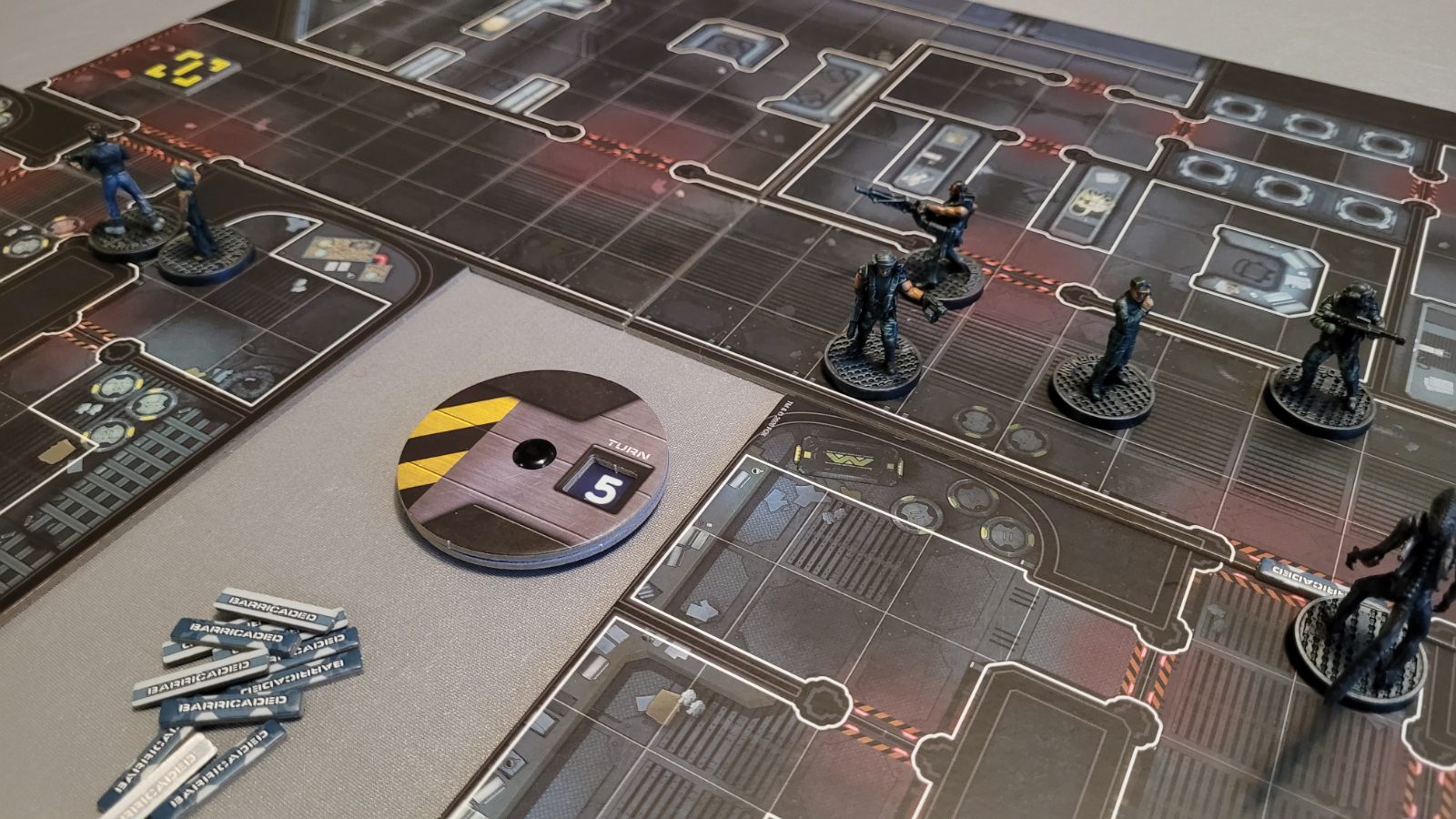
Somewhat surprisingly, Aliens: Another Glorious Day in the Corps isn't really either of those things. It's similar to Leading Edge's Aliens in that it is a cooperative game where the players control Ripley and the marines in an attempt to survive and escape rather than defeat all the Aliens (an impossible task). It's similar to Firefly Adventures mainly in that the rule book is confusing and poorly organized, managing once again to make a relatively simple game seem overly complicated. But that's pretty normal for rule books these days.

The components are definitely light years ahead of the Leading Edge game, with heavy cardstock boards and detailed plastic miniatures. There have been a fair number of complaints in various forums online about the fact that the miniatures require assembly, without any warning on the box, but they include detailed instructions and I didn't find it particularly difficult. The only poor design decision here is that the Aliens have long, spindly hook-shaped tails that were a little challenging to attach, get in the way during play, and make the miniatures difficult to store (remember Barrel of Monkeys?). They're nice looking miniatures though, and as far as I know, this is the first time the actual human characters from the film have been represented by official 28mm gaming scale figures.

The game uses miniatures, gridded tiles, cards and dice to recreate the key scenes from the film. Each player takes control of a single character, and any remaining characters remain in the game as "grunts" that the players can order around, but without complex game info to keep track of. This means you always have the same number of characters on the board, but your team has more interesting abilities if you have more players. Of course, that also means the game will be more challenging.

While the game is played out on a grid with miniatures, the core game element is the Endurance Deck, a stack of 60 cards representing weapons, equipment, events, and hazards. The deck is used as a timer (when the deck runs out the players lose the game), a currency to pay for game effects (by discarding cards from the deck), a way to generate random effects and give players extra tactical choices (by drawing or revealing cards). It also contains a few Hazards, negative effects that must be resolved when the card is drawn or revealed. It's very similar to the way the old Star Wars Customizable Card Game worked, but honestly the idea is so good that someone should be using it.

At the end of every turn, the players draw several "Blip" cards to determine where the Aliens appear. Aliens start out as blip tokens, unseen until they move into proximity to the human characters, at which point the tokens are replaced by one or more Alien miniatures. It's a neat effect that mimics the tension-building motion trackers from the film, and allows for some uncertainty as you don't know how many Aliens are approaching until they're in the room with you.

The details of the different scenarios allow for some variety, but ultimately the goal is always to escape the board with as many survivors as possible. This leads to some agonizing tactical decisions: do I take the time to weld that door shut, or just run for it? Do I keep my marines near the door to cover each other and all escape together, or is it better to risk some of them so that others can get out for certain?

If anything, my only complaint is that if too many Aliens are on the board all at once it can get to be a bit of a grind, both with the sheer number of Aliens you're moving around each turn, and also with the repetitive rolling to try to shoot Alien after Alien. But it's a good game that definitely simulates the action and tension of the film.

Rating: 3 (out of 5) I'm docking this game one star for the murky, hard to follow rule book, and another in acknowledgement that my overwhelming affection for the source material makes this game more fun for me than it might be for others.

Thursday, May 31, 2018

Alien vs. Predator: the Hunt Begins...for a better set of rules


Alien vs Predator: the Hunt Begins by Prodos Games began life as a very troubled Kickstarter campaign, followed by a high-priced retail boxed set, and despite being a massive fan of the Alien and Predator franchises, this kept me from showing much interest in the game. However, the release of a much more reasonably priced second edition, combined with my interest in the emerging category of skirmish/board game hybrids such as Conan and Mythic Battles, prompted me to take another look.

The components are, for the most part, very high quality. The miniatures look great, and the game's three factions are cast in different colors so you can start playing right away without struggling to tell who is who. The interlocking tiles that make up the board are quite nice too, with artwork that evokes the industrial look of the first two Alien films. The cards and counters leave a bit to be desired, but more on that later.

I wish I could say that the game lives up to the quality of its components, but unfortunately it is marred by convoluted rules, as well as some ill-considered graphic design that makes the rules, cards and tokens very difficult to read.

The basic structure of the game isn't bad at all. The board is constructed from the tiles based on the scenario being played, and as I already mentioned, it all looks great on the table. Players take control of either a large group of Aliens, a small group of human Marines, or 1-2 Predators, and from there it's a pretty straightforward move-and-shoot tactical game. However, the rules governing the moving and shooting are very obtuse and difficult to follow, with tons of modifiers and exceptions to keep track of.

One feature of the rules that seems like an interesting idea in theory is the use of what the game calls "ping" tokens. The idea is that at the start of the game, players don't know anything about their opponent's forces, so figures are represented by face-down tokens until the move into view of another player's team, at which time the token is revealed and replaced with a miniature. This semi-hidden movement seems quite thematic, evoking the tension-filled motion tracker scenes in the Alien films, but in practice it means that you're playing a fair amount of the game with flat cardboard disks instead of awesome-looking miniatures.

The stat cards for the figures are another problem, with very small white-on-black text that is impossible to read, and a system of symbols that is too involved to memorize, prompting constant referral to the rule book just to translate what's on your card.

A game element  that I do quite like is the addition of a deck of strategy cards for each player, themed for each faction. Cards such as Cloaking Field for the Predators, Covering Fire for the marines, and Acid Blood Splash for the Aliens allow players to introduce unpredictable elements into the game. There is also a deck of environmental cards that are drawn at the end of each round, creating effects that all players must work around. 7TV does something similar with its Gadget and Countdown decks.

Ultimately, I am a narrative gamer: what I want out of a miniatures game is a conduit into whatever world the game takes place in. The rules are there to provide a structure for that, and then get out of the way. The complicated rules system for AVP: The Hunt Begins seems aimed at tournament-level play, where being able to manipulate the rules to your advantage is more important than enjoying the theme and setting.

The miniatures and tiles are so good, though, that I'm really interested in finding another rules system I can use them for. There's a fan-created set of cards for 7TV detailing the Aliens, Predators and Marines, and a thread on BoardGameGeek dedicated to expanding the rules for the excellent Aliens board game published by Leading Edge Games in 1989. I've even thought of adapting the Aliens Predator CCG to include miniatures and more tactical movement.

Rating: 2 (out of 5) I'm reluctant to give this game a rating at all since the tactile components are so out of line with the game itself, but ultimately it fails to deliver a satisfying game experience.

Friday, April 20, 2018

Argo: a xenomorph by any other name


Stop me if this sounds familiar: in the cold, isolated blackness of deep space, a freighter crew wakes up from suspended animation for find that their ship is crawling with bug-like monstrosities bent on their destruction...

If this sounds like a familiar science fiction franchise that starts with the letter "A," you're half right. Argo is a tile-laying game in which players race to be the first to evacuate their crew of astronauts while leaving their opponents to be food for the vicious alien invaders. Sort of.

Game play involves placing tiles to add to the maze of rooms and corridors that all future space stations will no doubt be, and moving your figures around in such a way that you get your pieces to the escape pods and your opponents do not. There are several game elements that make this more interesting than it sounds.

Most tiles can only accommodate one or two player figures, so if you move your piece onto a tile, you bump someone else off, and if this puts them on an overcrowded tile, its piece moves as well, often creating a chain reaction that can allow you to put your pieces in the best positions and your opponents in the worst.

Additionally, many tiles have special abilities that can be activated to make figures move faster, trade places, return to the board after being removed, and so on. The object is to move your pieces to the escape pod tiles and launch them, but each pod can only hold two figures, and the pods are worth more points the longer you wait before evacuating.

Most importantly, some tiles call for an alien creature figure to be added to the board. At the start of each player's turn, that player can move one of the aliens, and if it lands on a player's figure (or if a figure moves onto a tile containing an alien), that piece is removed, and the player who moved the alien earns a point for any figure (other than his or her own) that is devoured.

The catch is that the aliens earn points of their own based on how many astronauts they devour, and if they finish the game with more points than the winning player, then no one wins. The aliens earn more points for devoured pieces than the players do, so the game becomes a bit of a balancing act - you can't let the aliens eat too many of your opponent's pieces.

Each player piece has a unique ability - marines can kill aliens, explorers can move faster, robots can move past aliens without being attacked, and so on. It gives you quite a bit to think about, and the shuffled tiles are the only random element in the game so it's almost all strategy and tactics.

Rating: 3 (out of 5) A little too simple to be something that we'll play a lot, but it's a solid mid-weight game with a great theme that doesn't feel painted on.

  • Argo official website
  • Argo on BoardGameGeek

Friday, April 29, 2016

Alien vs. Predator: this time it's Battle Yahtzee


Fill-in-the-blanks licensed versions of games like Monopoly or Clue are tie-in products first and games second, and Battle Yahtzee: Alien vs. Predator is no exception. If you're a fan of Yahtzee and the Aliens vs Predator franchise you'll probably enjoy the game, but it's not going to change your mind about either.

That said, the game does add some interesting elements to the game in deference to the confrontational nature of the AvP license. Rather than just trying to score more points than your opponents before the game ends, Battle Yahtzee allows you to use some of your rolled combos to attack your opponents and take away some of their points. It also adds a "battle chance" die that you can roll on your turn, that will either add or subtract from your score depending on how it rolls. Additionally, each player gets to play as a character, either the Alien, Predator, Marine, or Scientist, each with a unique once-per-game special ability.

The additional rules don't really make the game that much more complicated, and it is still recognizably Yahtzee. Players can easily use the included dice and score pads to play by the standard Yahtzee rules, which are included on the rules sheet.

The components are slick and nicely designed, but the dice are a little hard to read, and the included score board is too small for its score tracking pieces, so the board tends to get crowded when player scores are close, and the pieces can get bumped easily.

Rating: 2 (out of 5) Not bad if you already like Yahtzee, but there are a lot of more compelling AvP games out there. AvP Clue looks interesting though...

Tuesday, May 19, 2015

Revolver: cowboys or Aliens?


Revolver is kind of a strange game, but perhaps a little bit less so if you know how it started out.

It's a two-player card game set in the wild west, with each player using a separate deck. One player is the fearsome Colty gang, who have just robbed the bank at Repentance Springs and must now escape to the Mexican border, pursued by Colonel MacReady and his horde of lawmen and bounty hunters. It seems like a pretty straightforward plot for a western, but once you set up the game and start playing, you begin to notice a few peculiarities.

The game begins with four location cards in the center of the table. The outlaw player has spend a certain number of rounds at each location, fighting off lawmen before moving on to the next location in the line. If the outlaw player makes it to the fourth and final location with at least one or two of his characters intact, he wins.

The outlaw player starts with 16 character cards in play, each representing a distinct member of the Colty Gang. Some of them have particular game text and/or a negative effect if that character dies, but many of them appear to be nothing but cannon fodder. The cards in the outlaw player's deck represent weapons and actions, most of which contribute firepower to the battle raging at whatever location is active.

The lawman player doesn't start with any characters in play, and in fact only has a few unique characters, with most of his deck made up of generic deputies, scouts and hired guns, who directly contribute firepower to the current battle (unlike the outlaw characters, who must play weapon cards).

At the end of each round, if the lawman player has more firepower in play than the outlaw player, one of the outlaw characters is killed and taken out of play. Each round that the lawmen fail to kill at least one of the outlaws, the outlaw player gets to remove a token from the "Mexican Border" card that is off to the side, and can win the game early by removing all the tokens from this card.

The game has a weird flow to it that doesn't make a lot of sense unless you are aware that it was originally an unlicensed, fan-produced game based on the second movie in the Alien series. It was re-themed as a western game when the designer decided he wanted to publish the game without paying for the Aliens license.

Now it all makes sense. The 16 outlaws are the human Colonial Marines, along with Ripley, Newt and Burke, being picked off one by one as they move through the different areas of the doomed colony, trying to escape from hordes of nameless, faceless Aliens, who have been replaced with nameless, faceless deputies and bounty hunters.

I must admit that I haven't played the Aliens version of this game, but it's obvious that the structure of the game is based solidly on the film, and it's easy to look at the Revolver characters and guess their Aliens counterparts. I suspect that this is a case where the game play suits the theme too well, to the point that changing the theme diminishes the game. All the game elements make sense when married to the Aliens story, and I can see the Aliens version doing a decent job of putting you in the action of the movie and making you care about characters you're familiar with.

Unfortunately, Revolver doesn't do a particularly good job of telling its own story, so you're left with ill-fitting game mechanics and a game about characters and situations you aren't given any reason to care about.

Rating: 2 (out of 5) The game play doesn't fit the theme, and doesn't hold up particularly well on its own.

Wednesday, October 15, 2014

Legendary Encounters: An ALIEN Deck Building Game -- in space, no one can hear you deck build

Back in 1989, Dark Horse Comics published the first issue of Aliens vs. Predator, an idea that seems inevitable now but was pretty radical at the time. It opened up a floodgate of comic book crossovers, with the ubiquitous Aliens and Predators in the thick of it, fighting everyone from Superman and Batman to Judge Dredd and the Terminator, and of course each other.

So it makes a kind of sense that Upper Deck Entertainment would release Legendary Encounters: an Alien Deck Building Game as an expansion to Legendary, their Marvel super hero deck building game, although it should be pointed out that Marvel never jumped on the Aliens/Predator crossover bandwagon in the comics.

Interestingly, Legendary Encounters is a complete, self-contained game which uses some elements from the Marvel game (enough that crossovers are possible) but plays somewhat differently. It's a fully cooperative game, not unlike Arkham Horror, which makes sense given the Alien universe's almost Lovecraftian atmosphere of doom and futility. Players work together against an encounter deck composed of Aliens and other plot complications, depending on what scenario elements the players choose to add.

The game consists of four different three-part scenarios, based on the four Alien films. Each part of each scenario consists of a set of story-specific encounter cards that are added to the deck. In an ingenious bit of game design, the scenario parts can be mixed and matched, so that, for example, you can put together a scenario consisting of the first part of Aliens, the second part of Alien Ressurection, and the thrilling finale of Alien 3. This increases the game's replayability exponentially, as does the fact that for each game, players are also required to shuffle in a random assortment of additional Alien cards.

Another wonderfully theme-appropriate game mechanic is what happens when a player is infected by an Alien embryo. In the films, Alien facehuggers implant embryos in hapless human hosts, who then give grisly, explosive birth, usually at the most inconvenient of times. In the game, if a player is unlucky enough to lose a fight with a facehugger, they shuffle a chestburster card into their deck. When the chestburster makes it to the top of the deck and is drawn, it's all over for that player, leading to some great tension as each card draw is a nerve-wracking experience. There are even a few (but not many) cards a player can play to choke down the little monster and keep fighting a little longer.


The designers seem to really understand the source material, even to the point that each scenario's tone matches the film it's based on. The scenario for the original film is tense and atmospheric, with very limited resources for the players to use in fighting the Alien. The second one is much more action-packed, with an emphasis on equipping the players with weapons and gadgets. The less said about Alien 3 the better, and the Alien Resurrection scenario is as bombastic and over the top as the film.

As if the near-endless scenario combinations weren't enough, the game also includes several optional elements such as secret objectives that can result in one or more of the players being a hidden traitor, and even an Alien player deck, so that a player who has been killed by a chestburster can play as the Aliens. Great stuff.

Rating: 5 (out of 5) A terrific, engaging game that is ingeniously designed and very true to its source material. Can't wait to see the Predator edition...

Date played: September 14, 2014

Wednesday, March 12, 2014

Monster squads

When Horrorclix was released in 2006, the collectible miniature/click dial treatment had been given to several games: the original Mage Knight, Marvel and DC Comics Heroclix, Crimson Skies, which was two games in one (air combat and brawling pilots), and Mechwarrior with its giant robots. Strangely, the games' designers made no effort to make any of these games compatible with each other, and in most cases seemed to go out of their way to make them as different as possible.

Freddy Krueger takes on the Aliens
As the name suggests, Horrorclix features all the old standbys of the horror genre, including vampires, werewolves, zombies, Lovecraftian shoggoths and deep ones, and even ghost hunters and vampire slayers. Freddy Krueger from the Nightmare on Elm Street film series and Jason Vorhees from Friday the 13th both make an appearance via a special boxed set, as do the Aliens and Predators from the recent Alien vs. Predator film. They even did a large Alien Queen figure, and an even larger Cthulhu, which stood about 18 inches tall.

The game itself was sold as a more story-driven game than Heroclix, which tended to get right down to the fighting with little preamble. Horrorclix uses the same basic movement and combat system, but the character abilities have been greatly simplified, and the game adds plot twist cards and victim tokens in its attempt to add more narrative to the action.

Hellboy vs the Alien Queen
The plot twists and victims do add an interesting wrinkle to the game, especially the first few turns as each player's monsters scramble to consume (or rescue) the victim tokens in order to enhance their abilities. But in the end it still comes down to a fight between each player's squad of figures.

Rasputin, the Mad Monk
That said, the figures are pretty great. Aliens and Predators aside, the game wasn't beholden to a specific license, so the designers were able to be more imaginative with the characters populating the game. In addition to the standard werewolves, zombies and vampires, the game features some unusual figures such as a ghost-addled Rasputin and a whole set of sinister carnival freaks.

Fun as it is on its own, it's unfortunate that the game wasn't made to be more compatible with Heroclix, but the games are just different enough to make crossovers a bit awkward, and they are best played separately. They did release a Hellboy boxed set that was supposed to work in both games, but in practice the figures are a bit overpowered in Horrorclix and underpowered in Heroclix.

Wizkids Games has been releasing all of their new figures to be fully Heroclix-compatible, so hopefully they'll get around to re-releasing a few figures from Horrorclix. After all, who wouldn't want to pit a hunting party of Predators against the Justice League, or see if Doctor Strange can stop the zombie apocalypse?

Rating: 4 (out of 5) A great game that offers a similar experience to Heroclix, but is a bit easier to play.


Dates played: February 8 and 16, 2014

Friday, December 6, 2013

When franchises clash

The Aliens Predator Collectible Card Game was released in 1998, at the tail end of a slew of new trading card games that flooded the market in 1997. The concept seems like a shoe-in for a trading card game; the majority of the games in this format have followed Magic: the Gathering's concept of a duel between two players, and who better to duel than the iconic Aliens and Predators, especially when both franchises happened to be owned by the same studio?

The game is complex, but engaging. Cards represent characters, weapons, locations and actions, and each player has their own goal depending on whether they're playing the Aliens, Predator or the unfortunate humans caught in the crossfire.
  • Aliens players capture supporting characters, taking them to the Alien Queen in her breeding chamber to make more Aliens. The player's eventual goal is to use his hoard of aliens to convert all the locations in play to parts of the Alien hive.
  • Predator players earn points for hunting Aliens, human Marines and supporting characters. The number of points the Predator needs in order to win is determined by the amount of weaponry and equipment the player chooses to use.
  • The Marines win by evacuating a certain number of supporting characters -- even Jonesey the cat counts.
  • Additionally, any player wins if they manage to eliminate all the other players' main characters.
An expansion based on Alien: Resurrection adds a fourth faction, the Rogues, who win by stealing data and taking hostages.

There are two different scenarios detailed in the basic rules; both carry the same victory conditions, and are different mainly in determining what cards players get to start with, and in what manner the game's location cards enter play. The game stopped being officially supported years ago, but there is still an active fan community who have created many new scenarios and even new cards for the game. More interestingly, the same design team later created a card game based on the Terminator movies that is fully compatible with this one.

In our first game, Katherine played the Aliens and I played the Colonial Marines, using the rules for the basic Contact scenario. I had some trouble getting the locations I needed into play, and she was able to get her Alien breeding machine going relatively quickly. Soon she had a hoard of Aliens tearing through every location and converting them all to the hive, and killing most of my Marines in the process. It came down to me having one Marine left in play and needing to evacuate one more supporting character, but she had a choice of either hiving the last location in play or just killing my last Marine. Either way, she wins.

We enjoyed the first game so much that we decided to play a second. Looking through our cards we found that we had built decks for the second, more complex scenario. Katherine played a hunting pack of Predators, and I played the Cloned Aliens from Alien: Ressurection, who play a little differently from the natural born Aliens. My poor clones never had a chance.

Katherine managed to get a card into play early in the game which amounted to a short cut her Predators could use to get to my Alien Breeding Chamber. She was able to assassinate the Alien Queen right away, and then pick off my Aliens and Facehuggers one by one.

Collectible card games require a high level of commitment: they tend to have complex rules, and there is a lot of prep time involved in creating and honing decks. This is the reason the format is so popular and engaging, but also a detriment if you don't want to focus all your time and energy on a single game.

Rating: 4 (out of 5) We could easily play this game all day and then some, but it does have a steep learning curve, which makes it difficult to just jump into after not playing for a while.


Date played: November 29, 2013

Thursday, December 5, 2013

This time it's war


I bought Leading Edge Games' Aliens board game new when it was originally published in 1989, and I've been dragging it around with me ever since. It's a terrific little game that served as my introduction to both cooperative board games and tactical combat games.

The game uses a simple action based combat system to recreate the action of the 1986 film. Players control the Colonial Marines and hapless civilians who find themselves under siege by hoards of bloodthirsty monsters. The Aliens themselves are controlled by simple system that places them in random squares on the map and has each one make a beeline for the nearest human. Victory in each of the scenarios is determined by the number of surviving humans.

It is interesting to note that, according to the game's victory conditions, the characters in the film lost.

The base game allows players to play through the Marines' initial foray into the Alien hive (3 survivors out of 9 in the film), and their escape through the air ducts towards the end (2 survivors out of 7 in the film, since Newt got captured by the Aliens). There is even a scenario that allows a single player to play through Ripley's powerloader battle with the Alien Queen, and an expansion adds a second map so Ripley can rescue Newt from a fate worse than death in the Alien hive. You can play each scenario with the characters that were there in the film, or play a campaign option that allows players to play through each scenario in order, keeping the survivors from the previous game.

We did quite well on the first scenario when we played, with only 2 Marines lost. However, we lost everyone except for Ripley and Newt in the air ducts.

Aliens is a great game that really does a good job of evoking its source material. The only place it falls down is in the poor quality of its components, paper maps and rough punched cardboard counters in plastic stands that don't always fit properly. The publisher did release a line of unpainted metal miniatures for the game, but I don't remember ever seeing them in my local hobby store back then. They're virtually impossible to find now, much like the game itself.

Rating: 4 (out of 5) A good, solid game with a lot of replay value. The only major drawback is the relatively poor quality of the game pieces.


Date played: November 28, 2013