Monday, August 26, 2024

Race, crash and shoot your way to the finish with Thunder Road: Vendetta

How many racing games is too many? I'll let you know when I find out, but so far I don't seem to have reached my limit.

Restoration Games has carved a sub-niche within the hobby gaming world by refreshing classic board games with updated game mechanics, components, and graphic design. They worked wonders transforming Star Wars: Epic Duels into Unmatched, and now they've given their restoration treatment to Thunder Road, a fairly obscure post-apocalyptic racing game that was originally published in 1986.

I never played the original Thunder Road, so I can't tell you what has changed with the new Thunder Road: Vendetta, but the game play in the restored version is very smooth and simple. Each player gets three cars, one helicopter, and four dice. The board is made up of three randomly chosen tiles laid out in a row, with spaces laid out in a hexagonal pattern. Cars can move straight ahead or forward to the right or left -- never backward, this is a race after all. The road is littered with hidden hazard tiles as well as visible obstacles such as mud puddles and rock formations that can slow your car down or destroy it all together.

Each turn, players roll their four dice and take turns assigning them to their cars. The number on the die determines how far the car moves -- it must move the full amount, this is a race after all. The fourth die can be assigned to one of a few extra options, such as nitro boost to make the car go faster, repair to remove damage, drift to allow it to glide past other cars without crashing, or the dreaded helicopter.

Helicopters are able to appear anywhere on the board and shoot at your opponents' vehicles, or even your own if they are in the way -- this is a race, after all. What's more, if a car ends a move in the same space as a helicopter, it is immediately destroyed and removed from play.

After moving, if there is another car in front of yours, you can try shooting at it. Each player has 3 different sizes of cars, with the smallest being the hardest to hit but the easiest to push out of the way by crashing into them. Damage is dealt via a stack of tiles that will generally have a one-time effect and then linger as damage counters. If a car takes two damage it is immobilized until repaired.

Crashes are probably the most fun part of the game. When a car enters another car's space, it is placed on top of the other car and then two dice are rolled: one determines which of the two cars (top or bottom) is moved, and the other indicates what direction. In this way, cars can get knocked into other cars, causing a chain reaction of crashes. They can also get knocked into rock walls or off the board entirely, either of which results in elimination.

The aforementioned hazard tiles add even more chaos to the game. They're hidden until a car moves into one, and they can be anything from clear patches of road to land mines. Often a player will be faced with a choice of either moving into a hazard that could be harmless or even helpful, or taking a safer, more predictable path around. Just as often, there's no choice at all, leading to all manner of hilarity with mud puddles that slow your car down, oil slicks that send it careening off in a random direction, or wreckage that triggers more crashes.

As soon as a car reaches the edge of the third tile, a new tile is drawn and added to the track. Then, any cars that are still on the first tile are eliminated from the race, and that tile is removed from play. This continues until one player has had all of their cars eliminated. At that point, the edge of the third tile is the finish line, and the first player whose car crosses it is the winner. It's a great way to take the sting out of player elimination as a game-ender, since the eliminated player will normally only have to wait one round (often less) for the game to be over.

Rating: 5 (out of 5) Thunder Road: Vendetta is a little on the egregious and random side, but nonetheless it is a lot of fun, and makes for an excellent, low-entry-point alternative to more complicated games like Car Wars or Gaslands.

Note: I highly recommend the Carnage at Devil's Run expansion if you can find it, it adds new hazards and road tiles that push this game from good to great.


Wednesday, August 14, 2024

Dive into yet another corner of the Star Wars universe with The Mandalorian Adventures

I never seem to get tired of "moving guys around on a map" games. One of the oldest games in my collection is Leading Edge's 1989 Aliens; Unmatched and Core Space are among my current favorites, and that's not even getting into "proper" miniatures games with three dimensional terrain like Star Wars: Shatterpoint or Gangs of Rome.

The Mandalorian Adventures is definitely on the light end of games of this type. It's a cooperative game that asks players to take on the roles of characters from the Disney+ series and work together to complete missions based on episodes from the first season of the show. The game makes use of a spiral-bound book, with each two-page spread consisting of a map and its game objectives plus any special rules needed. The missions tend to be fairly simple variations on finding a particular item from among several face-down tokens and then escaping off the edge of the map.

The game uses cardboard standees rather than plastic miniatures, presumably to keep the production costs down. Even as a dedicated miniature painter I didn't mind this at all -- the artwork on the standees matches the other game artwork, and it meant I could get playing without having to take extra time for painting.

Each character uses a unique deck of cards to perform actions in the game, with the number on the card determining how effective the action is. For example, play a four for movement and your character moves four spaces; play it for attack, your target takes four damage. Some of the cards also include special game text that is resolved if that card is used for a particular action -- this is what makes the different characters distinct from each other, with some relying on stealth, and others on greater mobility or simple brute force.

Enemies are represented by tokens on the board, each with a type (either a melee fighter, a shooter, or a sniper), a number of wounds required to eliminate them, and a special ability that resolves when a player character moves near them.

One of the game's more ingenious innovations is the game mechanic for activating the enemies. Each time a player uses a card to perform an action, that card goes in a pile that is specific to that action. Once the numbers on the cards in a particular stack add up to 5, a card is drawn that will cause a particular type of enemy to either move towards or attack the closest player character. If the total adds up to 6 or more, it also triggers a "crisis" event that is specific to the scenario being played, usually something  that will make things more difficult for the players. This forces the players to consider their actions each turn carefully: they'll need to try to spread out their actions as much as possible among the different choices, and also to consider when to play a particular action. Normally, game-controlled enemy actions are fairly arbitrary in cooperative games like this, but here the players can mitigate that with their choices. It makes the game a lot more interesting.

As "hobby" board games attempt to reach a wider market, designers are faced with the reality that their games might be a bit much for people whose only previous experience is with family games like the dreaded Monopoly. Many designers have chosen to address this issue by instructing players to start out with a series of tutorial games that dole out the game's concepts and mechanisms gradually. Normally I don't care for this sort of thing (although I do recognize its value), but The Mandalorian Adventures implements the idea well. The game includes a deck of cards in a fixed order that are meant to be worked through over the course of the first six games. Whether the players win or lose, after each game they are introduced to new content that will make the game a little more complex and improve its replayability.

Rating: 4 (out of 5) A very fun little game that should be accessible to a much wider audience than something like Shatterpoint or even Firefly Adventures.


Wednesday, August 7, 2024

Race to the finish with Heat: Pedal to the Metal

I'm a few years late to the party with regards to Heat: Pedal to the Metal, which is ironic given the game's subject matter. I've never been particularly interested in race cars or racing, but recently a few things have happened that may be changing my mind. One was Lacorsa, a beautifully designed racing game that lured me in with its deluxe components and simple but elegant game play. Another was Michael Mann's excellent film Ferrari, which is about the Italian car magnate and features a plot that revolves around a high stakes race.

It may be just as well -- Heat was extremely popular right out of the gate when it was released towards the end of 2022, so much so that stores around the world were having a hard time meeting demand. By the time I got to it, there wasn't any problem finding a copy as it has become a ubiquitous fixture at most local game stores. After I got a chance to get it to the table and play a few games, I could see why it was such a phenomenon.

It's a simple enough game, and mostly what you would expect. The board represents a race track (there are several to choose from) and the goal is to be the first to get your little plastic race car across the finish line after a set number of laps, usually two or three. Each player gets their own deck of cards that govern how fast and far their car can move. The faster your car is going (represented by what gear it is in), the more cards you play each turn. It seems simple, right?

The trick is that you need to slow down to get around corners, and this is where the real game lies. You have to look at your cards, and at your car's position on the track relative to the next sharp curve, and figure out how to slow down without falling behind the other cars in the race. Your deck consists mainly of cards numbered zero through five, and these are what you use to move. Each turn you have to play a number of cards equal to the gear your car is in -- no more and no less. Normally you can only shift up or down one gear at the start of each turn, but you can shift an extra gear by adding heat cards to your deck.

Heat cards are the primary currency of the game. Each player starts with six in their "engine," a separate pile next to their deck, and one already shuffled in with their other cards. Heat cards in your hand can't be used for anything, so they clutter up your hand and limit your options each turn. The only way to get rid of them is to cool down, which usually means spending a turn in first or second gear. The most important thing you do in the game is manage the back and forth of using heat, because...

Each corner on the track has a speed limit number attached to it, depending on how sharp the curve is. If your speed (the total of all the cards you've played at the start of the turn) is higher than the corner's speed limit, you have to take on heat cards equal to the difference. If you don't have enough heat, you spin out, which means your car stops at the beinning of the curve and is reduced to first gear. Plus, you have to take on stress cards, which make your speed unpredictable by generating a random number when played. The more stress you take on, the harder it gets to control your car.

The game is thrilling, in a way that not many board games are. The feeling of trying to decide how fast you can take an upcoming corner, or of knowing that you can't slow down enough, can't be a million miles away from what it's like to actually drive a race car. It's very easy for me to see why this game is so popular and well reviewed. It hits that sweet spot of being simple to play but extremely engaging.

Additional modules allow the game to be played with customized cars, weather conditions, and a multi-race tournament series. Additionally, the game has a simple but effective way to add non-player cars in order to fill out the track when you have a smaller player count. A recently published expansion adds new tracks, components for a seventh player, and rules for driving in the rain.

Rating: 5 (out of 5) A phenomenally well-designed game that brings all the excitement of racing whether you are a fan of the sport or not.


Monday, July 22, 2024

Habitats, a game about good animals making good neighbors

I'm not overly interested in computer or video games, but every once in a while one comes along that catches my interest. In the early 2000s I was quite fond of Zoo Tycoon, a zoo-building game that covered everything from building well-balanced enclosures to managing crowds and balancing income and expenses. My favorite part of the game was building enclosures for the animals; you had to balance different kinds of terrain, topography, and just the right type and amount of trees and bushes to keep the animals happy.

A Zoo Tycoon board game came out last year, but I found it to be a little too fiddly and complicated to be enjoyable. I started looking around for another game that would scratch the same itch. Ark Nova is a great zoo game and includes some of the building element that I enjoyed in the Zoo Tycoon computer game, as do Dinosaur Island and DinoGenics, although they are more focused on cloning dinosaurs and stopping them from eating your park visitors.

I recently stumbled across Habitats, a game from a small publisher based in the Netherlands that has since been reprinted in the United States. And I must say, it is exactly the game I wanted.

In Habitats, you're managing a nature preserve rather than a zoo, so the thematic goal is entirely to create an environment that your animals will be . It's a tile-laying game with one really interesting innovation: the way each player picks up new tiles to play. The game starts with a grid of tiles in the center. Each player has a jeep meeple ("jeeple" just seems too precious) that moves around the grid, one tile at a time. On your turn, you can choose a tile that is ahead or to the left or right of your jeep. After choosing a tile you move your jeep into the tile's space, and then place a new tile in happy withthe space you just vacated. It means that you have a choice of three tiles to pick from each turn, but it also adds a lot of interesting strategic decision-making to the game. There might be a tile you really want that you need to move through a few less desirable tiles to get to, or you might be racing to a particular tile in order to get there ahead of your opponent.

Most of the tiles represent both an animal in search of a suitable habitat, and a type of terrain that adjacent animals might want. Tiles are played in a grid pattern in each player's tableaux. An animal tile will indicate one or more types of terrain, either water, desert, grassland, or forest, that need to be on adjacent tiles in order for that animal to be happy and score points at the end of the game. Other tiles represent watchtowers that score based on the tiles in various patterns around them; tourists that score depending on how your different terrain is grouped; and gates and campsites that earn points depending on how many tiles they are adjacent to.

The game becomes a puzzle-like exercise where you want to place your tiles so that adjacent animals can make use of each other's terrain as much as possible, and multiple animals can benefit from the same groupings of terrain. In addition to scoring your tiles at the end, the game is split up into three "years" composed of a number of turns (depending on the number of players), with two goals for each year that will award additional points to whoever fulfills them most completely. They are things like the most sets of different types of terrain or the longest unbroken line of tiles, and they give you something else to work for as you decide how to place your tiles.

An optional extra, available from the publisher's website, is a set of animal meeples that can be used to indicate when an animal tile has reached the conditions it needs to score points. They are entirely unnecessary (the base game comes with simple tokens for this purpose) but add to the tactile quality of the game and make it look that much more impressive on the table.

It's not a terribly complex game (the rules for the U. S. edition published by Allplay clock in at 4 pages), but it is very engrossing, giving you a lot to think about as you play but also requiring you to think on your feet and not get too attached to any one strategy or tactic. It's not quite Zoo Tycoon, but it definitely fills the same void, and in many ways it's more enjoyable.

Rating: 5 (out of 5) The highest praise I can give a game is that as soon as I'm done playing I want to play again, and that is definitely true with this one.

Wednesday, July 10, 2024

General Orders: World War II gets wargaming down to the bare essentials

General Orders: World War II, by Undaunted creators David Thompson and Trevor Benjamin, is an interesting game that abstracts two of the most iconic types of battles from that war to the point that it doesn't really matter which side is which. Players merely choose to play as either yellow or blue and start on opposite sides of the board, which the game even declines to name as a particular theatre of war, instead calling them either "alpine" or "island," depending on which game mode you choose to play.

The game is a mix of worker placement and area control, with a bit of card play thrown in for good measure. The boards are divided up into hexes, with the path to victory being to deploy and move armies in an advance towards the center of the board. The game ends after four rounds, with players scoring points based on which map hexes their armies occupy, but it can also end early if a player manages to occupy their opponent's headquarters space on the opposite side of the board.

Each hex has one or two worker placement spaces. Most of them are used to move armies into the hex, with a few offering different options like landing paratroopers or firing artillery into nearby spaces. The hexes in the middle of the board offer in-game bonuses for occupying them such as gaining extra troops, extending the range of artillery, or drawing cards. If a player moves into a hex occupied by the opponent's troops, the conflict is played out with a simple dice roll followed by an attrition mechanic that removes an even number of each player's troops until only one player's troops remain.

The game uses cards to add a little extra uncertainty to the combat, with cards providing advantages such as extra dice, rerolls, troop reinforcements, and even extra turns.

The alpine board is the basic game, with each side using paratroopers and artillery to fight over a village surrounded by mountains. The island board represents a beach assault adding planes that can drop bombs on locations and help control the areas they're flying over. Even with that added bit of complexity, the game manages to be wonderfully simple, distilling a war game down to being about as simple as it can be while still being engaging for the players. And, like all of Osprey's board game offerings, the graphic design, illustration, and component quality are all top-notch.

Rating: 4 (out of 5) a neat little game that strips out unnecessary historical detail in favor of getting down to the mechanics of combat in two of the most prevalent types of World War II battles.

Thursday, June 27, 2024

Top 10 board games published in the last 5 years

I haven't done a top 10 list since 2019, so I thought I'd take a look at my favorite games from the last five years. Looking strictly at the hours spent playing each game, tried and true favorites tend to have an advantage over newer games, so for this list I'll only be looking at games published since the beginning of 2020.


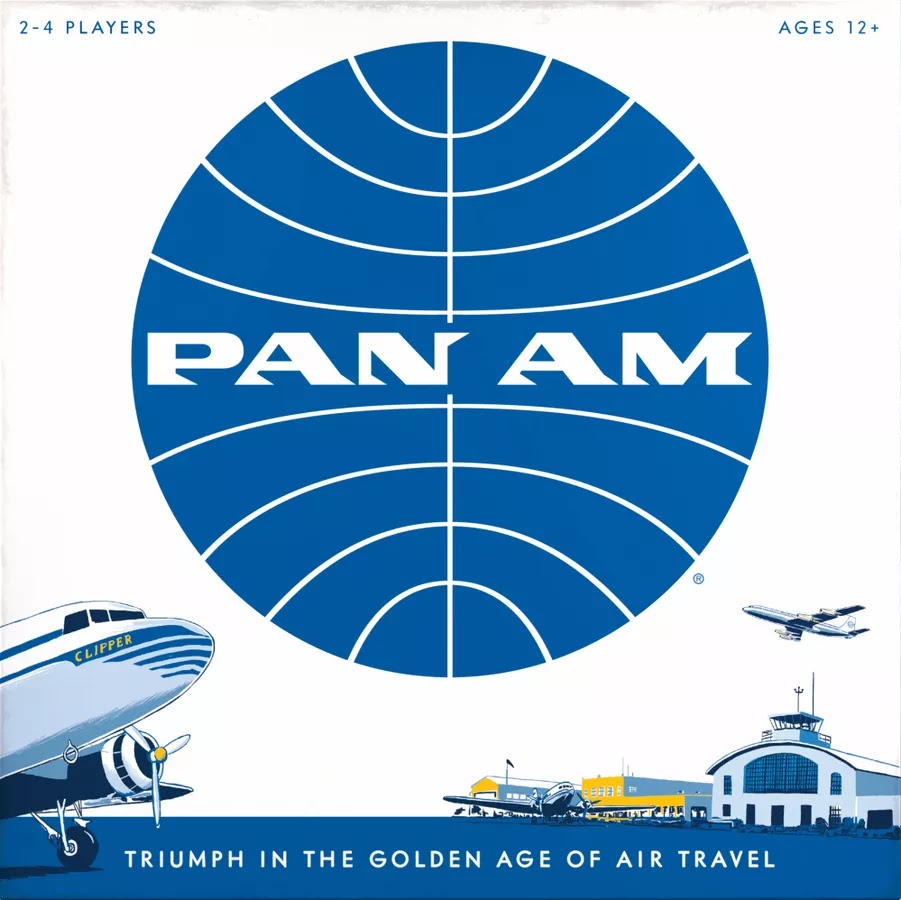
10. Pan Am (2020)

I was initially attracted to this game due to the elegant, retro graphic design. As I shop for new games, I am finding that I have less and less interest in the fantasy and horror titles that used to grab my attention, so a travel-themed game that doesn't involve stabbing anyone seemed like a nice change of pace. It's a very clever design, and different from a lot of "empire building" games in that rather than claiming more an more territory on the board, the goal is to anticipate the air travel routes that Pan Am will want to buy from you at the end of each round, with the winner being the one with the most Pan Am stock. Read the full review.


9. Star Trek: Away Missions (2023)

When I first looked at this game, the goofy looking miniatures were a turn off but I'm glad I reconsidered. Most "miniatures on map tiles" games involve a lot of fighting, but this one is much more about moving your characters to the right spot on the board for them to fulfill their missions, giving them advantages based on the cards you have in your hand. The different factions play very differently, with the Klingons more interested in openly attacking, for example, while the Romulans skulk about in the shadows and the Federation boldly go (or go boldly) about their business. And those miniatures really have grown on me. Read the full review.


8. Star Wars Unlimited (2024)

I've always enjoyed the collectible card game format. I like the idea of assembling the right combination of cards to win the game the way you want to win it, and there is a definite thrill to ripping open random card packs hoping for that rare card you need for your deck. Star Wars Unlimited is the sixth such Star Wars themed game since 1993, and definitely the most playable. Read the full review.


7. Ark Nova (2021)

Ark Nova is a bit of a rarity: a game about animals that doesn't feature any cute wooden meeples or other figurines. The game's somewhat dry appearance hides an absolutely fascinating game that combines card drafting, worker placement, and even tile laying. I always get a sense of accomplishment when the game is over, even if I didn't win. Read the full review.


6. Tiny Epic Dinosaurs (2020)

As I struggle to find room for all our games, I find the Tiny Epic line more and more appealing. And honestly, a tiny box was the only way I was going to be able to justify a third dinosaur zoo game in our collection after DinoGenics and Dinosaur Island, both of which are major space hogs. It's a delightful little game about breeding and selling different types of dinosaurs, sort of a prequel to the larger zoo games that don't stress too much about where the dinosaurs are coming from. As with most of the other Tiny Epic games, this one does a lot with as little as possible, managing to be a full featured worker placement/resource management game in a very small package. Read the full review.


5. Oltréé (2021)

I bought this board game (apparently based on a French-language roleplaying game) entirely on a whim. I was enticed by the gorgeous Vincent Dutrait cover artwork, and also by the promise of an adventure board game that might be a little smoother than Talisman and/or less fiddly than Arkham Horror, and I wasn't disappointed. Oltréé doesn't necessarily do anything new with this type of game, but it does it very, very well. Read the full review.


4. Starship Captains (2022)

Starship Captains does Star Trek better than most licensed Star Trek games do. At its best, Star Trek should be about problem solving rather than fighting, and I'm always disappointed when a Star Trek game is too combat-centric, as many of them tend to be. Starship Captains has players assigning and managing their crew in an ingenious variation on the worker placement mechanism, and juggling ship upgrades in a way that would do Montgomery Scott (or Geordi LaForge) proud. Read the full review.


3. Dune: Imperium (2020)

Combining different game mechanisms has become a popular way to design games, and this one mixes two of my favorites: deck building and worker placement. Most deck building games start each player with a small deck of cards representing basic resources, with the point being to spend those resources to get better cards, and eventually build up an engine of cards that can do whatever it is that needs to be done to win the game. Dune: Imperium takes that idea and adds worker placement, with cards dictating where workers can be placed, and a simple battle mechanism that functions as an additional resource to be spent. It's an elegant combination of elements, and it fits the Dune source material perfectly. Read the full review.


2. Lost Ruins of Arnak (2020)

Like Dune: Imperium, Lost Ruins of Arnak combines deck building with worker placement, but manages to do it in a completely different way. Arnak has players gaining cards from two different decks, one of tools and items and the other representing archaeological artifacts. As the game progresses, the amount of available tools decreases, increasing the amount of artifacts that players can add to their card decks. Cards are played to gain resources, which are then used to move around the board exploring lost temples, with the eventual goal of moving counters along a track that gives out even more resources, and also eventually leads to victory. It's an amazing game with a lot going on. Read the full review.


1. Star Wars: Shatterpoint (2023)

This was another one I wasn't going to get into because I didn't like the miniatures. Specifically, I didn't like the size of the miniatures, which are a bit larger than the standard 28mm size used for most wargames and roleplaying games. I don't know why we miniatures gamers are so obsessed with being able to mix and match our figures -- it's something we rarely if ever do, it seems that we just want to always have the option. Anyway, the miniatures for Shatterpoint are actually amazingly well done, and the larger size makes them a little easier to paint. Its an important detail considering that the average miniatures gamer is going to spend a lot more time assembling and painting their miniatures than they are actually playing.

But the game itself is fantastic too. It seems to specifically address a lot of the pitfalls common to other games of this time, avoiding stale game play by emphasizing movement and area control over just eliminating the opponent's figures as quickly as possible. In Shatterpoint it's rare that any figures ever leave the board -- the point of the game is to occupy areas of the board, and the tactical challenge is to be able to adapt when those areas move. It's a great game that really feels like Star Wars. Read the full review.


Honorable Mention

Blade Runner: the Roleplaying Game

I'm never sure whether I should lump roleplaying games in with board and card games because the experience is so different, although that is changing with hybrid storytelling games like Detective and even some miniatures games like Core Space or Conan. Blade Runner doesn't use a board or miniatures, but it does include a whole slew of prop photos, brochures, and even a newspaper, physical components that aren't common in a lot of RPGs but were absolutely essential to this one. Read the full review.


So there you have it, my favorite games from the past five years, at least for now. Ask me again in six months and it might be a completely different list...